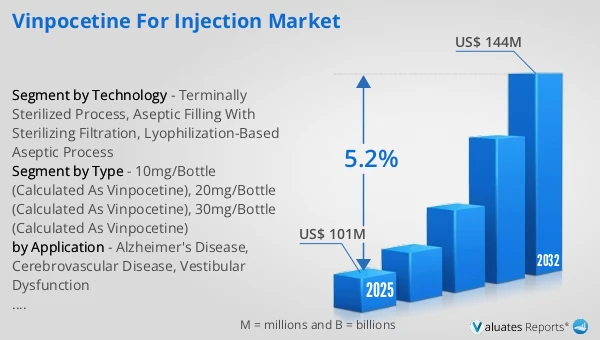
The global Vinpocetine for Injection market was valued at US$ 101 million in 2025 and is anticipated to reach US$ 144 million by 2032, at a CAGR of 5.2% from 2026 to 2032.
Vinpocetine for Injection Market
The 2025 U.S. tariff policies introduce profound uncertainty into the global economic landscape. This report critically examines the implications of recent tariff adjustments and international strategic countermeasures on Vinpocetine for Injection competitive dynamics, regional economic interdependencies, and supply chain reconfigurations.
Vinpocetine for Injection refers to sterile parenteral formulations containing vinpocetine as the active pharmaceutical ingredient, most commonly supplied as a lyophilized powder for reconstitution or as a preparation intended for controlled administration in hospital settings. It is used in clinical scenarios where rapid onset, predictable exposure, or inability to take oral dosage forms makes injectable therapy preferable, typically as an adjunct in cerebrovascular and cerebral perfusion–related management and rehabilitation pathways. Compared with oral products, injectable vinpocetine places higher requirements on formulation design and aseptic manufacturing—covering solubility and compatibility after reconstitution, particulate and visible matter control, endotoxin limits, and a validated sterility assurance strategy—implemented through tightly controlled steps such as compounding, sterilizing filtration, aseptic filling, and lyophilization where applicable. Upstream inputs include the API, parenteral-grade excipients (e.g., tonicity agents, pH adjusters, stabilizers/lyoprotectants), water for injection and critical solvents, and primary packaging components (vials, stoppers, seals, ampoules or prefilled systems). Key “components/consumables” are largely linked to sterile operations, including filtration membranes/cartridges, single-use tubing and connectors, filling-line consumables, lyophilizer-related accessories, in-process sensors and controls, and cleanroom consumables, all supporting safety, consistency, and traceability.In 2025, the global production capacity of vinpocetine for injection is estimated at 20 million packs, with sales volume reaching 16.55 million packs. The average selling price is approximately USD 6.1 per pack, and corporate gross margins generally range between 30% and 40%.
The market for injectable vinpocetine is largely hospital-driven and shaped by structured, protocol-based use rather than broad retail dynamics. In many jurisdictions, demand is concentrated in neurology, rehabilitation, geriatrics, and general inpatient care settings, where prescribing is closely tied to formulary access, institutional governance, and clinical pathway preferences. Competitive positioning therefore hinges on supply continuity, batch consistency, and compliance traceability more than on pure channel expansion. The landscape often features multiple generic players, with differentiation emerging from quality systems maturity, low incidence of batch deviations, and dependable distribution performance. Because parenteral products face higher safety and quality thresholds, factors such as sterility assurance, endotoxin and particulate control, and the stability/compatibility profile during reconstitution and infusion can materially influence institutional trust and long-term procurement decisions.
Looking forward, the market is likely to evolve through tighter compliance, sharper scenario focus, and manufacturing upgrades aimed at quality and efficiency. As regulatory scrutiny for sterile injectables intensifies—covering GMP expectations, ongoing inspections, and pharmacovigilance—companies will need stronger, system-level proof of consistent critical quality attributes and clearer clinical guidance on appropriate populations, administration practices, and risk communication to align with stricter hospital prescribing controls. Hospitals’ operational priorities—reducing preparation errors, improving nursing workflow, and lowering contamination exposure—will elevate the value of pack configurations and usage instructions that fit clinical processes, supported by robust compatibility and in-use stability data as well as practical storage and logistics performance. On the manufacturing side, further adoption of automation, isolation, single-use systems, and real-time monitoring is expected, primarily to reduce contamination and human-variation risks, thereby improving batch reliability and lowering the probability of quality incidents—key advantages under centralized procurement and access frameworks.
Growth drivers and constraints tend to coexist. Drivers include persistent inpatient needs for controlled, predictable administration and, in some regions, established clinical habits and accessibility considerations within neurorehabilitation support practices. Supply-side maturity across sterile manufacturing ecosystems—API, parenteral-grade excipients, primary packaging, and aseptic consumables—can also reinforce stable availability and operational efficiency. Constraints are centered on variability in evidence strength and guideline endorsement, tightening reimbursement and indication policies in certain markets, and heightened sensitivity to injectable safety risks such as hypersensitivity, incompatibilities, and administration-related errors, all of which increase compliance burden and limit broad, non-specific use. Combined with centralized purchasing, stricter hospital utilization management, and the availability of alternative therapies, suppliers increasingly need to shift emphasis from coverage-driven selling to quality governance, compliant market access, real-world evidence generation, and disciplined medical education to sustain momentum.
This report delivers a comprehensive overview of the global Vinpocetine for Injection market, with both quantitative and qualitative analyses, to help readers develop growth strategies, assess the competitive landscape, evaluate their position in the current market, and make informed business decisions regarding Vinpocetine for Injection. The Vinpocetine for Injection market size, estimates, and forecasts are provided in terms of sales volume (K Units) and revenue (US$ millions), with 2025 as the base year and historical and forecast data for 2021–2032.
The report segments the global Vinpocetine for Injection market comprehensively. Regional market sizes by Type, by Application, by Technology, and by company are also provided. For deeper insight, the report profiles the competitive landscape, key competitors, and their respective market rankings, and discusses technological trends and new product developments.
This report will assist Vinpocetine for Injection manufacturers, new entrants, and companies across the industry value chain with information on revenues, sales volume, and average prices for the overall market and its sub-segments, by company, by Type, by Application, and by region.
Market Segmentation
Scope of Vinpocetine for Injection Market Report
| Report Metric |
Details |
| Report Name |
Vinpocetine for Injection Market |
| Accounted market size in 2025 |
US$ 101 million |
| Forecasted market size in 2032 |
US$ 144 million |
| CAGR |
5.2% |
| Base Year |
2025 |
| Forecasted years |
2026 - 2032 |
| Segment by Type |
- 10mg/Bottle (Calculated As Vinpocetine)
- 20mg/Bottle (Calculated As Vinpocetine)
- 30mg/Bottle (Calculated As Vinpocetine)
|
| Segment by Technology |
- Terminally Sterilized Process
- Aseptic Filling With Sterilizing Filtration
- Lyophilization-Based Aseptic Process
|
| Segment by Use Case |
- Hospital Prescription Use
- Rehabilitation Support Use
- Outpatient Maintenance Use
|
| by Application |
- Alzheimer's Disease
- Cerebrovascular Disease
- Vestibular Dysfunction
|
| Consumption by Region |
- North America (United States, Canada)
- Europe (Germany, France, UK, Italy, Russia)
- Asia-Pacific (China, Japan, South Korea, Taiwan)
- Southeast Asia (India)
- Latin America (Mexico, Brazil)
|
| By Company |
Gedeon Richter, Runhong, Northeast Pharma, Zhitong Biopharma, Hunan WZT, Pude Pharmaceutical, Anhui Wellman, Suicheng Pharmaceutical, Harbin Medisan Pharmaceutical, Lei Yunshang Pharmaceutical, Hainan STAR Pharmaceutical, Dezhou Deyao Pharmaceutical, Guangzhou Yipinhong Pharmaceutical |
| Forecast units |
USD million in value |
| Report coverage |
Revenue and volume forecast, company share, competitive landscape, growth factors and trends |
Chapter Outline
- Chapter 1: Defines the scope of the report and presents an executive summary of market segments (by Type, by Application, by Technology, etc.), including the size of each segment and its future growth potential. It offers a high-level view of the current market and its likely evolution in the short, medium, and long term.
- Chapter 2: Provides a detailed analysis of the competitive landscape for Vinpocetine for Injection manufacturers, covering pricing, sales and revenue shares, latest development plans, and mergers and acquisitions.
- Chapter 3: Examines Vinpocetine for Injection sales and revenue at the regional and country levels. It quantifies market size and growth potential for each region and its key countries, and outlines market development, outlook, addressable space, and national market size.
- Chapter 4: Analyzes segments by Type, detailing the size and growth potential of each segment to help readers identify “blue ocean” opportunities.
- Chapter 5: Analyzes market segments by Application, covering the size and growth potential of each segment to help readers identify “blue ocean” opportunities in downstream markets.
- Chapter 6: Profiles key players, presenting core information on leading companies, including product sales, revenue, pricing, gross margin, product portfolio/introductions, and recent developments.
- Chapter 7: Reviews the industry value chain, including upstream and downstream segments.
- Chapter 8: Discusses market dynamics and recent developments, including drivers, restraints, challenges and risks for manufacturers, U.S. Tariffs and relevant policy analysis.
- Chapter 9: Summarizes the key findings and conclusions of the report.
Ans: The Vinpocetine for Injection Market witnessing a CAGR of 5.2% during the forecast period 2026-2032.
Ans: The Vinpocetine for Injection Market size in 2032 will be US$ 144 million.
Ans: The main players in the Vinpocetine for Injection Market are Gedeon Richter, Runhong, Northeast Pharma, Zhitong Biopharma, Hunan WZT, Pude Pharmaceutical, Anhui Wellman, Suicheng Pharmaceutical, Harbin Medisan Pharmaceutical, Lei Yunshang Pharmaceutical, Hainan STAR Pharmaceutical, Dezhou Deyao Pharmaceutical, Guangzhou Yipinhong Pharmaceutical
Ans: The Applications covered in the Vinpocetine for Injection Market report are Alzheimer's Disease, Cerebrovascular Disease, Vestibular Dysfunction
Ans: The Types covered in the Vinpocetine for Injection Market report are 10mg/Bottle (Calculated As Vinpocetine), 20mg/Bottle (Calculated As Vinpocetine), 30mg/Bottle (Calculated As Vinpocetine)