FEATURED COMPANIES
Tesla
BYD
BMW
Volkswagen AG
Li Auto
NIO
High Performance Battery Electric Vehicle Market Size
The global High Performance Battery Electric Vehicle market was valued at US$ 41060 million in 2025 and is anticipated to reach US$ 92407 million by 2032, at a CAGR of 6.4% from 2026 to 2032.
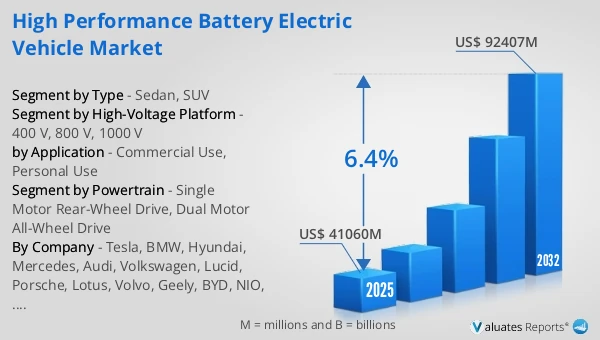
High Performance Battery Electric Vehicle Market
The 2025 U.S. tariff policies introduce profound uncertainty into the global economic landscape. This report critically examines the implications of recent tariff adjustments and international strategic countermeasures on High Performance Battery Electric Vehicle competitive dynamics, regional economic interdependencies, and supply chain reconfigurations.
In 2025, global High Performance Battery Electric Vehicle production reached approximately 410k units, with an average global market price of around US$100k per unit.
A high-performance battery electric vehicle (BEV) is a fully electric vehicle engineered around acceleration, sustained power delivery, and high dynamic limits. It typically combines high-output motors (often dual- or tri-motor AWD), a high-discharge battery with enhanced thermal management, and upgraded chassis/braking systems to deliver repeatable performance in demanding driving conditions while maintaining usable range and charging convenience.
Upstream spans batteries and key materials (lithium chemicals, Ni-Co-Mn chemistries, graphite, electrolytes) plus cell-to-pack and thermal systems, e-powertrain components (motors, inverters, gear reduction), power semiconductors and controls (e.g., SiC and domain/vehicle controllers), and chassis/lightweighting materials (aluminum, high-strength steel, carbon-fiber parts, tires and braking systems). Representative battery supply-chain players include CATL, LG Energy Solution, and Panasonic, while well-known high-performance BEV examples include the Tesla Model S Plaid, Porsche Taycan Turbo GT, and Lucid Air Sapphire.
The high-performance BEV segment is shifting from a simple “0–60 race” to a systems-engineering contest centered on repeatable performance—integrating high-voltage fast charging with robust thermal management, sustained output under high-load conditions, chassis-domain coordination (torque vectoring, regen blending, and stability control), and software-defined drive modes with OTA iteration. This trend is elevating demand for SiC power electronics, advanced cooling materials, lightweight structures, high-grip tires, and performance braking. Key drivers include affluent buyers’ appetite for extreme performance and tech-forward experiences, OEMs’ use of flagship performance models to build brand premium and technical halo, and continued advances in batteries and e-powertrains expanding achievable performance. Headwinds include high cost and pricing, stronger dependence on charging infrastructure and thermal robustness, tighter regulatory/insurance/safety requirements that can constrain feature deployment, and margin pressure from promotions and competitive pricing, along with supply volatility in critical materials and premium components.
This report delivers a comprehensive overview of the global High Performance Battery Electric Vehicle market, with both quantitative and qualitative analyses, to help readers develop growth strategies, assess the competitive landscape, evaluate their position in the current market, and make informed business decisions regarding High Performance Battery Electric Vehicle. The High Performance Battery Electric Vehicle market size, estimates, and forecasts are provided in terms of output/shipments (K Units) and revenue (US$ millions), with 2025 as the base year and historical and forecast data for 2021–2032.
The report segments the global High Performance Battery Electric Vehicle market comprehensively. Regional market sizes by Type, by Application, by Powertrain, and by company are also provided. For deeper insight, the report profiles the competitive landscape, key competitors, and their respective market rankings, and discusses technological trends and new product developments.
This report will assist High Performance Battery Electric Vehicle manufacturers, new entrants, and companies across the industry value chain with information on revenues, production, and average prices for the overall market and its sub-segments, by company, by Type, by Application, and by region.
Market Segmentation
Scope of High Performance Battery Electric Vehicle Market Report
| Report Metric |
Details |
| Report Name |
High Performance Battery Electric Vehicle Market |
| Accounted market size in 2025 |
US$ 41060 million |
| Forecasted market size in 2032 |
US$ 92407 million |
| CAGR |
6.4% |
| Base Year |
2025 |
| Forecasted years |
2026 - 2032 |
| Segment by Type |
|
| Segment by Powertrain |
- Single Motor Rear-Wheel Drive
- Dual Motor All-Wheel Drive
|
| Segment by High-Voltage Platform |
|
| by Application |
- Commercial Use
- Personal Use
|
| Production by Region |
- North America
- Europe
- China
- Japan
|
| Consumption by Region |
- North America (United States, Canada)
- Europe (Germany, France, UK, Italy, Russia)
- Asia-Pacific (China, Japan, South Korea, Taiwan)
- Southeast Asia (India)
- Latin America (Mexico, Brazil)
|
| By Company |
Tesla, BMW, Hyundai, Mercedes, Audi, Volkswagen, Lucid, Porsche, Lotus, Volvo, Geely, BYD, NIO, Changan Automobile, Xiaomi, Xpeng, Li Auto, GWM |
| Forecast units |
USD million in value |
| Report coverage |
Revenue and volume forecast, company share, competitive landscape, growth factors and trends |
Chapter Outline
- Chapter 1: Defines the scope of the report and presents an executive summary of market segments (by Type, by Application, by Powertrain, etc.), including the size of each segment and its future growth potential. It offers a high-level view of the current market and its likely evolution in the short, medium, and long term.
- Chapter 2: Provides a detailed analysis of the competitive landscape for High Performance Battery Electric Vehicle manufacturers, including prices, production, value-based market shares, latest development plans, and information on mergers and acquisitions.
- Chapter 3: Examines High Performance Battery Electric Vehicle production/output and value by region and country, providing a quantitative assessment of market size and growth potential for each region over the next six years.
- Chapter 4: Analyzes High Performance Battery Electric Vehicle consumption at the regional and country levels. It quantifies market size and growth potential for each region and its key countries, and outlines market development, outlook, addressable space, and national production.
- Chapter 5: Analyzes market segments by Type, covering the size and growth potential of each segment to help readers identify “blue ocean” opportunities.
- Chapter 6: Analyzes market segments by Application, covering the size and growth potential of each segment to help readers identify “blue ocean” opportunities in downstream markets.
- Chapter 7: Profiles key players, detailing the fundamentals of major companies, including product production/output, value, price, gross margin, product portfolio/introductions, and recent developments.
- Chapter 8: Reviews the industry value chain, including upstream and downstream segments.
- Chapter 9: Discusses market dynamics and recent developments, including drivers, restraints, challenges and risks for manufacturers, U.S. Tariffs and relevant policy analysis.
- Chapter 10: Summarizes the key findings and conclusions of the report.
FAQ for this report
How fast is High Performance Battery Electric Vehicle Market growing?
Ans: The High Performance Battery Electric Vehicle Market witnessing a CAGR of 6.4% during the forecast period 2026-2032.
What is the High Performance Battery Electric Vehicle Market size in 2032?
Ans: The High Performance Battery Electric Vehicle Market size in 2032 will be US$ 92407 million.
Who are the main players in the High Performance Battery Electric Vehicle Market report?
Ans: The main players in the High Performance Battery Electric Vehicle Market are Tesla, BMW, Hyundai, Mercedes, Audi, Volkswagen, Lucid, Porsche, Lotus, Volvo, Geely, BYD, NIO, Changan Automobile, Xiaomi, Xpeng, Li Auto, GWM
What are the Application segmentation covered in the High Performance Battery Electric Vehicle Market report?
Ans: The Applications covered in the High Performance Battery Electric Vehicle Market report are Commercial Use, Personal Use
What are the Type segmentation covered in the High Performance Battery Electric Vehicle Market report?
Ans: The Types covered in the High Performance Battery Electric Vehicle Market report are Sedan, SUV