FEATURED COMPANIES
CMA Robotics
ABB Ltd
Dürr Group
Fanuc
Kuka Robotics
Staubli
Yaskawa
Kawasaki Robotics
Comau Robotics
DENSO Robotics
Nachi Robotics
Automotive Painting Robot Market Size
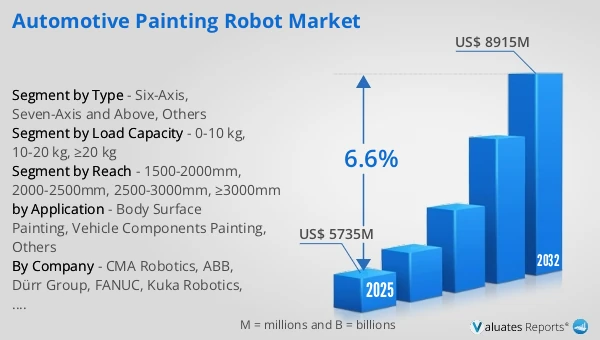
The global Automotive Painting Robot market was valued at US$ 5735 million in 2025 and is anticipated to reach US$ 8915 million by 2032, at a CAGR of 6.6% from 2026 to 2032.
Automotive Painting Robot Market
The 2025 U.S. tariff policies introduce profound uncertainty into the global economic landscape. This report critically examines the implications of recent tariff adjustments and international strategic countermeasures on Automotive Painting Robot competitive dynamics, regional economic interdependencies, and supply chain reconfigurations.
In 2025, global Automotive Painting Robot production reached approximately 38k units, with an average global market price of around US$150k per unit.
An automotive painting robot is a purpose-built industrial robot used in automotive paint shops to apply coatings (primer/basecoat/clearcoat) inside controlled spray booths. It typically carries a rotary bell atomizer or spray gun, features hollow arms/wrists for internal routing of paint/air/electrostatic lines, and supports high-speed, smooth path control plus conveyor tracking to achieve consistent film build, finish quality, and fast color changes under explosion-proof and cleanliness constraints.
Upstream typically includes: the robot and core components (servo motors, reducers, encoders, cables, controllers, safety hardware), paint process equipment (rotary bell atomizers/spray guns, paint dosing & mixing, valve manifolds, color-change/flush units, paint/air hoses, electrostatic systems), plus coatings/solvents as consumables. Representative suppliers/examples include paint-shop technology & integration players such as Dürr, finishing applicator makers such as Graco and Sames, and fluid/hosing suppliers such as Parker (actual BOM varies by plant and spec). Downstream demand mainly comes from automotive OEM paint shops and tier suppliers coating bodies and parts (e.g., bumpers/plastics/wheels), often delivered through turnkey paint-line projects and retrofits by integrators.
The global automotive painting robot market refers to the market for robotic systems used for painting vehicles in the automotive industry. These robots are specifically designed to perform precise and efficient painting tasks on automobiles, replacing or augmenting human labor in the painting process. The market for automotive painting robots is driven by several factors. Firstly, the growing demand for automobiles worldwide is a significant driver. As the automotive industry continues to expand, manufacturers are looking for ways to improve efficiency and productivity. Painting robots offer advantages such as speed, accuracy, and the ability to work in hazardous environments, making them an attractive solution for automakers. Secondly, regulations and quality standards play a crucial role in the adoption of painting robots. Automotive manufacturers need to comply with strict environmental and safety regulations. Painting robots offer precise control over paint application, minimizing wastage and reducing harmful emissions, thus helping manufacturers meet these regulatory requirements. Moreover, the need for consistent quality and finish also drives the demand for painting robots. These robots can apply paint uniformly and consistently, reducing variations caused by human error. This ensures a high-quality and aesthetically pleasing finish, which is essential for automotive manufacturers to maintain their brand reputation. Additionally, the advancements in robotic technologies, such as improved vision systems, advanced software, and artificial intelligence, have enhanced the capabilities of painting robots. These advancements enable robots to perform complex painting tasks, adapt to different vehicle shapes, and optimize paint usage. As technology continues to evolve, the market for automotive painting robots is expected to grow further. In terms of geography, Asia Pacific is expected to dominate the global automotive painting robot market. The region is home to some of the largest automotive manufacturers, such as Japan, China, and South Korea. The increasing adoption of automation in the automotive industry in these countries, coupled with government initiatives to promote manufacturing automation, contributes to the market growth. North America and Europe are also significant markets for automotive painting robots. Established automotive industries and the presence of major automotive manufacturers in these regions drive the demand for painting robots. Additionally, the focus on improving productivity and efficiency in manufacturing processes further fuels the market growth. Key players in the global automotive painting robot market are major robotics manufacturers and suppliers who offer a range of painting robot systems. These companies often provide integrated solutions that include not only the robots but also paint application equipment, software, and support services. In conclusion, the global automotive painting robot market is driven by factors such as the growing demand for automobiles, regulatory compliance, the need for consistent quality, and advancements in robotic technologies. As the automotive industry continues to evolve and automation becomes more prevalent, the market for painting robots is expected to witness significant growth.
This report delivers a comprehensive overview of the global Automotive Painting Robot market, with both quantitative and qualitative analyses, to help readers develop growth strategies, assess the competitive landscape, evaluate their position in the current market, and make informed business decisions regarding Automotive Painting Robot. The Automotive Painting Robot market size, estimates, and forecasts are provided in terms of output/shipments (K Units) and revenue (US$ millions), with 2025 as the base year and historical and forecast data for 2021–2032.
The report segments the global Automotive Painting Robot market comprehensively. Regional market sizes by Type, by Application, by Load Capacity, and by company are also provided. For deeper insight, the report profiles the competitive landscape, key competitors, and their respective market rankings, and discusses technological trends and new product developments.
This report will assist Automotive Painting Robot manufacturers, new entrants, and companies across the industry value chain with information on revenues, production, and average prices for the overall market and its sub-segments, by company, by Type, by Application, and by region.
Market Segmentation
Scope of Automotive Painting Robot Market Report
| Report Metric |
Details |
| Report Name |
Automotive Painting Robot Market |
| Accounted market size in 2025 |
US$ 5735 million |
| Forecasted market size in 2032 |
US$ 8915 million |
| CAGR |
6.6% |
| Base Year |
2025 |
| Forecasted years |
2026 - 2032 |
| Segment by Type |
- Six-Axis
- Seven-Axis and Above
- Others
|
| Segment by Load Capacity |
|
| Segment by Reach |
- 1500-2000mm
- 2000-2500mm
- 2500-3000mm
- ≥3000mm
|
| by Application |
- Body Surface Painting
- Vehicle Components Painting
- Others
|
| Production by Region |
- North America
- Europe
- China
- Japan
|
| Consumption by Region |
- North America (United States, Canada)
- Europe (Germany, France, UK, Italy, Russia)
- Asia-Pacific (China, Japan, South Korea, Taiwan)
- Southeast Asia (India)
- Latin America (Mexico, Brazil)
|
| By Company |
CMA Robotics, ABB, Dürr Group, FANUC, Kuka Robotics, Staubli, Yaskawa, Kawasaki Robotics, Comau Robotics, Denso Robotics, Nachi Robotics, OTC Daihen, Reis Robotics, YANMAR, HD Hyundai Robotics, Krautzberger, Takubo Engineering |
| Forecast units |
USD million in value |
| Report coverage |
Revenue and volume forecast, company share, competitive landscape, growth factors and trends |
Chapter Outline
- Chapter 1: Defines the scope of the report and presents an executive summary of market segments (by Type, by Application, by Load Capacity, etc.), including the size of each segment and its future growth potential. It offers a high-level view of the current market and its likely evolution in the short, medium, and long term.
- Chapter 2: Provides a detailed analysis of the competitive landscape for Automotive Painting Robot manufacturers, including prices, production, value-based market shares, latest development plans, and information on mergers and acquisitions.
- Chapter 3: Examines Automotive Painting Robot production/output and value by region and country, providing a quantitative assessment of market size and growth potential for each region over the next six years.
- Chapter 4: Analyzes Automotive Painting Robot consumption at the regional and country levels. It quantifies market size and growth potential for each region and its key countries, and outlines market development, outlook, addressable space, and national production.
- Chapter 5: Analyzes market segments by Type, covering the size and growth potential of each segment to help readers identify “blue ocean” opportunities.
- Chapter 6: Analyzes market segments by Application, covering the size and growth potential of each segment to help readers identify “blue ocean” opportunities in downstream markets.
- Chapter 7: Profiles key players, detailing the fundamentals of major companies, including product production/output, value, price, gross margin, product portfolio/introductions, and recent developments.
- Chapter 8: Reviews the industry value chain, including upstream and downstream segments.
- Chapter 9: Discusses market dynamics and recent developments, including drivers, restraints, challenges and risks for manufacturers, U.S. Tariffs and relevant policy analysis.
- Chapter 10: Summarizes the key findings and conclusions of the report.
FAQ for this report
How fast is Automotive Painting Robot Market growing?
Ans: The Automotive Painting Robot Market witnessing a CAGR of 6.6% during the forecast period 2026-2032.
What is the Automotive Painting Robot Market size in 2032?
Ans: The Automotive Painting Robot Market size in 2032 will be US$ 8915 million.
Who are the main players in the Automotive Painting Robot Market report?
Ans: The main players in the Automotive Painting Robot Market are CMA Robotics, ABB, Dürr Group, FANUC, Kuka Robotics, Staubli, Yaskawa, Kawasaki Robotics, Comau Robotics, Denso Robotics, Nachi Robotics, OTC Daihen, Reis Robotics, YANMAR, HD Hyundai Robotics, Krautzberger, Takubo Engineering
What are the Application segmentation covered in the Automotive Painting Robot Market report?
Ans: The Applications covered in the Automotive Painting Robot Market report are Body Surface Painting, Vehicle Components Painting, Others
What are the Type segmentation covered in the Automotive Painting Robot Market report?
Ans: The Types covered in the Automotive Painting Robot Market report are Six-Axis, Seven-Axis and Above, Others