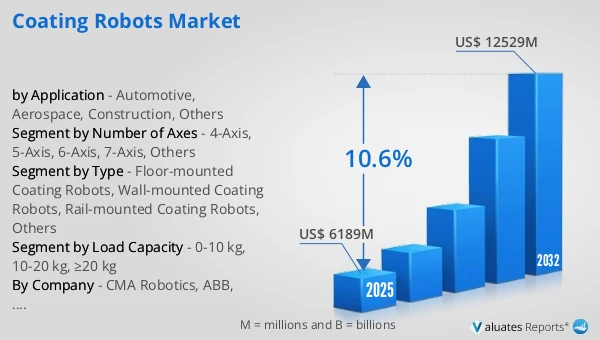
The global Coating Robots market was valued at US$ 6189 million in 2025 and is anticipated to reach US$ 12529 million by 2032, at a CAGR of 10.6% from 2026 to 2032.
Coating Robots Market
The 2025 U.S. tariff policies introduce profound uncertainty into the global economic landscape. This report critically examines the implications of recent tariff adjustments and international strategic countermeasures on Coating Robots competitive dynamics, regional economic interdependencies, and supply chain reconfigurations.
In 2025, global Coating Robots production reached approximately 46k units, with an average global market price of around US$135k per unit.
Coating robots are industrial robots or robotic cells used to apply coatings—such as primer, basecoat, clearcoat, anti-corrosion or functional coatings—onto workpieces via spraying, atomization, electrostatic or powder coating processes. A typical system combines the robot arm with applicators (spray gun/rotary bell, etc.), paint/powder supply and metering, color-change and flushing, electrostatics and safety/booth controls (including ventilation and explosion protection), enabling consistent film build and finish quality, better material utilization, and reduced operator exposure to overspray, solvents, and dust.
Upstream typically includes robot manipulators and core components (servo motors, reducers, encoders, controllers, cables, safety hardware), coating process equipment (guns/rotary bells, paint metering and valve manifolds, color-change/flush units, electrostatics, hoses/fittings, booth ventilation and filtration), plus consumables such as coatings/powders, solvents and cleaning agents. Representative suppliers/examples include robot OEMs (ABB, FANUC, Yaskawa, KUKA), finishing equipment providers (Graco, Sames), and coating material suppliers (PPG, AkzoNobel, BASF). Downstream demand spans automotive OEMs and tiers, construction/agricultural machinery, steel structures and metal fabrication, appliances, furniture and broader industrial manufacturers—most commonly delivered through system integrators and turnkey coating line projects (new builds and retrofits).
The coating robot market is advancing along four parallel themes—quality upgrades, environmental compliance, production flexibility, and digital operations. In both automotive and general industrial coating, tighter requirements for finish consistency, stable film build, edge coverage on complex geometries, fast changeovers, and higher material utilization keep driving improvements in applicators (guns/rotary bells, electrostatics), paint metering and rapid flush/color-change, smoother motion control, and workpiece tracking. Meanwhile, high-mix production and customization increase process complexity, making offline programming, virtual commissioning, parameter traceability, condition monitoring, and predictive maintenance increasingly mainstream. Core growth drivers include the safety and consistency limits of manual spraying in solvent/overspray/dust environments, stricter regulatory pressure to reduce VOC emissions and rework while saving material, and manufacturers’ ongoing need for stable takt time and repeatable quality. Key headwinds persist because coating is highly process-dependent: robots are only one element of the system, and final results hinge on booth airflow, coating chemistry and curing, fixturing, and line synchronization—often requiring longer on-site tuning and validation. High upfront capex, downtime costs for retrofits, and delivery risks from process changes or customer-specific acceptance standards also lead buyers to favor suppliers and integrators with proven process packages, robust service coverage, and strong reference installations.
This report delivers a comprehensive overview of the global Coating Robots market, with both quantitative and qualitative analyses, to help readers develop growth strategies, assess the competitive landscape, evaluate their position in the current market, and make informed business decisions regarding Coating Robots. The Coating Robots market size, estimates, and forecasts are provided in terms of output/shipments (K Units) and revenue (US$ millions), with 2025 as the base year and historical and forecast data for 2021–2032.
The report segments the global Coating Robots market comprehensively. Regional market sizes by Type, by Application, by Number of Axes, and by company are also provided. For deeper insight, the report profiles the competitive landscape, key competitors, and their respective market rankings, and discusses technological trends and new product developments.
This report will assist Coating Robots manufacturers, new entrants, and companies across the industry value chain with information on revenues, production, and average prices for the overall market and its sub-segments, by company, by Type, by Application, and by region.
Market Segmentation
Scope of Coating Robots Market Report
| Report Metric |
Details |
| Report Name |
Coating Robots Market |
| Accounted market size in 2025 |
US$ 6189 million |
| Forecasted market size in 2032 |
US$ 12529 million |
| CAGR |
10.6% |
| Base Year |
2025 |
| Forecasted years |
2026 - 2032 |
| Segment by Type |
- Floor-mounted Coating Robots
- Wall-mounted Coating Robots
- Rail-mounted Coating Robots
- Others
|
| Segment by Number of Axes |
- 4-Axis
- 5-Axis
- 6-Axis
- 7-Axis
- Others
|
| Segment by Load Capacity |
|
| by Application |
- Automotive
- Aerospace
- Construction
- Others
|
| Production by Region |
- North America
- Europe
- China
- Japan
|
| Consumption by Region |
- North America (United States, Canada)
- Europe (Germany, France, UK, Italy, Russia)
- Asia-Pacific (China, Japan, South Korea, Taiwan)
- Southeast Asia (India)
- Latin America (Mexico, Brazil)
|
| By Company |
CMA Robotics, ABB, Dürr Group, FANUC, Kuka Robotics, Staubli, Yaskawa, Kawasaki Robotics, Comau Robotics, Denso Robotics, Nachi Robotics, OTC Daihen, Reis Robotics, YANMAR, HD Hyundai Robotics, Krautzberger, Takubo Engineering |
| Forecast units |
USD million in value |
| Report coverage |
Revenue and volume forecast, company share, competitive landscape, growth factors and trends |
Chapter Outline
- Chapter 1: Defines the scope of the report and presents an executive summary of market segments (by Type, by Application, by Number of Axes, etc.), including the size of each segment and its future growth potential. It offers a high-level view of the current market and its likely evolution in the short, medium, and long term.
- Chapter 2: Provides a detailed analysis of the competitive landscape for Coating Robots manufacturers, including prices, production, value-based market shares, latest development plans, and information on mergers and acquisitions.
- Chapter 3: Examines Coating Robots production/output and value by region and country, providing a quantitative assessment of market size and growth potential for each region over the next six years.
- Chapter 4: Analyzes Coating Robots consumption at the regional and country levels. It quantifies market size and growth potential for each region and its key countries, and outlines market development, outlook, addressable space, and national production.
- Chapter 5: Analyzes market segments by Type, covering the size and growth potential of each segment to help readers identify “blue ocean” opportunities.
- Chapter 6: Analyzes market segments by Application, covering the size and growth potential of each segment to help readers identify “blue ocean” opportunities in downstream markets.
- Chapter 7: Profiles key players, detailing the fundamentals of major companies, including product production/output, value, price, gross margin, product portfolio/introductions, and recent developments.
- Chapter 8: Reviews the industry value chain, including upstream and downstream segments.
- Chapter 9: Discusses market dynamics and recent developments, including drivers, restraints, challenges and risks for manufacturers, U.S. Tariffs and relevant policy analysis.
- Chapter 10: Summarizes the key findings and conclusions of the report.
Ans: The Coating Robots Market witnessing a CAGR of 10.6% during the forecast period 2026-2032.
Ans: The Coating Robots Market size in 2032 will be US$ 12529 million.
Ans: The main players in the Coating Robots Market are CMA Robotics, ABB, Dürr Group, FANUC, Kuka Robotics, Staubli, Yaskawa, Kawasaki Robotics, Comau Robotics, Denso Robotics, Nachi Robotics, OTC Daihen, Reis Robotics, YANMAR, HD Hyundai Robotics, Krautzberger, Takubo Engineering
Ans: The Applications covered in the Coating Robots Market report are Automotive, Aerospace, Construction, Others
Ans: The Types covered in the Coating Robots Market report are Floor-mounted Coating Robots, Wall-mounted Coating Robots, Rail-mounted Coating Robots, Others