0
U.S. (TOLL FREE)
+1 (315) 215-3225
Automative

0
U.S. (TOLL FREE)
+1 (315) 215-3225
Global Thermal Management in Electric and Hybrid Vehicles Market Research Report 2025
Published Date: 2025-12-04
|
Report Code: QYRE-Auto-15E13477
Home | Market Reports | Autos & Vehicles| Motor Vehicles (By Type)| Hybrid & Alternative Vehicles
Global Thermal Management in Electric and Hybrid Vehicles Market Research Report 2023
BUY CHAPTERS

Global Thermal Management in Electric and Hybrid Vehicles Market Research Report 2025

Code: QYRE-Auto-15E13477
Report
2025-12-04
Pages:88
QYResearch
Buy Now with 15% Discount
DESCRIPTION
TABLE OF CONTENT
TABLES & FIGURES

Thermal Management in Electric and Hybrid Vehicles Market Size

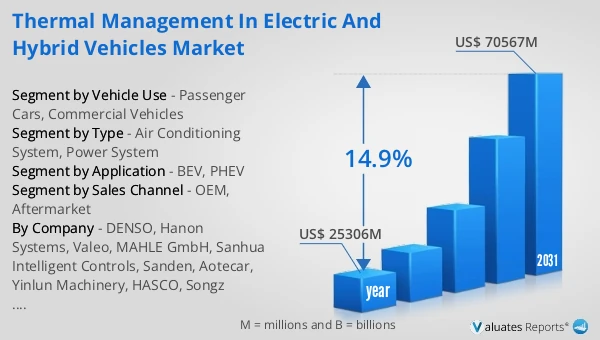
The global market for Thermal Management in Electric and Hybrid Vehicles was valued at US$ 25306 million in the year 2024 and is projected to reach a revised size of US$ 70567 million by 2031, growing at a CAGR of 14.9% during the forecast period.

Thermal Management in Electric and Hybrid Vehicles Market

Thermal Management in Electric and Hybrid Vehicles Market

Thermal Management in Electric and Hybrid Vehicles refers to the overall engineering discipline and system architecture used in HEVs, PHEVs and BEVs to control the temperature and energy flows of all heat-relevant subsystems. It covers the internal-combustion engine (for hybrids), the traction battery pack, e-motor and e-axle, power electronics (inverter, on-board charger, DC/DC converter), on-board charging hardware and the cabin HVAC/heat-pump unit. By using coolant loops and cold plates or jackets, refrigerant circuits with chillers or direct battery cooling, heat pumps and PTC heaters, electric coolant pumps, electronic valves, electric compressors and dedicated control strategies, the vehicle coordinates heating, cooling, pre-conditioning and waste-heat recovery across operating modes such as electric drive, hybrid drive, fast charging and regenerative braking. The goal is to keep each subsystem within its optimal temperature window while improving overall energy efficiency, driving range and emissions performance (for hybrids), and maintaining safe operation and occupant comfort under diverse ambient conditions.
The supply chain for Thermal Management in Electric and Hybrid Vehicles can broadly be divided into three tiers. Upstream suppliers provide coolants and refrigerants, aluminum and copper sheets/extrusions, engineering plastics, rubber seals, fin materials for heat exchangers, as well as sensors, power semiconductors and control electronics. Midstream Tier-1 and Tier-2 suppliers deliver electric coolant pumps, electronically controlled valves, electric A/C compressors, cold plates and battery cooling modules, EGR and waste-heat recovery heat exchangers, heat-pump assemblies, integrated thermal management modules (ITM/ICM), and hose/pipe and wiring assemblies, often co-developing system architecture and calibration with OEMs. Downstream, vehicle manufacturers and some battery, e-drive and engine integrators define the overall thermal concept for HEVs and EVs and source complete systems or major modules.
Thermal management in electric and hybrid vehicles has become a core discipline that quietly determines how these platforms perform in the real world: it influences energy efficiency, usable range, fast-charging robustness, component lifetime and all-climate comfort. As electrification moves from niche to mainstream, OEMs can no longer treat cooling and heating as add-on utilities around the powertrain. Instead, batteries, e-motors, inverters, on-board chargers, engines and transmissions in hybrids, as well as cabin HVAC, are managed as one interconnected thermal ecosystem. The ability to keep all these systems within tight temperature windows under city congestion, highway driving, steep gradients and repeated DC fast-charging is now a visible differentiator between brands and platforms.
From a technology perspective, thermal management in electric and hybrid vehicles is evolving from simple, component-level cooling loops to multi-loop, highly integrated architectures with strong software content. Early hybrids and EVs often relied on relatively basic glycol circuits for batteries and power electronics, with the engine cooling system and cabin HVAC largely separated. Newer designs increasingly adopt liquid-cooled battery packs with precision cold plates, dedicated loops for e-axles and inverters, compact chillers that couple refrigerant and coolant circuits, and high-efficiency heat pump systems using low-GWP refrigerants. In hybrids, thermal management also has to support fast engine warm-up, catalyst light-off and aftertreatment temperature control, often by sharing heat exchangers and coolant routes with the electrified side to save space and cost. Across both hybrids and EVs, integrated valve blocks, variable-speed pumps and e-compressors, combined with thermal domain controllers and model-based algorithms, enable pre-conditioning of batteries before fast charging, intelligent reuse of engine or inverter waste heat in winter, and real-time optimisation of energy use across driving and charging scenarios.
Looking ahead, thermal management in electric and hybrid vehicles sits at the intersection of several powerful industry trends and faces non-trivial constraints. Higher-voltage platforms, ultra-fast charging, high-energy-density batteries and the electrification of buses, trucks and dedicated fleet vehicles all raise the bar for precision and reliability in thermal control, creating room for innovation in heat exchanger design, coolant and refrigerant systems, integrated modules and predictive control strategies. At the same time, these advances must be delivered within tight cost and packaging envelopes, under low-GWP refrigerant rules and long-life durability expectations. Ensuring consistent thermal behaviour across different cell formats, pack architectures and multi-powertrain platforms demands close collaboration between battery, powertrain, body and software teams. In this context, “Thermal Management in Electric and Hybrid Vehicles” is no longer a narrow engineering topic, but a strategic cross-discipline linking electrochemistry, mechanical and thermal hardware, embedded software and user experience across the entire electrified vehicle value chain.
This report aims to provide a comprehensive presentation of the global market for Thermal Management in Electric and Hybrid Vehicles, with both quantitative and qualitative analysis, to help readers develop business/growth strategies, assess the market competitive situation, analyze their position in the current marketplace, and make informed business decisions regarding Thermal Management in Electric and Hybrid Vehicles.
The Thermal Management in Electric and Hybrid Vehicles market size, estimations, and forecasts are provided in terms of and revenue ($ millions), considering 2024 as the base year, with history and forecast data for the period from 2020 to 2031. This report segments the global Thermal Management in Electric and Hybrid Vehicles market comprehensively. Regional market sizes, concerning products by Type, by Application, by Sales Channel and by players, are also provided.
For a more in-depth understanding of the market, the report provides profiles of the competitive landscape, key competitors, and their respective market ranks. The report also discusses technological trends and new product developments.
The report will help the Thermal Management in Electric and Hybrid Vehicles companies, new entrants, and industry chain related companies in this market with information on the revenues for the overall market and the sub-segments across the different segments, by company, by Type, by Application, and by regions.
Market Segmentation

Scope of Thermal Management in Electric and Hybrid Vehicles Market Report

Report Metric Details
Report Name Thermal Management in Electric and Hybrid Vehicles Market
Accounted market size in year US$ 25306 million
Forecasted market size in 2031 US$ 70567 million
CAGR 14.9%
Base Year year
Forecasted years 2026 - 2031
Segment by Type
  • Air Conditioning System
  • Power System
Segment by Sales Channel
  • OEM
  • Aftermarket
Segment by Vehicle Use
  • Passenger Cars
  • Commercial Vehicles
Segment by Application
  • BEV
  • PHEV
By Region
  • North America (United States, Canada)
  • Europe (Germany, France, UK, Italy, Russia) Rest of Europe
  • Nordic Countries
  • Asia-Pacific (China, Japan, South Korea)
  • Southeast Asia (India, Australia)
  • Rest of Asia
  • Latin America (Mexico, Brazil)
  • Rest of Latin America
  • Middle East & Africa (Turkey, Saudi Arabia, UAE, Rest of MEA)
By Company DENSO, Hanon Systems, Valeo, MAHLE GmbH, Sanhua Intelligent Controls, Sanden, Aotecar, Yinlun Machinery, HASCO, Songz Automobile Air Conditioning, Tuopu Group, Zhongding Group, Feilong Auto Components, Tenglong Auto Parts, Senior Flexonics
Forecast units USD million in value
Report coverage Revenue and volume forecast, company share, competitive landscape, growth factors and trends

Chapter Outline

  • Chapter 1: Introduces the report scope of the report, executive summary of different market segments (by Type, by Application, by Sales Channel etc), including the market size of each market segment, future development potential, and so on. It offers a high-level view of the current state of the market and its likely evolution in the short to mid-term, and long term.
  • Chapter 2: Introduces executive summary of global market size, regional market size, this section also introduces the market dynamics, latest developments of the market, the driving factors and restrictive factors of the market, the challenges and risks faced by companies in the industry, and the analysis of relevant policies in the industry.
  • Chapter 3: Detailed analysis of Thermal Management in Electric and Hybrid Vehicles company competitive landscape, revenue market share, latest development plan, merger, and acquisition information, etc.
  • Chapter 4: Provides the analysis of various market segments by Type, covering the market size and development potential of each market segment, to help readers find the blue ocean market in different market segments.
  • Chapter 5: Provides the analysis of various market segments by Application, covering the market size and development potential of each market segment, to help readers find the blue ocean market in different downstream markets.
  • Chapter 6, 7, 8, 9, 10: North America, Europe, Asia Pacific, Latin America, Middle East and Africa segment by country. It provides a quantitative analysis of the market size and development potential of each region and its main countries and introduces the market development, future development prospects, market space, and capacity of each country in the world.
  • Chapter 11: Provides profiles of key players, introducing the basic situation of the main companies in the market in detail, including product sales, revenue, price, gross margin, product introduction, recent development, etc.
  • Chapter 12: The main points and conclusions of the report.

FAQ for this report

How fast is Thermal Management in Electric and Hybrid Vehicles Market growing?

Ans: The Thermal Management in Electric and Hybrid Vehicles Market witnessing a CAGR of 14.9% during the forecast period 2026-2031.

What is the Thermal Management in Electric and Hybrid Vehicles Market size in 2031?

Ans: The Thermal Management in Electric and Hybrid Vehicles Market size in 2031 will be US$ 70567 million.

Who are the main players in the Thermal Management in Electric and Hybrid Vehicles Market report?

Ans: The main players in the Thermal Management in Electric and Hybrid Vehicles Market are DENSO, Hanon Systems, Valeo, MAHLE GmbH, Sanhua Intelligent Controls, Sanden, Aotecar, Yinlun Machinery, HASCO, Songz Automobile Air Conditioning, Tuopu Group, Zhongding Group, Feilong Auto Components, Tenglong Auto Parts, Senior Flexonics

What are the Application segmentation covered in the Thermal Management in Electric and Hybrid Vehicles Market report?

Ans: The Applications covered in the Thermal Management in Electric and Hybrid Vehicles Market report are BEV, PHEV

What are the Type segmentation covered in the Thermal Management in Electric and Hybrid Vehicles Market report?

Ans: The Types covered in the Thermal Management in Electric and Hybrid Vehicles Market report are Air Conditioning System, Power System

1 Report Overview
1.1 Study Scope
1.2 Market Analysis by Type
1.2.1 Global Thermal Management in Electric and Hybrid Vehicles Market Size Growth Rate by Type: 2020 VS 2024 VS 2031
1.2.2 Air Conditioning System
1.2.3 Power System
1.3 Market by Sales Channel
1.3.1 Global Thermal Management in Electric and Hybrid Vehicles Market Size Growth Rate by Sales Channel: 2020 VS 2024 VS 2031
1.3.2 OEM
1.3.3 Aftermarket
1.4 Market by Vehicle Use
1.4.1 Global Thermal Management in Electric and Hybrid Vehicles Market Size Growth Rate by Vehicle Use: 2020 VS 2024 VS 2031
1.4.2 Passenger Cars
1.4.3 Commercial Vehicles
1.5 Market by Application
1.5.1 Global Thermal Management in Electric and Hybrid Vehicles Market Growth by Application: 2020 VS 2024 VS 2031
1.5.2 BEV
1.5.3 PHEV
1.6 Assumptions and Limitations
1.7 Study Objectives
1.8 Years Considered
2 Global Growth Trends
2.1 Global Thermal Management in Electric and Hybrid Vehicles Market Perspective (2020-2031)
2.2 Global Thermal Management in Electric and Hybrid Vehicles Growth Trends by Region
2.2.1 Global Thermal Management in Electric and Hybrid Vehicles Market Size by Region: 2020 VS 2024 VS 2031
2.2.2 Thermal Management in Electric and Hybrid Vehicles Historic Market Size by Region (2020-2025)
2.2.3 Thermal Management in Electric and Hybrid Vehicles Forecasted Market Size by Region (2026-2031)
2.3 Thermal Management in Electric and Hybrid Vehicles Market Dynamics
2.3.1 Thermal Management in Electric and Hybrid Vehicles Industry Trends
2.3.2 Thermal Management in Electric and Hybrid Vehicles Market Drivers
2.3.3 Thermal Management in Electric and Hybrid Vehicles Market Challenges
2.3.4 Thermal Management in Electric and Hybrid Vehicles Market Restraints
3 Competition Landscape by Key Players
3.1 Global Top Thermal Management in Electric and Hybrid Vehicles Players by Revenue
3.1.1 Global Top Thermal Management in Electric and Hybrid Vehicles Players by Revenue (2020-2025)
3.1.2 Global Thermal Management in Electric and Hybrid Vehicles Revenue Market Share by Players (2020-2025)
3.2 Global Top Thermal Management in Electric and Hybrid Vehicles Players by Company Type and Market Share by Company Type (Tier 1, Tier 2, and Tier 3)
3.3 Global Key Players Ranking by Thermal Management in Electric and Hybrid Vehicles Revenue
3.4 Global Thermal Management in Electric and Hybrid Vehicles Market Concentration Ratio
3.4.1 Global Thermal Management in Electric and Hybrid Vehicles Market Concentration Ratio (CR5 and HHI)
3.4.2 Global Top 10 and Top 5 Companies by Thermal Management in Electric and Hybrid Vehicles Revenue in 2024
3.5 Global Key Players of Thermal Management in Electric and Hybrid Vehicles Head office and Area Served
3.6 Global Key Players of Thermal Management in Electric and Hybrid Vehicles, Product and Application
3.7 Global Key Players of Thermal Management in Electric and Hybrid Vehicles, Date of Enter into This Industry
3.8 Mergers & Acquisitions, Expansion Plans
4 Thermal Management in Electric and Hybrid Vehicles Breakdown Data by Type
4.1 Global Thermal Management in Electric and Hybrid Vehicles Historic Market Size by Type (2020-2025)
4.2 Global Thermal Management in Electric and Hybrid Vehicles Forecasted Market Size by Type (2026-2031)
5 Thermal Management in Electric and Hybrid Vehicles Breakdown Data by Application
5.1 Global Thermal Management in Electric and Hybrid Vehicles Historic Market Size by Application (2020-2025)
5.2 Global Thermal Management in Electric and Hybrid Vehicles Forecasted Market Size by Application (2026-2031)
6 North America
6.1 North America Thermal Management in Electric and Hybrid Vehicles Market Size (2020-2031)
6.2 North America Thermal Management in Electric and Hybrid Vehicles Market Growth Rate by Country: 2020 VS 2024 VS 2031
6.3 North America Thermal Management in Electric and Hybrid Vehicles Market Size by Country (2020-2025)
6.4 North America Thermal Management in Electric and Hybrid Vehicles Market Size by Country (2026-2031)
6.5 United States
6.6 Canada
7 Europe
7.1 Europe Thermal Management in Electric and Hybrid Vehicles Market Size (2020-2031)
7.2 Europe Thermal Management in Electric and Hybrid Vehicles Market Growth Rate by Country: 2020 VS 2024 VS 2031
7.3 Europe Thermal Management in Electric and Hybrid Vehicles Market Size by Country (2020-2025)
7.4 Europe Thermal Management in Electric and Hybrid Vehicles Market Size by Country (2026-2031)
7.5 Germany
7.6 France
7.7 U.K.
7.8 Italy
7.9 Russia
7.10 Ireland
8 Asia-Pacific
8.1 Asia-Pacific Thermal Management in Electric and Hybrid Vehicles Market Size (2020-2031)
8.2 Asia-Pacific Thermal Management in Electric and Hybrid Vehicles Market Growth Rate by Region: 2020 VS 2024 VS 2031
8.3 Asia-Pacific Thermal Management in Electric and Hybrid Vehicles Market Size by Region (2020-2025)
8.4 Asia-Pacific Thermal Management in Electric and Hybrid Vehicles Market Size by Region (2026-2031)
8.5 China
8.6 Japan
8.7 South Korea
8.8 Southeast Asia
8.9 India
8.10 Australia & New Zealand
9 Latin America
9.1 Latin America Thermal Management in Electric and Hybrid Vehicles Market Size (2020-2031)
9.2 Latin America Thermal Management in Electric and Hybrid Vehicles Market Growth Rate by Country: 2020 VS 2024 VS 2031
9.3 Latin America Thermal Management in Electric and Hybrid Vehicles Market Size by Country (2020-2025)
9.4 Latin America Thermal Management in Electric and Hybrid Vehicles Market Size by Country (2026-2031)
9.5 Mexico
9.6 Brazil
10 Middle East & Africa
10.1 Middle East & Africa Thermal Management in Electric and Hybrid Vehicles Market Size (2020-2031)
10.2 Middle East & Africa Thermal Management in Electric and Hybrid Vehicles Market Growth Rate by Country: 2020 VS 2024 VS 2031
10.3 Middle East & Africa Thermal Management in Electric and Hybrid Vehicles Market Size by Country (2020-2025)
10.4 Middle East & Africa Thermal Management in Electric and Hybrid Vehicles Market Size by Country (2026-2031)
10.5 Israel
10.6 Saudi Arabia
10.7 UAE
11 Key Players Profiles
11.1 DENSO
11.1.1 DENSO Company Details
11.1.2 DENSO Business Overview
11.1.3 DENSO Thermal Management in Electric and Hybrid Vehicles Introduction
11.1.4 DENSO Revenue in Thermal Management in Electric and Hybrid Vehicles Business (2020-2025)
11.1.5 DENSO Recent Development
11.2 Hanon Systems
11.2.1 Hanon Systems Company Details
11.2.2 Hanon Systems Business Overview
11.2.3 Hanon Systems Thermal Management in Electric and Hybrid Vehicles Introduction
11.2.4 Hanon Systems Revenue in Thermal Management in Electric and Hybrid Vehicles Business (2020-2025)
11.2.5 Hanon Systems Recent Development
11.3 Valeo
11.3.1 Valeo Company Details
11.3.2 Valeo Business Overview
11.3.3 Valeo Thermal Management in Electric and Hybrid Vehicles Introduction
11.3.4 Valeo Revenue in Thermal Management in Electric and Hybrid Vehicles Business (2020-2025)
11.3.5 Valeo Recent Development
11.4 MAHLE GmbH
11.4.1 MAHLE GmbH Company Details
11.4.2 MAHLE GmbH Business Overview
11.4.3 MAHLE GmbH Thermal Management in Electric and Hybrid Vehicles Introduction
11.4.4 MAHLE GmbH Revenue in Thermal Management in Electric and Hybrid Vehicles Business (2020-2025)
11.4.5 MAHLE GmbH Recent Development
11.5 Sanhua Intelligent Controls
11.5.1 Sanhua Intelligent Controls Company Details
11.5.2 Sanhua Intelligent Controls Business Overview
11.5.3 Sanhua Intelligent Controls Thermal Management in Electric and Hybrid Vehicles Introduction
11.5.4 Sanhua Intelligent Controls Revenue in Thermal Management in Electric and Hybrid Vehicles Business (2020-2025)
11.5.5 Sanhua Intelligent Controls Recent Development
11.6 Sanden
11.6.1 Sanden Company Details
11.6.2 Sanden Business Overview
11.6.3 Sanden Thermal Management in Electric and Hybrid Vehicles Introduction
11.6.4 Sanden Revenue in Thermal Management in Electric and Hybrid Vehicles Business (2020-2025)
11.6.5 Sanden Recent Development
11.7 Aotecar
11.7.1 Aotecar Company Details
11.7.2 Aotecar Business Overview
11.7.3 Aotecar Thermal Management in Electric and Hybrid Vehicles Introduction
11.7.4 Aotecar Revenue in Thermal Management in Electric and Hybrid Vehicles Business (2020-2025)
11.7.5 Aotecar Recent Development
11.8 Yinlun Machinery
11.8.1 Yinlun Machinery Company Details
11.8.2 Yinlun Machinery Business Overview
11.8.3 Yinlun Machinery Thermal Management in Electric and Hybrid Vehicles Introduction
11.8.4 Yinlun Machinery Revenue in Thermal Management in Electric and Hybrid Vehicles Business (2020-2025)
11.8.5 Yinlun Machinery Recent Development
11.9 HASCO
11.9.1 HASCO Company Details
11.9.2 HASCO Business Overview
11.9.3 HASCO Thermal Management in Electric and Hybrid Vehicles Introduction
11.9.4 HASCO Revenue in Thermal Management in Electric and Hybrid Vehicles Business (2020-2025)
11.9.5 HASCO Recent Development
11.10 Songz Automobile Air Conditioning
11.10.1 Songz Automobile Air Conditioning Company Details
11.10.2 Songz Automobile Air Conditioning Business Overview
11.10.3 Songz Automobile Air Conditioning Thermal Management in Electric and Hybrid Vehicles Introduction
11.10.4 Songz Automobile Air Conditioning Revenue in Thermal Management in Electric and Hybrid Vehicles Business (2020-2025)
11.10.5 Songz Automobile Air Conditioning Recent Development
11.11 Tuopu Group
11.11.1 Tuopu Group Company Details
11.11.2 Tuopu Group Business Overview
11.11.3 Tuopu Group Thermal Management in Electric and Hybrid Vehicles Introduction
11.11.4 Tuopu Group Revenue in Thermal Management in Electric and Hybrid Vehicles Business (2020-2025)
11.11.5 Tuopu Group Recent Development
11.12 Zhongding Group
11.12.1 Zhongding Group Company Details
11.12.2 Zhongding Group Business Overview
11.12.3 Zhongding Group Thermal Management in Electric and Hybrid Vehicles Introduction
11.12.4 Zhongding Group Revenue in Thermal Management in Electric and Hybrid Vehicles Business (2020-2025)
11.12.5 Zhongding Group Recent Development
11.13 Feilong Auto Components
11.13.1 Feilong Auto Components Company Details
11.13.2 Feilong Auto Components Business Overview
11.13.3 Feilong Auto Components Thermal Management in Electric and Hybrid Vehicles Introduction
11.13.4 Feilong Auto Components Revenue in Thermal Management in Electric and Hybrid Vehicles Business (2020-2025)
11.13.5 Feilong Auto Components Recent Development
11.14 Tenglong Auto Parts
11.14.1 Tenglong Auto Parts Company Details
11.14.2 Tenglong Auto Parts Business Overview
11.14.3 Tenglong Auto Parts Thermal Management in Electric and Hybrid Vehicles Introduction
11.14.4 Tenglong Auto Parts Revenue in Thermal Management in Electric and Hybrid Vehicles Business (2020-2025)
11.14.5 Tenglong Auto Parts Recent Development
11.15 Senior Flexonics
11.15.1 Senior Flexonics Company Details
11.15.2 Senior Flexonics Business Overview
11.15.3 Senior Flexonics Thermal Management in Electric and Hybrid Vehicles Introduction
11.15.4 Senior Flexonics Revenue in Thermal Management in Electric and Hybrid Vehicles Business (2020-2025)
11.15.5 Senior Flexonics Recent Development
12 Analyst's Viewpoints/Conclusions
13 Appendix
13.1 Research Methodology
13.1.1 Methodology/Research Approach
13.1.1.1 Research Programs/Design
13.1.1.2 Market Size Estimation
13.1.1.3 Market Breakdown and Data Triangulation
13.1.2 Data Source
13.1.2.1 Secondary Sources
13.1.2.2 Primary Sources
13.2 Author Details
13.3 Disclaimer
List of Tables
 Table 1. Global Thermal Management in Electric and Hybrid Vehicles Market Size Growth Rate by Type (US$ Million): 2020 VS 2024 VS 2031
 Table 2. Key Players of Air Conditioning System
 Table 3. Key Players of Power System
 Table 4. Global Thermal Management in Electric and Hybrid Vehicles Market Size Growth Rate by Sales Channel (US$ Million): 2020 VS 2024 VS 2031
 Table 5. Key Players of OEM
 Table 6. Key Players of Aftermarket
 Table 7. Global Thermal Management in Electric and Hybrid Vehicles Market Size Growth Rate by Vehicle Use (US$ Million): 2020 VS 2024 VS 2031
 Table 8. Key Players of Passenger Cars
 Table 9. Key Players of Commercial Vehicles
 Table 10. Global Thermal Management in Electric and Hybrid Vehicles Market Size Growth by Application (US$ Million): 2020 VS 2024 VS 2031
 Table 11. Global Thermal Management in Electric and Hybrid Vehicles Market Size by Region (US$ Million): 2020 VS 2024 VS 2031
 Table 12. Global Thermal Management in Electric and Hybrid Vehicles Market Size by Region (2020-2025) & (US$ Million)
 Table 13. Global Thermal Management in Electric and Hybrid Vehicles Market Share by Region (2020-2025)
 Table 14. Global Thermal Management in Electric and Hybrid Vehicles Forecasted Market Size by Region (2026-2031) & (US$ Million)
 Table 15. Global Thermal Management in Electric and Hybrid Vehicles Market Share by Region (2026-2031)
 Table 16. Thermal Management in Electric and Hybrid Vehicles Market Trends
 Table 17. Thermal Management in Electric and Hybrid Vehicles Market Drivers
 Table 18. Thermal Management in Electric and Hybrid Vehicles Market Challenges
 Table 19. Thermal Management in Electric and Hybrid Vehicles Market Restraints
 Table 20. Global Thermal Management in Electric and Hybrid Vehicles Revenue by Players (2020-2025) & (US$ Million)
 Table 21. Global Thermal Management in Electric and Hybrid Vehicles Market Share by Players (2020-2025)
 Table 22. Global Top Thermal Management in Electric and Hybrid Vehicles Players by Company Type (Tier 1, Tier 2, and Tier 3) & (based on the Revenue in Thermal Management in Electric and Hybrid Vehicles as of 2024)
 Table 23. Ranking of Global Top Thermal Management in Electric and Hybrid Vehicles Companies by Revenue (US$ Million) in 2024
 Table 24. Global 5 Largest Players Market Share by Thermal Management in Electric and Hybrid Vehicles Revenue (CR5 and HHI) & (2020-2025)
 Table 25. Global Key Players of Thermal Management in Electric and Hybrid Vehicles, Headquarters and Area Served
 Table 26. Global Key Players of Thermal Management in Electric and Hybrid Vehicles, Product and Application
 Table 27. Global Key Players of Thermal Management in Electric and Hybrid Vehicles, Date of Enter into This Industry
 Table 28. Mergers & Acquisitions, Expansion Plans
 Table 29. Global Thermal Management in Electric and Hybrid Vehicles Market Size by Type (2020-2025) & (US$ Million)
 Table 30. Global Thermal Management in Electric and Hybrid Vehicles Revenue Market Share by Type (2020-2025)
 Table 31. Global Thermal Management in Electric and Hybrid Vehicles Forecasted Market Size by Type (2026-2031) & (US$ Million)
 Table 32. Global Thermal Management in Electric and Hybrid Vehicles Revenue Market Share by Type (2026-2031)
 Table 33. Global Thermal Management in Electric and Hybrid Vehicles Market Size by Application (2020-2025) & (US$ Million)
 Table 34. Global Thermal Management in Electric and Hybrid Vehicles Revenue Market Share by Application (2020-2025)
 Table 35. Global Thermal Management in Electric and Hybrid Vehicles Forecasted Market Size by Application (2026-2031) & (US$ Million)
 Table 36. Global Thermal Management in Electric and Hybrid Vehicles Revenue Market Share by Application (2026-2031)
 Table 37. North America Thermal Management in Electric and Hybrid Vehicles Market Size Growth Rate by Country (US$ Million): 2020 VS 2024 VS 2031
 Table 38. North America Thermal Management in Electric and Hybrid Vehicles Market Size by Country (2020-2025) & (US$ Million)
 Table 39. North America Thermal Management in Electric and Hybrid Vehicles Market Size by Country (2026-2031) & (US$ Million)
 Table 40. Europe Thermal Management in Electric and Hybrid Vehicles Market Size Growth Rate by Country (US$ Million): 2020 VS 2024 VS 2031
 Table 41. Europe Thermal Management in Electric and Hybrid Vehicles Market Size by Country (2020-2025) & (US$ Million)
 Table 42. Europe Thermal Management in Electric and Hybrid Vehicles Market Size by Country (2026-2031) & (US$ Million)
 Table 43. Asia-Pacific Thermal Management in Electric and Hybrid Vehicles Market Size Growth Rate by Region (US$ Million): 2020 VS 2024 VS 2031
 Table 44. Asia-Pacific Thermal Management in Electric and Hybrid Vehicles Market Size by Region (2020-2025) & (US$ Million)
 Table 45. Asia-Pacific Thermal Management in Electric and Hybrid Vehicles Market Size by Region (2026-2031) & (US$ Million)
 Table 46. Latin America Thermal Management in Electric and Hybrid Vehicles Market Size Growth Rate by Country (US$ Million): 2020 VS 2024 VS 2031
 Table 47. Latin America Thermal Management in Electric and Hybrid Vehicles Market Size by Country (2020-2025) & (US$ Million)
 Table 48. Latin America Thermal Management in Electric and Hybrid Vehicles Market Size by Country (2026-2031) & (US$ Million)
 Table 49. Middle East & Africa Thermal Management in Electric and Hybrid Vehicles Market Size Growth Rate by Country (US$ Million): 2020 VS 2024 VS 2031
 Table 50. Middle East & Africa Thermal Management in Electric and Hybrid Vehicles Market Size by Country (2020-2025) & (US$ Million)
 Table 51. Middle East & Africa Thermal Management in Electric and Hybrid Vehicles Market Size by Country (2026-2031) & (US$ Million)
 Table 52. DENSO Company Details
 Table 53. DENSO Business Overview
 Table 54. DENSO Thermal Management in Electric and Hybrid Vehicles Product
 Table 55. DENSO Revenue in Thermal Management in Electric and Hybrid Vehicles Business (2020-2025) & (US$ Million)
 Table 56. DENSO Recent Development
 Table 57. Hanon Systems Company Details
 Table 58. Hanon Systems Business Overview
 Table 59. Hanon Systems Thermal Management in Electric and Hybrid Vehicles Product
 Table 60. Hanon Systems Revenue in Thermal Management in Electric and Hybrid Vehicles Business (2020-2025) & (US$ Million)
 Table 61. Hanon Systems Recent Development
 Table 62. Valeo Company Details
 Table 63. Valeo Business Overview
 Table 64. Valeo Thermal Management in Electric and Hybrid Vehicles Product
 Table 65. Valeo Revenue in Thermal Management in Electric and Hybrid Vehicles Business (2020-2025) & (US$ Million)
 Table 66. Valeo Recent Development
 Table 67. MAHLE GmbH Company Details
 Table 68. MAHLE GmbH Business Overview
 Table 69. MAHLE GmbH Thermal Management in Electric and Hybrid Vehicles Product
 Table 70. MAHLE GmbH Revenue in Thermal Management in Electric and Hybrid Vehicles Business (2020-2025) & (US$ Million)
 Table 71. MAHLE GmbH Recent Development
 Table 72. Sanhua Intelligent Controls Company Details
 Table 73. Sanhua Intelligent Controls Business Overview
 Table 74. Sanhua Intelligent Controls Thermal Management in Electric and Hybrid Vehicles Product
 Table 75. Sanhua Intelligent Controls Revenue in Thermal Management in Electric and Hybrid Vehicles Business (2020-2025) & (US$ Million)
 Table 76. Sanhua Intelligent Controls Recent Development
 Table 77. Sanden Company Details
 Table 78. Sanden Business Overview
 Table 79. Sanden Thermal Management in Electric and Hybrid Vehicles Product
 Table 80. Sanden Revenue in Thermal Management in Electric and Hybrid Vehicles Business (2020-2025) & (US$ Million)
 Table 81. Sanden Recent Development
 Table 82. Aotecar Company Details
 Table 83. Aotecar Business Overview
 Table 84. Aotecar Thermal Management in Electric and Hybrid Vehicles Product
 Table 85. Aotecar Revenue in Thermal Management in Electric and Hybrid Vehicles Business (2020-2025) & (US$ Million)
 Table 86. Aotecar Recent Development
 Table 87. Yinlun Machinery Company Details
 Table 88. Yinlun Machinery Business Overview
 Table 89. Yinlun Machinery Thermal Management in Electric and Hybrid Vehicles Product
 Table 90. Yinlun Machinery Revenue in Thermal Management in Electric and Hybrid Vehicles Business (2020-2025) & (US$ Million)
 Table 91. Yinlun Machinery Recent Development
 Table 92. HASCO Company Details
 Table 93. HASCO Business Overview
 Table 94. HASCO Thermal Management in Electric and Hybrid Vehicles Product
 Table 95. HASCO Revenue in Thermal Management in Electric and Hybrid Vehicles Business (2020-2025) & (US$ Million)
 Table 96. HASCO Recent Development
 Table 97. Songz Automobile Air Conditioning Company Details
 Table 98. Songz Automobile Air Conditioning Business Overview
 Table 99. Songz Automobile Air Conditioning Thermal Management in Electric and Hybrid Vehicles Product
 Table 100. Songz Automobile Air Conditioning Revenue in Thermal Management in Electric and Hybrid Vehicles Business (2020-2025) & (US$ Million)
 Table 101. Songz Automobile Air Conditioning Recent Development
 Table 102. Tuopu Group Company Details
 Table 103. Tuopu Group Business Overview
 Table 104. Tuopu Group Thermal Management in Electric and Hybrid Vehicles Product
 Table 105. Tuopu Group Revenue in Thermal Management in Electric and Hybrid Vehicles Business (2020-2025) & (US$ Million)
 Table 106. Tuopu Group Recent Development
 Table 107. Zhongding Group Company Details
 Table 108. Zhongding Group Business Overview
 Table 109. Zhongding Group Thermal Management in Electric and Hybrid Vehicles Product
 Table 110. Zhongding Group Revenue in Thermal Management in Electric and Hybrid Vehicles Business (2020-2025) & (US$ Million)
 Table 111. Zhongding Group Recent Development
 Table 112. Feilong Auto Components Company Details
 Table 113. Feilong Auto Components Business Overview
 Table 114. Feilong Auto Components Thermal Management in Electric and Hybrid Vehicles Product
 Table 115. Feilong Auto Components Revenue in Thermal Management in Electric and Hybrid Vehicles Business (2020-2025) & (US$ Million)
 Table 116. Feilong Auto Components Recent Development
 Table 117. Tenglong Auto Parts Company Details
 Table 118. Tenglong Auto Parts Business Overview
 Table 119. Tenglong Auto Parts Thermal Management in Electric and Hybrid Vehicles Product
 Table 120. Tenglong Auto Parts Revenue in Thermal Management in Electric and Hybrid Vehicles Business (2020-2025) & (US$ Million)
 Table 121. Tenglong Auto Parts Recent Development
 Table 122. Senior Flexonics Company Details
 Table 123. Senior Flexonics Business Overview
 Table 124. Senior Flexonics Thermal Management in Electric and Hybrid Vehicles Product
 Table 125. Senior Flexonics Revenue in Thermal Management in Electric and Hybrid Vehicles Business (2020-2025) & (US$ Million)
 Table 126. Senior Flexonics Recent Development
 Table 127. Research Programs/Design for This Report
 Table 128. Key Data Information from Secondary Sources
 Table 129. Key Data Information from Primary Sources
 Table 130. Authors List of This Report


List of Figures
 Figure 1. Thermal Management in Electric and Hybrid Vehicles Picture
 Figure 2. Global Thermal Management in Electric and Hybrid Vehicles Market Size Comparison by Type (2020-2031) & (US$ Million)
 Figure 3. Global Thermal Management in Electric and Hybrid Vehicles Market Share by Type: 2024 VS 2031
 Figure 4. Air Conditioning System Features
 Figure 5. Power System Features
 Figure 6. Global Thermal Management in Electric and Hybrid Vehicles Market Size Comparison by Sales Channel (2020-2031) & (US$ Million)
 Figure 7. OEM Features
 Figure 8. Aftermarket Features
 Figure 9. Global Thermal Management in Electric and Hybrid Vehicles Market Size Comparison by Vehicle Use (2020-2031) & (US$ Million)
 Figure 10. Passenger Cars Features
 Figure 11. Commercial Vehicles Features
 Figure 12. Global Thermal Management in Electric and Hybrid Vehicles Market Size by Application (2020-2031) & (US$ Million)
 Figure 13. Global Thermal Management in Electric and Hybrid Vehicles Market Share by Application: 2024 VS 2031
 Figure 14. BEV Case Studies
 Figure 15. PHEV Case Studies
 Figure 16. Thermal Management in Electric and Hybrid Vehicles Report Years Considered
 Figure 17. Global Thermal Management in Electric and Hybrid Vehicles Market Size (US$ Million), Year-over-Year: 2020-2031
 Figure 18. Global Thermal Management in Electric and Hybrid Vehicles Market Size, (US$ Million), 2020 VS 2024 VS 2031
 Figure 19. Global Thermal Management in Electric and Hybrid Vehicles Market Share by Region: 2024 VS 2031
 Figure 20. Global Thermal Management in Electric and Hybrid Vehicles Market Share by Players in 2024
 Figure 21. Global Thermal Management in Electric and Hybrid Vehicles Market Share by Company Type (Tier 1, Tier 2, and Tier 3)
 Figure 22. The Top 10 and 5 Players Market Share by Thermal Management in Electric and Hybrid Vehicles Revenue in 2024
 Figure 23. North America Thermal Management in Electric and Hybrid Vehicles Market Size YoY Growth (2020-2031) & (US$ Million)
 Figure 24. North America Thermal Management in Electric and Hybrid Vehicles Market Share by Country (2020-2031)
 Figure 25. United States Thermal Management in Electric and Hybrid Vehicles Market Size YoY Growth (2020-2031) & (US$ Million)
 Figure 26. Canada Thermal Management in Electric and Hybrid Vehicles Market Size YoY Growth (2020-2031) & (US$ Million)
 Figure 27. Europe Thermal Management in Electric and Hybrid Vehicles Market Size YoY Growth (2020-2031) & (US$ Million)
 Figure 28. Europe Thermal Management in Electric and Hybrid Vehicles Market Share by Country (2020-2031)
 Figure 29. Germany Thermal Management in Electric and Hybrid Vehicles Market Size YoY Growth (2020-2031) & (US$ Million)
 Figure 30. France Thermal Management in Electric and Hybrid Vehicles Market Size YoY Growth (2020-2031) & (US$ Million)
 Figure 31. U.K. Thermal Management in Electric and Hybrid Vehicles Market Size YoY Growth (2020-2031) & (US$ Million)
 Figure 32. Italy Thermal Management in Electric and Hybrid Vehicles Market Size YoY Growth (2020-2031) & (US$ Million)
 Figure 33. Russia Thermal Management in Electric and Hybrid Vehicles Market Size YoY Growth (2020-2031) & (US$ Million)
 Figure 34. Ireland Thermal Management in Electric and Hybrid Vehicles Market Size YoY Growth (2020-2031) & (US$ Million)
 Figure 35. Asia-Pacific Thermal Management in Electric and Hybrid Vehicles Market Size YoY Growth (2020-2031) & (US$ Million)
 Figure 36. Asia-Pacific Thermal Management in Electric and Hybrid Vehicles Market Share by Region (2020-2031)
 Figure 37. China Thermal Management in Electric and Hybrid Vehicles Market Size YoY Growth (2020-2031) & (US$ Million)
 Figure 38. Japan Thermal Management in Electric and Hybrid Vehicles Market Size YoY Growth (2020-2031) & (US$ Million)
 Figure 39. South Korea Thermal Management in Electric and Hybrid Vehicles Market Size YoY Growth (2020-2031) & (US$ Million)
 Figure 40. Southeast Asia Thermal Management in Electric and Hybrid Vehicles Market Size YoY Growth (2020-2031) & (US$ Million)
 Figure 41. India Thermal Management in Electric and Hybrid Vehicles Market Size YoY Growth (2020-2031) & (US$ Million)
 Figure 42. Australia & New Zealand Thermal Management in Electric and Hybrid Vehicles Market Size YoY Growth (2020-2031) & (US$ Million)
 Figure 43. Latin America Thermal Management in Electric and Hybrid Vehicles Market Size YoY Growth (2020-2031) & (US$ Million)
 Figure 44. Latin America Thermal Management in Electric and Hybrid Vehicles Market Share by Country (2020-2031)
 Figure 45. Mexico Thermal Management in Electric and Hybrid Vehicles Market Size YoY Growth (2020-2031) & (US$ Million)
 Figure 46. Brazil Thermal Management in Electric and Hybrid Vehicles Market Size YoY Growth (2020-2031) & (US$ Million)
 Figure 47. Middle East & Africa Thermal Management in Electric and Hybrid Vehicles Market Size YoY Growth (2020-2031) & (US$ Million)
 Figure 48. Middle East & Africa Thermal Management in Electric and Hybrid Vehicles Market Share by Country (2020-2031)
 Figure 49. Israel Thermal Management in Electric and Hybrid Vehicles Market Size YoY Growth (2020-2031) & (US$ Million)
 Figure 50. Saudi Arabia Thermal Management in Electric and Hybrid Vehicles Market Size YoY Growth (2020-2031) & (US$ Million)
 Figure 51. UAE Thermal Management in Electric and Hybrid Vehicles Market Size YoY Growth (2020-2031) & (US$ Million)
 Figure 52. DENSO Revenue Growth Rate in Thermal Management in Electric and Hybrid Vehicles Business (2020-2025)
 Figure 53. Hanon Systems Revenue Growth Rate in Thermal Management in Electric and Hybrid Vehicles Business (2020-2025)
 Figure 54. Valeo Revenue Growth Rate in Thermal Management in Electric and Hybrid Vehicles Business (2020-2025)
 Figure 55. MAHLE GmbH Revenue Growth Rate in Thermal Management in Electric and Hybrid Vehicles Business (2020-2025)
 Figure 56. Sanhua Intelligent Controls Revenue Growth Rate in Thermal Management in Electric and Hybrid Vehicles Business (2020-2025)
 Figure 57. Sanden Revenue Growth Rate in Thermal Management in Electric and Hybrid Vehicles Business (2020-2025)
 Figure 58. Aotecar Revenue Growth Rate in Thermal Management in Electric and Hybrid Vehicles Business (2020-2025)
 Figure 59. Yinlun Machinery Revenue Growth Rate in Thermal Management in Electric and Hybrid Vehicles Business (2020-2025)
 Figure 60. HASCO Revenue Growth Rate in Thermal Management in Electric and Hybrid Vehicles Business (2020-2025)
 Figure 61. Songz Automobile Air Conditioning Revenue Growth Rate in Thermal Management in Electric and Hybrid Vehicles Business (2020-2025)
 Figure 62. Tuopu Group Revenue Growth Rate in Thermal Management in Electric and Hybrid Vehicles Business (2020-2025)
 Figure 63. Zhongding Group Revenue Growth Rate in Thermal Management in Electric and Hybrid Vehicles Business (2020-2025)
 Figure 64. Feilong Auto Components Revenue Growth Rate in Thermal Management in Electric and Hybrid Vehicles Business (2020-2025)
 Figure 65. Tenglong Auto Parts Revenue Growth Rate in Thermal Management in Electric and Hybrid Vehicles Business (2020-2025)
 Figure 66. Senior Flexonics Revenue Growth Rate in Thermal Management in Electric and Hybrid Vehicles Business (2020-2025)
 Figure 67. Bottom-up and Top-down Approaches for This Report
 Figure 68. Data Triangulation
 Figure 69. Key Executives Interviewed

SELECT A FORMAT
Added to Cart
Electronic

$2900

Single User License
Electronic

$4350

Multi User License
Electronic

$5800

Enterprise License
Add to Cart
Buy Now (15% Discount)

OUR CUSTOMER

Samsung SD

SIMILAR REPORTS