0
U.S. (TOLL FREE)
+1 (315) 215-3225
Automative

0
U.S. (TOLL FREE)
+1 (315) 215-3225
Global Through Glass Via (TGV) Substrate Market Research Report 2026
Published Date: 2026-04-08
|
Report Code: QYRE-Auto-17L6586
Home | Market Reports
Global Through Glass Via TGV Substrate Market Size Manufacturers Supply Chain Sales Channel and Clients 2021 2027
BUY CHAPTERS

Global Through Glass Via (TGV) Substrate Market Research Report 2026

Code: QYRE-Auto-17L6586
Report
2026-04-08
Pages:132
QYResearch
Buy Now with 15% Discount
DESCRIPTION
TABLE OF CONTENT
TABLES & FIGURES

Through Glass Via (TGV) Substrate Market Size

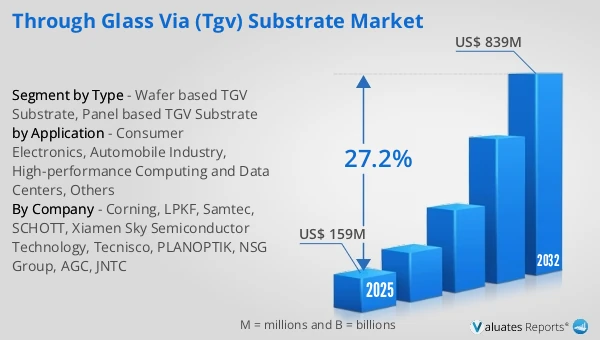
Substrate market was valued at US$ 159 million in 2025 and is anticipated to reach US$ 839 million by 2032, at a CAGR of 27.2% from 2026 to 2032.

Through Glass Via (TGV) Substrate Market

Through Glass Via (TGV) Substrate Market

The global Through Glass Via (TGV)
The 2025 U.S. tariff policies introduce profound uncertainty into the global economic landscape. This report critically examines the implications of recent tariff adjustments and international strategic countermeasures on Through Glass Via (TGV) Substrate competitive dynamics, regional economic interdependencies, and supply chain reconfigurations.
In 2024, global Through Glass Via (TGV) Substrate production reached approximately 4.05 million units , with an average global market price of around US$ 30.4 per unit.
TGV substrate, or Through-Glass Via (TGV) substrate, is a glass-based substrate featuring vertical electrical interconnections. It is characterized by three core aspects: glass material, through-via technology, and metallization.
TGV is a miniaturized packaging technology used in semiconductor packaging and microelectronic devices, providing vertical electrical interconnections through a glass substrate. It employs high-quality borosilicate glass or quartz glass as the base material. Processes such as laser-induced etching, seed layer sputtering, electroplating filling, chemical mechanical planarization, RDL, and bumping are used to achieve 3D interconnection. The diameter of TGVs typically ranges from 10μm to 100μm. For various applications in advanced packaging, tens of thousands of TGV vias are usually required per wafer, and they undergo metallization to ensure the necessary electrical conductivity.
TGV substrates exhibit excellent high-frequency electrical properties. The dielectric constant of glass material is only about one-third that of silicon, and its loss tangent is two to three orders of magnitude lower than that of silicon. This significantly reduces substrate loss and parasitic effects, ensuring signal integrity. The fabrication of TGV substrates does not require complex insulating layer deposition processes. Moreover, thinning is unnecessary for ultra-thin interposers, simplifying the production process and improving efficiency. Since large-format, ultra-thin panel glass is readily available and no insulating layer deposition is required on the substrate surface or the inner walls of the TGVs, manufacturing costs are greatly reduced. Even when the interposer thickness is less than 100μm, warpage remains minimal, ensuring the stability and reliability of the packaged structure. TGV substrates offer unique advantages in applications such as RF chips, high-end MEMS sensors, and high-density system integration, making them one of the preferred choices for next-generation high-frequency 3D chip packaging.
Currently, wafer-level TGV substrates are relatively mature in the market, while panel-level TGV substrates are still in the research or trial production stage. This report provides statistics based on wafer-sized TGV substrates. Additionally, a separate forecast and analysis for panel-level TGV substrates are included in Section 1.5 of this chapter.
Through-Glass Via (TGV) is an advanced 3D integrated circuit technology that enables device miniaturization, high-density packaging, and GHz-speed data processing for various markets such as data centers, 5G communication networks, and IoT devices. Glass is a potential alternative to silicon-based interposers. Compared to Through-Silicon Vias (TSVs), TGVs offer advantages such as lower cost, easy availability of large-format ultra-thin glass substrates, and superior high-frequency electrical performance. The core of TGV technology lies in the deep via formation process. Currently developed glass via formation techniques include plasma etching and laser ablation. However, due to the fragile nature, surface smoothness, and chemical inertness of glass materials, existing technologies have not yet enabled large-scale production and widespread application of TGVs.
From a regional perspective, the Chinese market has experienced rapid changes in recent years. In 2024, China's market size was $25.42 million, accounting for approximately 20.62% of the global market. It is expected to reach $132.12 million by 2031, representing 27.83% of the global market share by then. China is not only a leading country in 5G network deployment but also a major producer of downstream 5G terminal devices. The growth rate of China's TGV market exceeds the global average. With future technological advancements and cost reductions, the TGV market is poised for significant expansion.
In terms of product types and technologies, 300 mm wafers dominated the market in 2024, holding a 65.05% global market share.
Analyzing application areas, the consumer electronics sector is the largest application market for TGV substrates, accounting for 63.91% of the market. TGV substrates are widely used in smartphones, wearable devices, and high-speed processors to meet the demand for miniaturization of electronic components. The automotive industry accounts for 21.10% of the market, where TGV substrates enhance vehicle safety and performance in applications such as advanced driver-assistance systems (ADAS), infotainment systems, and power modules for electric vehicles. In other sectors, biomedical applications are gradually increasing due to the biocompatibility and high precision of TGV substrates, playing an important role in implantable medical devices, biosensors, and microfluidic chips. The integration rate of TGV substrates in 5G and high-frequency communication applications is rising, strongly supporting the development of next-generation wireless networks and data centers.
The TGV substrate market is highly concentrated. Globally, core manufacturers of TGV substrates mainly include Corning, LPKF, Samtec, SCHOTT, Xiamen Sky Semiconductor Technology, and Tecnisco. In 2024, the first-tier manufacturers, primarily Corning and LPKF, held a combined 50% market share. Second-tier manufacturers, such as Samtec, SCHOTT, Xiamen Sky Semiconductor Technology, and Tecnisco, collectively accounted for 33.86% of the market. The top players held nearly 90% of the market share in 2024. Competition in the industry is expected to intensify in the coming years, particularly in the Chinese market.
However, market development faces challenges. High production costs are a significant barrier to market expansion. Compared to traditional substrates, TGV substrate manufacturing technology is complex, leading to increased production time and impacting supply chain efficiency. Furthermore, in emerging markets, adoption rates are slower than in mature markets due to limited awareness of TGV technology.
In summary, the global TGV substrate market holds promising prospects but is accompanied by significant challenges. Companies must continuously optimize production processes to reduce costs, increase R&D investment to overcome technical hurdles, strengthen market promotion to enhance technology awareness, and closely monitor changes in policies and regulations. Only by doing so can they secure a favorable position in the intense market competition and promote the sustainable and healthy development of the TGV substrate market.
This report delivers a comprehensive overview of the global Through Glass Via (TGV) Substrate market, with both quantitative and qualitative analyses, to help readers develop growth strategies, assess the competitive landscape, evaluate their position in the current market, and make informed business decisions regarding Through Glass Via (TGV) Substrate. The Through Glass Via (TGV) Substrate market size, estimates, and forecasts are provided in terms of shipments (K Pcs) and revenue (US$ millions), with 2025 as the base year and historical and forecast data for 2021–2032.
The report segments the global Through Glass Via (TGV) Substrate market comprehensively. Regional market sizes by Type, by Application, , and by company are also provided. For deeper insight, the report profiles the competitive landscape, key competitors, and their respective market rankings, and discusses technological trends and new product developments.
This report will assist Through Glass Via (TGV) Substrate manufacturers, new entrants, and companies across the industry value chain with information on revenues, production, and average prices for the overall market and its sub-segments, by company, by Type, by Application, and by region.
Market Segmentation

Scope of Through Glass Via (TGV) Substrate Market Report

Report Metric Details
Report Name Through Glass Via (TGV) Substrate Market
Accounted market size in 2025 US$ 159 million
Forecasted market size in 2032 US$ 839 million
CAGR 27.2%
Base Year 2025
Forecasted years 2026 - 2032
Segment by Type
  • Wafer based TGV Substrate
  • Panel based TGV Substrate
by Application
  • Consumer Electronics
  • Automobile Industry
  • High-performance Computing and Data Centers
  • Others
Production by Region
  • North America
  • Europe
  • China
  • Japan
Consumption by Region
  • North America (United States, Canada)
  • Europe (Germany, France, UK, Italy, Russia)
  • Asia-Pacific (China, Japan, South Korea, Taiwan)
  • Southeast Asia (India)
  • Latin America (Mexico, Brazil)
By Company Corning, LPKF, Samtec, SCHOTT, Xiamen Sky Semiconductor Technology, Tecnisco, PLANOPTIK, NSG Group, AGC, JNTC
Forecast units USD million in value
Report coverage Revenue and volume forecast, company share, competitive landscape, growth factors and trends

Chapter Outline

  • Chapter 1: Defines the scope of the report and presents an executive summary of market segments (by Type, by Application, , etc.), including the size of each segment and its future growth potential. It offers a high-level view of the current market and its likely evolution in the short, medium, and long term.
  • Chapter 2: Provides a detailed analysis of the competitive landscape for Through Glass Via (TGV) Substrate manufacturers, including prices, production, value-based market shares, latest development plans, and information on mergers and acquisitions.
  • Chapter 3: Examines Through Glass Via (TGV) Substrate production/output and value by region and country, providing a quantitative assessment of market size and growth potential for each region over the next six years.
  • Chapter 4: Analyzes Through Glass Via (TGV) Substrate consumption at the regional and country levels. It quantifies market size and growth potential for each region and its key countries, and outlines market development, outlook, addressable space, and national production.
  • Chapter 5: Analyzes market segments by Type, covering the size and growth potential of each segment to help readers identify “blue ocean” opportunities.
  • Chapter 6: Analyzes market segments by Application, covering the size and growth potential of each segment to help readers identify “blue ocean” opportunities in downstream markets.
  • Chapter 7: Profiles key players, detailing the fundamentals of major companies, including product production/output, value, price, gross margin, product portfolio/introductions, and recent developments.
  • Chapter 8: Reviews the industry value chain, including upstream and downstream segments.
  • Chapter 9: Discusses market dynamics and recent developments, including drivers, restraints, challenges and risks for manufacturers, U.S. Tariffs and relevant policy analysis.
  • Chapter 10: Summarizes the key findings and conclusions of the report.

FAQ for this report

How fast is Through Glass Via (TGV) Substrate Market growing?

Ans: The Through Glass Via (TGV) Substrate Market witnessing a CAGR of 27.2% during the forecast period 2026-2032.

What is the Through Glass Via (TGV) Substrate Market size in 2032?

Ans: The Through Glass Via (TGV) Substrate Market size in 2032 will be US$ 839 million.

What is the Through Glass Via (TGV) Substrate Market share by region?

Ans: In 2024, China's market size was $25.42 million, accounting for approximately 20.62% of the global market.

What is the Through Glass Via (TGV) Substrate Market share by application?

Ans: Analyzing application areas, the consumer electronics sector is the largest application market for TGV substrates, accounting for 63.91% of the market.

What is the Corning, LPKF share in Through Glass Via (TGV) Substrate Market?

Ans: In 2024, the first-tier manufacturers, primarily Corning and LPKF, held a combined 50% market share.

What is the Samtec, SCHOTT, Xiamen Sky Semiconductor Technology, Tecnisco share in Through Glass Via (TGV) Substrate Market?

Ans: Second-tier manufacturers, such as Samtec, SCHOTT, Xiamen Sky Semiconductor Technology, and Tecnisco, collectively accounted for 33.86% of the market.

Who are the main players in the Through Glass Via (TGV) Substrate Market report?

Ans: The main players in the Through Glass Via (TGV) Substrate Market are Corning, LPKF, Samtec, SCHOTT, Xiamen Sky Semiconductor Technology, Tecnisco, PLANOPTIK, NSG Group, AGC, JNTC

What are the Application segmentation covered in the Through Glass Via (TGV) Substrate Market report?

Ans: The Applications covered in the Through Glass Via (TGV) Substrate Market report are Consumer Electronics, Automobile Industry, High-performance Computing and Data Centers, Others

What are the Type segmentation covered in the Through Glass Via (TGV) Substrate Market report?

Ans: The Types covered in the Through Glass Via (TGV) Substrate Market report are Wafer based TGV Substrate, Panel based TGV Substrate

1 Through Glass Via (TGV) Substrate Market Overview
1.1 Product Definition
1.2 Through Glass Via (TGV) Substrate by Type
1.2.1 Global Through Glass Via (TGV) Substrate Market Value Growth Rate Analysis by Type: 2025 vs 2032
1.2.2 Wafer based TGV Substrate
1.2.3 Panel based TGV Substrate
1.3 Through Glass Via (TGV) Substrate by Application
1.3.1 Global Through Glass Via (TGV) Substrate Market Value Growth Rate Analysis by Application: 2025 vs 2032
1.3.2 Consumer Electronics
1.3.3 Automobile Industry
1.3.4 High-performance Computing and Data Centers
1.3.5 Others
1.4 Global Market Growth Prospects
1.4.1 Global Through Glass Via (TGV) Substrate Production Value Estimates and Forecasts (2021–2032)
1.4.2 Global Through Glass Via (TGV) Substrate Production Capacity Estimates and Forecasts (2021–2032)
1.4.3 Global Through Glass Via (TGV) Substrate Production Estimates and Forecasts (2021–2032)
1.4.4 Global Through Glass Via (TGV) Substrate Market Average Price Estimates and Forecasts (2021–2032)
1.5 Assumptions and Limitations
2 Market Competition by Manufacturers
2.1 Global Through Glass Via (TGV) Substrate Production Market Share by Manufacturers (2021–2026)
2.2 Global Through Glass Via (TGV) Substrate Production Value Market Share by Manufacturers (2021–2026)
2.3 Global Key Players of Through Glass Via (TGV) Substrate, Industry Ranking, 2024 vs 2025
2.4 Global Through Glass Via (TGV) Substrate Market Share by Company Tier (Tier 1, Tier 2, Tier 3)
2.5 Global Through Glass Via (TGV) Substrate Average Price by Manufacturers (2021–2026)
2.6 Global Key Manufacturers of Through Glass Via (TGV) Substrate, Manufacturing Footprints and Headquarters
2.7 Global Key Manufacturers of Through Glass Via (TGV) Substrate, Product Offerings and Applications
2.8 Global Key Manufacturers of Through Glass Via (TGV) Substrate, Date of Entry into the Industry
2.9 Through Glass Via (TGV) Substrate Market Competitive Situation and Trends
2.9.1 Through Glass Via (TGV) Substrate Market Concentration Rate
2.9.2 Top 5 and Top 10 Global Through Glass Via (TGV) Substrate Players Market Share by Revenue
2.10 Mergers & Acquisitions and Expansion
3 Through Glass Via (TGV) Substrate Production by Region
3.1 Global Through Glass Via (TGV) Substrate Production Value Estimates and Forecasts by Region: 2021 vs 2025 vs 2032
3.2 Global Through Glass Via (TGV) Substrate Production Value by Region (2021–2032)
3.2.1 Global Through Glass Via (TGV) Substrate Production Value by Region (2021–2026)
3.2.2 Global Forecasted Production Value of Through Glass Via (TGV) Substrate by Region (2027–2032)
3.3 Global Through Glass Via (TGV) Substrate Production Estimates and Forecasts by Region: 2021 vs 2025 vs 2032
3.4 Global Through Glass Via (TGV) Substrate Production Volume by Region (2021–2032)
3.4.1 Global Through Glass Via (TGV) Substrate Production by Region (2021–2026)
3.4.2 Global Forecasted Production of Through Glass Via (TGV) Substrate by Region (2027–2032)
3.5 Global Through Glass Via (TGV) Substrate Market Price Analysis by Region (2021–2026)
3.6 Global Through Glass Via (TGV) Substrate Production, Value, and Year-over-Year Growth
3.6.1 North America Through Glass Via (TGV) Substrate Production Value Estimates and Forecasts (2021–2032)
3.6.2 Europe Through Glass Via (TGV) Substrate Production Value Estimates and Forecasts (2021–2032)
3.6.3 China Through Glass Via (TGV) Substrate Production Value Estimates and Forecasts (2021–2032)
3.6.4 Japan Through Glass Via (TGV) Substrate Production Value Estimates and Forecasts (2021–2032)
4 Through Glass Via (TGV) Substrate Consumption by Region
4.1 Global Through Glass Via (TGV) Substrate Consumption Estimates and Forecasts by Region: 2021 vs 2025 vs 2032
4.2 Global Through Glass Via (TGV) Substrate Consumption by Region (2021–2032)
4.2.1 Global Through Glass Via (TGV) Substrate Consumption by Region (2021–2026)
4.2.2 Global Through Glass Via (TGV) Substrate Forecasted Consumption by Region (2027–2032)
4.3 North America
4.3.1 North America Through Glass Via (TGV) Substrate Consumption Growth Rate by Country: 2021 vs 2025 vs 2032
4.3.2 North America Through Glass Via (TGV) Substrate Consumption by Country (2021–2032)
4.3.3 U.S.
4.3.4 Canada
4.4 Europe
4.4.1 Europe Through Glass Via (TGV) Substrate Consumption Growth Rate by Country: 2021 vs 2025 vs 2032
4.4.2 Europe Through Glass Via (TGV) Substrate Consumption by Country (2021–2032)
4.4.3 Germany
4.4.4 France
4.4.5 U.K.
4.4.6 Italy
4.4.7 Russia
4.5 Asia Pacific
4.5.1 Asia Pacific Through Glass Via (TGV) Substrate Consumption Growth Rate by Region: 2021 vs 2025 vs 2032
4.5.2 Asia Pacific Through Glass Via (TGV) Substrate Consumption by Region (2021–2032)
4.5.3 China
4.5.4 Japan
4.5.5 South Korea
4.5.6 China Taiwan
4.5.7 Southeast Asia
4.5.8 India
4.6 Latin America, Middle East & Africa
4.6.1 Latin America, Middle East & Africa Through Glass Via (TGV) Substrate Consumption Growth Rate by Country: 2021 vs 2025 vs 2032
4.6.2 Latin America, Middle East & Africa Through Glass Via (TGV) Substrate Consumption by Country (2021–2032)
4.6.3 Mexico
4.6.4 Brazil
4.6.5 Israel
4.6.6 GCC Countries
5 Segment by Type
5.1 Global Through Glass Via (TGV) Substrate Production by Type (2021–2032)
5.1.1 Global Through Glass Via (TGV) Substrate Production by Type (2021–2026)
5.1.2 Global Through Glass Via (TGV) Substrate Production by Type (2027–2032)
5.1.3 Global Through Glass Via (TGV) Substrate Production Market Share by Type (2021–2032)
5.2 Global Through Glass Via (TGV) Substrate Production Value by Type (2021–2032)
5.2.1 Global Through Glass Via (TGV) Substrate Production Value by Type (2021–2026)
5.2.2 Global Through Glass Via (TGV) Substrate Production Value by Type (2027–2032)
5.2.3 Global Through Glass Via (TGV) Substrate Production Value Market Share by Type (2021–2032)
5.3 Global Through Glass Via (TGV) Substrate Price by Type (2021–2032)
6 Segment by Application
6.1 Global Through Glass Via (TGV) Substrate Production by Application (2021–2032)
6.1.1 Global Through Glass Via (TGV) Substrate Production by Application (2021–2026)
6.1.2 Global Through Glass Via (TGV) Substrate Production by Application (2027–2032)
6.1.3 Global Through Glass Via (TGV) Substrate Production Market Share by Application (2021–2032)
6.2 Global Through Glass Via (TGV) Substrate Production Value by Application (2021–2032)
6.2.1 Global Through Glass Via (TGV) Substrate Production Value by Application (2021–2026)
6.2.2 Global Through Glass Via (TGV) Substrate Production Value by Application (2027–2032)
6.2.3 Global Through Glass Via (TGV) Substrate Production Value Market Share by Application (2021–2032)
6.3 Global Through Glass Via (TGV) Substrate Price by Application (2021–2032)
7 Key Companies Profiled
7.1 Corning
7.1.1 Corning Through Glass Via (TGV) Substrate Company Information
7.1.2 Corning Through Glass Via (TGV) Substrate Product Portfolio
7.1.3 Corning Through Glass Via (TGV) Substrate Production, Value, Price, and Gross Margin (2021–2026)
7.1.4 Corning Main Business and Markets Served
7.1.5 Corning Recent Developments/Updates
7.2 LPKF
7.2.1 LPKF Through Glass Via (TGV) Substrate Company Information
7.2.2 LPKF Through Glass Via (TGV) Substrate Product Portfolio
7.2.3 LPKF Through Glass Via (TGV) Substrate Production, Value, Price, and Gross Margin (2021–2026)
7.2.4 LPKF Main Business and Markets Served
7.2.5 LPKF Recent Developments/Updates
7.3 Samtec
7.3.1 Samtec Through Glass Via (TGV) Substrate Company Information
7.3.2 Samtec Through Glass Via (TGV) Substrate Product Portfolio
7.3.3 Samtec Through Glass Via (TGV) Substrate Production, Value, Price, and Gross Margin (2021–2026)
7.3.4 Samtec Main Business and Markets Served
7.3.5 Samtec Recent Developments/Updates
7.4 SCHOTT
7.4.1 SCHOTT Through Glass Via (TGV) Substrate Company Information
7.4.2 SCHOTT Through Glass Via (TGV) Substrate Product Portfolio
7.4.3 SCHOTT Through Glass Via (TGV) Substrate Production, Value, Price, and Gross Margin (2021–2026)
7.4.4 SCHOTT Main Business and Markets Served
7.4.5 SCHOTT Recent Developments/Updates
7.5 Xiamen Sky Semiconductor Technology
7.5.1 Xiamen Sky Semiconductor Technology Through Glass Via (TGV) Substrate Company Information
7.5.2 Xiamen Sky Semiconductor Technology Through Glass Via (TGV) Substrate Product Portfolio
7.5.3 Xiamen Sky Semiconductor Technology Through Glass Via (TGV) Substrate Production, Value, Price, and Gross Margin (2021–2026)
7.5.4 Xiamen Sky Semiconductor Technology Main Business and Markets Served
7.5.5 Xiamen Sky Semiconductor Technology Recent Developments/Updates
7.6 Tecnisco
7.6.1 Tecnisco Through Glass Via (TGV) Substrate Company Information
7.6.2 Tecnisco Through Glass Via (TGV) Substrate Product Portfolio
7.6.3 Tecnisco Through Glass Via (TGV) Substrate Production, Value, Price, and Gross Margin (2021–2026)
7.6.4 Tecnisco Main Business and Markets Served
7.6.5 Tecnisco Recent Developments/Updates
7.7 PLANOPTIK
7.7.1 PLANOPTIK Through Glass Via (TGV) Substrate Company Information
7.7.2 PLANOPTIK Through Glass Via (TGV) Substrate Product Portfolio
7.7.3 PLANOPTIK Through Glass Via (TGV) Substrate Production, Value, Price, and Gross Margin (2021–2026)
7.7.4 PLANOPTIK Main Business and Markets Served
7.7.5 PLANOPTIK Recent Developments/Updates
7.8 NSG Group
7.8.1 NSG Group Through Glass Via (TGV) Substrate Company Information
7.8.2 NSG Group Through Glass Via (TGV) Substrate Product Portfolio
7.8.3 NSG Group Through Glass Via (TGV) Substrate Production, Value, Price, and Gross Margin (2021–2026)
7.8.4 NSG Group Main Business and Markets Served
7.8.5 NSG Group Recent Developments/Updates
7.9 AGC
7.9.1 AGC Through Glass Via (TGV) Substrate Company Information
7.9.2 AGC Through Glass Via (TGV) Substrate Product Portfolio
7.9.3 AGC Through Glass Via (TGV) Substrate Production, Value, Price, and Gross Margin (2021–2026)
7.9.4 AGC Main Business and Markets Served
7.9.5 AGC Recent Developments/Updates
7.10 JNTC
7.10.1 JNTC Through Glass Via (TGV) Substrate Company Information
7.10.2 JNTC Through Glass Via (TGV) Substrate Product Portfolio
7.10.3 JNTC Through Glass Via (TGV) Substrate Production, Value, Price, and Gross Margin (2021–2026)
7.10.4 JNTC Main Business and Markets Served
7.10.5 JNTC Recent Developments/Updates
8 Industry Chain and Sales Channels Analysis
8.1 Through Glass Via (TGV) Substrate Industry Chain Analysis
8.2 Through Glass Via (TGV) Substrate Raw Material Supply Analysis
8.2.1 Key Raw Materials
8.2.2 Raw Materials Key Suppliers
8.3 Through Glass Via (TGV) Substrate Production Modes and Processes
8.4 Through Glass Via (TGV) Substrate Sales and Marketing
8.4.1 Through Glass Via (TGV) Substrate Sales Channels
8.4.2 Through Glass Via (TGV) Substrate Distributors
8.5 Through Glass Via (TGV) Substrate Customer Analysis
9 Through Glass Via (TGV) Substrate Market Dynamics
9.1 Through Glass Via (TGV) Substrate Industry Trends
9.2 Through Glass Via (TGV) Substrate Market Drivers
9.3 Through Glass Via (TGV) Substrate Market Challenges
9.4 Through Glass Via (TGV) Substrate Market Restraints
9.5 Impact of U.S. Tariffs
10 Research Findings and Conclusion
11 Methodology and Data Source
11.1 Methodology/Research Approach
11.1.1 Research Programs/Design
11.1.2 Market Size Estimation
11.1.3 Market Breakdown and Data Triangulation
11.2 Data Source
11.2.1 Secondary Sources
11.2.2 Primary Sources
11.3 Author List
11.4 Disclaimer
List of Tables
 Table 1. Global Through Glass Via (TGV) Substrate Market Value by Type (US$ Million), 2025 vs 2032
 Table 2. Global Through Glass Via (TGV) Substrate Market Value by Application (US$ Million), 2025 vs 2032
 Table 3. Global Through Glass Via (TGV) Substrate Production Capacity (K Pcs) by Manufacturers in 2025
 Table 4. Global Through Glass Via (TGV) Substrate Production by Manufacturers (K Pcs), 2021–2026
 Table 5. Global Through Glass Via (TGV) Substrate Production Market Share by Manufacturers (2021–2026)
 Table 6. Global Through Glass Via (TGV) Substrate Production Value by Manufacturers (US$ Million), 2021–2026
 Table 7. Global Through Glass Via (TGV) Substrate Production Value Share by Manufacturers (2021–2026)
 Table 8. Global Key Players of Through Glass Via (TGV) Substrate, Industry Ranking, 2024 vs 2025
 Table 9. Classification of Companies by Tier (Tier 1, Tier 2, Tier 3), based on Through Glass Via (TGV) Substrate Production Value, 2025
 Table 10. Global Market Through Glass Via (TGV) Substrate Average Price by Manufacturers (US$/Pcs), 2021–2026
 Table 11. Global Key Manufacturers of Through Glass Via (TGV) Substrate, Manufacturing Footprints and Headquarters
 Table 12. Global Key Manufacturers of Through Glass Via (TGV) Substrate, Product Offerings and Applications
 Table 13. Global Key Manufacturers of Through Glass Via (TGV) Substrate, Date of Entry into the Industry
 Table 14. Global Through Glass Via (TGV) Substrate Manufacturers Market Concentration Ratio (CR5 and HHI)
 Table 15. Mergers & Acquisitions and Expansion Plans
 Table 16. Global Through Glass Via (TGV) Substrate Production Value by Region: 2021 vs 2025 vs 2032 (US$ Million)
 Table 17. Global Through Glass Via (TGV) Substrate Production Value (US$ Million) by Region (2021–2026)
 Table 18. Global Through Glass Via (TGV) Substrate Production Value Market Share by Region (2021–2026)
 Table 19. Global Through Glass Via (TGV) Substrate Production Value (US$ Million) Forecast by Region (2027–2032)
 Table 20. Global Through Glass Via (TGV) Substrate Production Value Market Share Forecast by Region (2027–2032)
 Table 21. Global Through Glass Via (TGV) Substrate Production Comparison by Region: 2021 vs 2025 vs 2032 (K Pcs)
 Table 22. Global Through Glass Via (TGV) Substrate Production (K Pcs) by Region (2021–2026)
 Table 23. Global Through Glass Via (TGV) Substrate Production Market Share by Region (2021–2026)
 Table 24. Global Through Glass Via (TGV) Substrate Production (K Pcs) Forecast by Region (2027–2032)
 Table 25. Global Through Glass Via (TGV) Substrate Production Market Share Forecast by Region (2027–2032)
 Table 26. Global Through Glass Via (TGV) Substrate Market Average Price (US$/Pcs) by Region (2021–2026)
 Table 27. Global Through Glass Via (TGV) Substrate Market Average Price (US$/Pcs) by Region (2027–2032)
 Table 28. Global Through Glass Via (TGV) Substrate Consumption Growth Rate by Region: 2021 vs 2025 vs 2032 (K Pcs)
 Table 29. Global Through Glass Via (TGV) Substrate Consumption by Region (K Pcs), 2021–2026
 Table 30. Global Through Glass Via (TGV) Substrate Consumption Market Share by Region (2021–2026)
 Table 31. Global Through Glass Via (TGV) Substrate Forecasted Consumption by Region (K Pcs), 2027–2032
 Table 32. Global Through Glass Via (TGV) Substrate Forecasted Consumption Market Share by Region (2027–2032)
 Table 33. North America Through Glass Via (TGV) Substrate Consumption Growth Rate by Country: 2021 vs 2025 vs 2032 (K Pcs)
 Table 34. North America Through Glass Via (TGV) Substrate Consumption by Country (K Pcs), 2021–2026
 Table 35. North America Through Glass Via (TGV) Substrate Consumption by Country (K Pcs), 2027–2032
 Table 36. Europe Through Glass Via (TGV) Substrate Consumption Growth Rate by Country: 2021 vs 2025 vs 2032 (K Pcs)
 Table 37. Europe Through Glass Via (TGV) Substrate Consumption by Country (K Pcs), 2021–2026
 Table 38. Europe Through Glass Via (TGV) Substrate Consumption by Country (K Pcs), 2027–2032
 Table 39. Asia Pacific Through Glass Via (TGV) Substrate Consumption Growth Rate by Region: 2021 vs 2025 vs 2032 (K Pcs)
 Table 40. Asia Pacific Through Glass Via (TGV) Substrate Consumption by Region (K Pcs), 2021–2026
 Table 41. Asia Pacific Through Glass Via (TGV) Substrate Consumption by Region (K Pcs), 2027–2032
 Table 42. Latin America, Middle East & Africa Through Glass Via (TGV) Substrate Consumption Growth Rate by Country: 2021 vs 2025 vs 2032 (K Pcs)
 Table 43. Latin America, Middle East & Africa Through Glass Via (TGV) Substrate Consumption by Country (K Pcs), 2021–2026
 Table 44. Latin America, Middle East & Africa Through Glass Via (TGV) Substrate Consumption by Country (K Pcs), 2027–2032
 Table 45. Global Through Glass Via (TGV) Substrate Production (K Pcs) by Type (2021–2026)
 Table 46. Global Through Glass Via (TGV) Substrate Production (K Pcs) by Type (2027–2032)
 Table 47. Global Through Glass Via (TGV) Substrate Production Market Share by Type (2021–2026)
 Table 48. Global Through Glass Via (TGV) Substrate Production Market Share by Type (2027–2032)
 Table 49. Global Through Glass Via (TGV) Substrate Production Value (US$ Million) by Type (2021–2026)
 Table 50. Global Through Glass Via (TGV) Substrate Production Value (US$ Million) by Type (2027–2032)
 Table 51. Global Through Glass Via (TGV) Substrate Production Value Market Share by Type (2021–2026)
 Table 52. Global Through Glass Via (TGV) Substrate Production Value Market Share by Type (2027–2032)
 Table 53. Global Through Glass Via (TGV) Substrate Price (US$/Pcs) by Type (2021–2026)
 Table 54. Global Through Glass Via (TGV) Substrate Price (US$/Pcs) by Type (2027–2032)
 Table 55. Global Through Glass Via (TGV) Substrate Production (K Pcs) by Application (2021–2026)
 Table 56. Global Through Glass Via (TGV) Substrate Production (K Pcs) by Application (2027–2032)
 Table 57. Global Through Glass Via (TGV) Substrate Production Market Share by Application (2021–2026)
 Table 58. Global Through Glass Via (TGV) Substrate Production Market Share by Application (2027–2032)
 Table 59. Global Through Glass Via (TGV) Substrate Production Value (US$ Million) by Application (2021–2026)
 Table 60. Global Through Glass Via (TGV) Substrate Production Value (US$ Million) by Application (2027–2032)
 Table 61. Global Through Glass Via (TGV) Substrate Production Value Market Share by Application (2021–2026)
 Table 62. Global Through Glass Via (TGV) Substrate Production Value Market Share by Application (2027–2032)
 Table 63. Global Through Glass Via (TGV) Substrate Price (US$/Pcs) by Application (2021–2026)
 Table 64. Global Through Glass Via (TGV) Substrate Price (US$/Pcs) by Application (2027–2032)
 Table 65. Corning Through Glass Via (TGV) Substrate Company Information
 Table 66. Corning Through Glass Via (TGV) Substrate Specification and Application
 Table 67. Corning Through Glass Via (TGV) Substrate Production (K Pcs), Value (US$ Million), Price (US$/Pcs) and Gross Margin (2021–2026)
 Table 68. Corning Main Business and Markets Served
 Table 69. Corning Recent Developments/Updates
 Table 70. LPKF Through Glass Via (TGV) Substrate Company Information
 Table 71. LPKF Through Glass Via (TGV) Substrate Specification and Application
 Table 72. LPKF Through Glass Via (TGV) Substrate Production (K Pcs), Value (US$ Million), Price (US$/Pcs) and Gross Margin (2021–2026)
 Table 73. LPKF Main Business and Markets Served
 Table 74. LPKF Recent Developments/Updates
 Table 75. Samtec Through Glass Via (TGV) Substrate Company Information
 Table 76. Samtec Through Glass Via (TGV) Substrate Specification and Application
 Table 77. Samtec Through Glass Via (TGV) Substrate Production (K Pcs), Value (US$ Million), Price (US$/Pcs) and Gross Margin (2021–2026)
 Table 78. Samtec Main Business and Markets Served
 Table 79. Samtec Recent Developments/Updates
 Table 80. SCHOTT Through Glass Via (TGV) Substrate Company Information
 Table 81. SCHOTT Through Glass Via (TGV) Substrate Specification and Application
 Table 82. SCHOTT Through Glass Via (TGV) Substrate Production (K Pcs), Value (US$ Million), Price (US$/Pcs) and Gross Margin (2021–2026)
 Table 83. SCHOTT Main Business and Markets Served
 Table 84. SCHOTT Recent Developments/Updates
 Table 85. Xiamen Sky Semiconductor Technology Through Glass Via (TGV) Substrate Company Information
 Table 86. Xiamen Sky Semiconductor Technology Through Glass Via (TGV) Substrate Specification and Application
 Table 87. Xiamen Sky Semiconductor Technology Through Glass Via (TGV) Substrate Production (K Pcs), Value (US$ Million), Price (US$/Pcs) and Gross Margin (2021–2026)
 Table 88. Xiamen Sky Semiconductor Technology Main Business and Markets Served
 Table 89. Xiamen Sky Semiconductor Technology Recent Developments/Updates
 Table 90. Tecnisco Through Glass Via (TGV) Substrate Company Information
 Table 91. Tecnisco Through Glass Via (TGV) Substrate Specification and Application
 Table 92. Tecnisco Through Glass Via (TGV) Substrate Production (K Pcs), Value (US$ Million), Price (US$/Pcs) and Gross Margin (2021–2026)
 Table 93. Tecnisco Main Business and Markets Served
 Table 94. Tecnisco Recent Developments/Updates
 Table 95. PLANOPTIK Through Glass Via (TGV) Substrate Company Information
 Table 96. PLANOPTIK Through Glass Via (TGV) Substrate Specification and Application
 Table 97. PLANOPTIK Through Glass Via (TGV) Substrate Production (K Pcs), Value (US$ Million), Price (US$/Pcs) and Gross Margin (2021–2026)
 Table 98. PLANOPTIK Main Business and Markets Served
 Table 99. PLANOPTIK Recent Developments/Updates
 Table 100. NSG Group Through Glass Via (TGV) Substrate Company Information
 Table 101. NSG Group Through Glass Via (TGV) Substrate Specification and Application
 Table 102. NSG Group Through Glass Via (TGV) Substrate Production (K Pcs), Value (US$ Million), Price (US$/Pcs) and Gross Margin (2021–2026)
 Table 103. NSG Group Main Business and Markets Served
 Table 104. NSG Group Recent Developments/Updates
 Table 105. AGC Through Glass Via (TGV) Substrate Company Information
 Table 106. AGC Through Glass Via (TGV) Substrate Specification and Application
 Table 107. AGC Through Glass Via (TGV) Substrate Production (K Pcs), Value (US$ Million), Price (US$/Pcs) and Gross Margin (2021–2026)
 Table 108. AGC Main Business and Markets Served
 Table 109. AGC Recent Developments/Updates
 Table 110. JNTC Through Glass Via (TGV) Substrate Company Information
 Table 111. JNTC Through Glass Via (TGV) Substrate Specification and Application
 Table 112. JNTC Through Glass Via (TGV) Substrate Production (K Pcs), Value (US$ Million), Price (US$/Pcs) and Gross Margin (2021–2026)
 Table 113. JNTC Main Business and Markets Served
 Table 114. JNTC Recent Developments/Updates
 Table 115. Key Raw Materials Lists
 Table 116. Raw Materials Key Suppliers Lists
 Table 117. Through Glass Via (TGV) Substrate Distributors List
 Table 118. Through Glass Via (TGV) Substrate Customers List
 Table 119. Through Glass Via (TGV) Substrate Market Trends
 Table 120. Through Glass Via (TGV) Substrate Market Drivers
 Table 121. Through Glass Via (TGV) Substrate Market Challenges
 Table 122. Through Glass Via (TGV) Substrate Market Restraints
 Table 123. Research Programs/Design for This Report
 Table 124. Key Data Information from Secondary Sources
 Table 125. Key Data Information from Primary Sources
 Table 126. Authors List of This Report


List of Figures
 Figure 1. Product Picture of Through Glass Via (TGV) Substrate
 Figure 2. Global Through Glass Via (TGV) Substrate Market Value by Type (US$ Million), 2021–2032
 Figure 3. Global Through Glass Via (TGV) Substrate Market Share by Type: 2025 vs 2032
 Figure 4. Wafer based TGV Substrate Product Picture
 Figure 5. Panel based TGV Substrate Product Picture
 Figure 6. Global Through Glass Via (TGV) Substrate Market Value by Application (US$ Million), 2021–2032
 Figure 7. Global Through Glass Via (TGV) Substrate Market Share by Application: 2025 vs 2032
 Figure 8. Consumer Electronics
 Figure 9. Automobile Industry
 Figure 10. High-performance Computing and Data Centers
 Figure 11. Others
 Figure 12. Global Through Glass Via (TGV) Substrate Production Value (US$ Million), 2021 vs 2025 vs 2032
 Figure 13. Global Through Glass Via (TGV) Substrate Production Value (US$ Million), 2021–2032
 Figure 14. Global Through Glass Via (TGV) Substrate Production Capacity (K Pcs), 2021–2032
 Figure 15. Global Through Glass Via (TGV) Substrate Production (K Pcs), 2021–2032
 Figure 16. Global Through Glass Via (TGV) Substrate Average Price (US$/Pcs), 2021–2032
 Figure 17. Through Glass Via (TGV) Substrate Report Years Considered
 Figure 18. Through Glass Via (TGV) Substrate Production Share by Manufacturers in 2025
 Figure 19. Global Through Glass Via (TGV) Substrate Production Value Share by Manufacturers (2025)
 Figure 20. Through Glass Via (TGV) Substrate Market Share by Company Type (Tier 1, Tier 2, and Tier 3): 2021 vs 2025
 Figure 21. Top 5 and Top 10 Global Players: Market Share by Through Glass Via (TGV) Substrate Revenue in 2025
 Figure 22. Global Through Glass Via (TGV) Substrate Production Value by Region: 2021 vs 2025 vs 2032 (US$ Million)
 Figure 23. Global Through Glass Via (TGV) Substrate Production Value Market Share by Region: 2021 vs 2025 vs 2032
 Figure 24. Global Through Glass Via (TGV) Substrate Production Comparison by Region: 2021 vs 2025 vs 2032 (K Pcs)
 Figure 25. Global Through Glass Via (TGV) Substrate Production Market Share by Region: 2021 vs 2025 vs 2032
 Figure 26. North America Through Glass Via (TGV) Substrate Production Value (US$ Million) Growth Rate (2021–2032)
 Figure 27. Europe Through Glass Via (TGV) Substrate Production Value (US$ Million) Growth Rate (2021–2032)
 Figure 28. China Through Glass Via (TGV) Substrate Production Value (US$ Million) Growth Rate (2021–2032)
 Figure 29. Japan Through Glass Via (TGV) Substrate Production Value (US$ Million) Growth Rate (2021–2032)
 Figure 30. Global Through Glass Via (TGV) Substrate Consumption by Region: 2021 vs 2025 vs 2032 (K Pcs)
 Figure 31. Global Through Glass Via (TGV) Substrate Consumption Market Share by Region: 2021 vs 2025 vs 2032
 Figure 32. North America Through Glass Via (TGV) Substrate Consumption and Growth Rate (K Pcs), 2021–2032
 Figure 33. North America Through Glass Via (TGV) Substrate Consumption Market Share by Country (2021–2032)
 Figure 34. U.S. Through Glass Via (TGV) Substrate Consumption and Growth Rate (K Pcs), 2021–2032
 Figure 35. Canada Through Glass Via (TGV) Substrate Consumption and Growth Rate (K Pcs), 2021–2032
 Figure 36. Europe Through Glass Via (TGV) Substrate Consumption and Growth Rate (K Pcs), 2021–2032
 Figure 37. Europe Through Glass Via (TGV) Substrate Consumption Market Share by Country (2021–2032)
 Figure 38. Germany Through Glass Via (TGV) Substrate Consumption and Growth Rate (K Pcs), 2021–2032
 Figure 39. France Through Glass Via (TGV) Substrate Consumption and Growth Rate (K Pcs), 2021–2032
 Figure 40. U.K. Through Glass Via (TGV) Substrate Consumption and Growth Rate (K Pcs), 2021–2032
 Figure 41. Italy Through Glass Via (TGV) Substrate Consumption and Growth Rate (K Pcs), 2021–2032
 Figure 42. Russia Through Glass Via (TGV) Substrate Consumption and Growth Rate (K Pcs), 2021–2032
 Figure 43. Asia Pacific Through Glass Via (TGV) Substrate Consumption and Growth Rate (K Pcs), 2021–2032
 Figure 44. Asia Pacific Through Glass Via (TGV) Substrate Consumption Market Share by Region (2021–2032)
 Figure 45. China Through Glass Via (TGV) Substrate Consumption and Growth Rate (K Pcs), 2021–2032
 Figure 46. Japan Through Glass Via (TGV) Substrate Consumption and Growth Rate (K Pcs), 2021–2032
 Figure 47. South Korea Through Glass Via (TGV) Substrate Consumption and Growth Rate (K Pcs), 2021–2032
 Figure 48. China Taiwan Through Glass Via (TGV) Substrate Consumption and Growth Rate (K Pcs), 2021–2032
 Figure 49. Southeast Asia Through Glass Via (TGV) Substrate Consumption and Growth Rate (K Pcs), 2021–2032
 Figure 50. India Through Glass Via (TGV) Substrate Consumption and Growth Rate (K Pcs), 2021–2032
 Figure 51. Latin America, Middle East & Africa Through Glass Via (TGV) Substrate Consumption and Growth Rate (K Pcs), 2021–2032
 Figure 52. Latin America, Middle East & Africa Through Glass Via (TGV) Substrate Consumption Market Share by Country (2021–2032)
 Figure 53. Mexico Through Glass Via (TGV) Substrate Consumption and Growth Rate (K Pcs), 2021–2032
 Figure 54. Brazil Through Glass Via (TGV) Substrate Consumption and Growth Rate (K Pcs), 2021–2032
 Figure 55. Israel Through Glass Via (TGV) Substrate Consumption and Growth Rate (K Pcs), 2021–2032
 Figure 56. GCC Countries Through Glass Via (TGV) Substrate Consumption and Growth Rate (K Pcs), 2021–2032
 Figure 57. Global Production Market Share of Through Glass Via (TGV) Substrate by Type (2021–2032)
 Figure 58. Global Production Value Market Share of Through Glass Via (TGV) Substrate by Type (2021–2032)
 Figure 59. Global Through Glass Via (TGV) Substrate Price (US$/Pcs) by Type (2021–2032)
 Figure 60. Global Production Market Share of Through Glass Via (TGV) Substrate by Application (2021–2032)
 Figure 61. Global Production Value Market Share of Through Glass Via (TGV) Substrate by Application (2021–2032)
 Figure 62. Global Through Glass Via (TGV) Substrate Price (US$/Pcs) by Application (2021–2032)
 Figure 63. Through Glass Via (TGV) Substrate Value Chain
 Figure 64. Channels of Distribution (Direct Vs Distribution)
 Figure 65. Bottom-up and Top-down Approaches for This Report
 Figure 66. Data Triangulation

SELECT A FORMAT
Added to Cart
Electronic

$2900

Single User License
Electronic

$4350

Multi User License
Electronic

$5800

Enterprise License
Add to Cart
Buy Now (15% Discount)

OUR CUSTOMER

Nano String