FEATURED COMPANIES
CAE
FlightSafety International Inc.
L-3 Simulation & Training
Rockwell Collins
Indra
Reiser Simulation and Training
Thales Group
Pacific Simulators
Frasca
Aerosim
STS
TRU Simulation + Training
Aviation Full Motion Flight Simulators Market Size
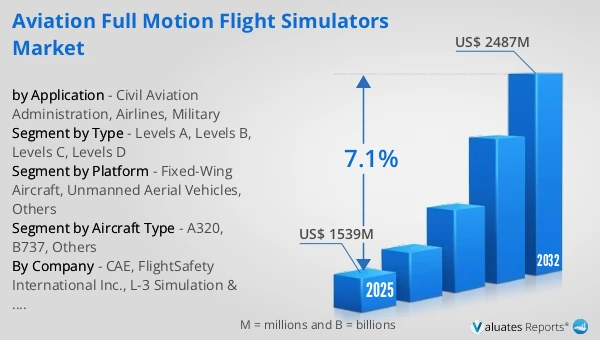
The global Aviation Full Motion Flight Simulators market was valued at US$ 1539 million in 2025 and is anticipated to reach US$ 2487 million by 2032, at a CAGR of 7.1% from 2026 to 2032.
Aviation Full Motion Flight Simulators Market
The 2025 U.S. tariff policies introduce profound uncertainty into the global economic landscape. This report critically examines the implications of recent tariff adjustments and international strategic countermeasures on Aviation Full Motion Flight Simulators competitive dynamics, regional economic interdependencies, and supply chain reconfigurations.
In 2025, approximately 342 Aviation Full Motion Flight Simulators were delivered globally, with an average price of approximately USD 4.5 million per unit (ranging from USD 1 to 15 million per unit depending on the level and configuration). The industry's average gross profit margin was approximately 18% to 25% (estimated based on differences in equipment complexity, software licensing, and after-sales contracts). An aviation full motion flight simulator is a high-fidelity training system that fully replicates aircraft control, avionics, engines, and environment on a six-degree-of-freedom (DOF) moving platform. Typical parameters include: qualification level (Level B/C/D), moving platform (6 DOF), fly-by-wire/force feedback control loading system, accurate cockpit replication (whole aircraft or modular cockpit), vision system (at least 180° field of view, multi-channel projection or dome screen/up to 8K resolution combination), airborne system simulation (FMS, avionics, engine models), stall/fault injection, and detailed data logging and evaluation functions. It requires significant installation space (cockpit + moving platform + machine room + cooling/fire protection) and stringent certification and continuous qualified maintenance (e.g., FAA/EASA/CCAR). Upstream industries include high-precision motors and servo drives, six-axis moving platform manufacturing, image projection and rendering hardware, flight model software and licensing, and audio-visual and control console manufacturing. Downstream industries include airlines, aviation training organizations (ATO), air force/government training centers, and OEM after-sales service.
The Aviation Full Motion Flight Simulator market is poised for steady and structural growth in the coming years. Driven by the recovery of global air passenger traffic, fleet expansion, and pilot recruitment needs, training hours and compliance requirements continue to rise, prompting airlines, ATOs, and OEMs to accelerate the procurement or upgrading of Level D/Level C full flight simulators to meet qualification and retraining requirements (this is the primary driver of demand growth). On the technology side, high-definition video scenes and high frame rate graphics, advanced motion platforms, more realistic system simulations (FMS/FADEC/integrated flight control), and AI-driven adaptive training and fault injection tools are simultaneously improving training effectiveness and efficiency per training session, thereby reducing overall training costs and expanding the simulator's educational reach. Secondly, the regional focus is shifting towards the Asia-Pacific and Middle East – the expansion of flight schools and the growth of low-cost carriers in these regions have created significant demand for introductory and type conversion training, making equipment procurement and training service outsourcing commonplace. Third, business models and product lines are diversifying: manufacturers are lowering barriers to entry and improving asset utilization by delivering more modular, remotely upgradable FFS systems and hybrid training solutions combined with low-cost aircraft training devices (FTD)/desktop simulations. Simultaneously, sustainability considerations are driving manufacturers to optimize energy consumption, maintenance, and on-site carbon footprint. Finally, the market competition landscape is concentrating on a binary structure of "a few large system vendors + localized service providers"—CAE, L3/Lockheed, TRU/FlightSafety, Frasca, and other vendors maintain their advantage through complete system integration and global maintenance networks, while smaller vendors gain niche market space through differentiation (cost, delivery speed, or specific aircraft model compatibility).
This report delivers a comprehensive overview of the global Aviation Full Motion Flight Simulators market, with both quantitative and qualitative analyses, to help readers develop growth strategies, assess the competitive landscape, evaluate their position in the current market, and make informed business decisions regarding Aviation Full Motion Flight Simulators. The Aviation Full Motion Flight Simulators market size, estimates, and forecasts are provided in terms of output/shipments (Units) and revenue (US$ millions), with 2025 as the base year and historical and forecast data for 2021–2032.
The report segments the global Aviation Full Motion Flight Simulators market comprehensively. Regional market sizes by Type, by Application, by Platform, and by company are also provided. For deeper insight, the report profiles the competitive landscape, key competitors, and their respective market rankings, and discusses technological trends and new product developments.
This report will assist Aviation Full Motion Flight Simulators manufacturers, new entrants, and companies across the industry value chain with information on revenues, production, and average prices for the overall market and its sub-segments, by company, by Type, by Application, and by region.
Market Segmentation
Scope of Aviation Full Motion Flight Simulators Market Report
| Report Metric |
Details |
| Report Name |
Aviation Full Motion Flight Simulators Market |
| Accounted market size in 2025 |
US$ 1539 million |
| Forecasted market size in 2032 |
US$ 2487 million |
| CAGR |
7.1% |
| Base Year |
2025 |
| Forecasted years |
2026 - 2032 |
| Segment by Type |
- Levels A
- Levels B
- Levels C
- Levels D
|
| Segment by Platform |
- Fixed-Wing Aircraft
- Unmanned Aerial Vehicles
- Others
|
| Segment by Aircraft Type |
|
| by Application |
- Civil Aviation Administration
- Airlines
- Military
|
| Production by Region |
- North America
- Europe
- China
- Japan
|
| Consumption by Region |
- North America (United States, Canada)
- Europe (Germany, France, UK, Italy, Russia)
- Asia-Pacific (China, Japan, South Korea, Taiwan)
- Southeast Asia (India)
- Latin America (Mexico, Brazil)
|
| By Company |
CAE, FlightSafety International Inc., L-3 Simulation & Training, Rockwell Collins, AXIS Flight Simulation, Indra, HAVELSAN, Reiser Simulation and Training, Thales Group, Quantum3D, Pacific Simulators, Frasca, Aerosim, STS, TRU Simulation + Training |
| Forecast units |
USD million in value |
| Report coverage |
Revenue and volume forecast, company share, competitive landscape, growth factors and trends |
Chapter Outline
- Chapter 1: Defines the scope of the report and presents an executive summary of market segments (by Type, by Application, by Platform, etc.), including the size of each segment and its future growth potential. It offers a high-level view of the current market and its likely evolution in the short, medium, and long term.
- Chapter 2: Provides a detailed analysis of the competitive landscape for Aviation Full Motion Flight Simulators manufacturers, including prices, production, value-based market shares, latest development plans, and information on mergers and acquisitions.
- Chapter 3: Examines Aviation Full Motion Flight Simulators production/output and value by region and country, providing a quantitative assessment of market size and growth potential for each region over the next six years.
- Chapter 4: Analyzes Aviation Full Motion Flight Simulators consumption at the regional and country levels. It quantifies market size and growth potential for each region and its key countries, and outlines market development, outlook, addressable space, and national production.
- Chapter 5: Analyzes market segments by Type, covering the size and growth potential of each segment to help readers identify “blue ocean” opportunities.
- Chapter 6: Analyzes market segments by Application, covering the size and growth potential of each segment to help readers identify “blue ocean” opportunities in downstream markets.
- Chapter 7: Profiles key players, detailing the fundamentals of major companies, including product production/output, value, price, gross margin, product portfolio/introductions, and recent developments.
- Chapter 8: Reviews the industry value chain, including upstream and downstream segments.
- Chapter 9: Discusses market dynamics and recent developments, including drivers, restraints, challenges and risks for manufacturers, U.S. Tariffs and relevant policy analysis.
- Chapter 10: Summarizes the key findings and conclusions of the report.
FAQ for this report
How fast is Aviation Full Motion Flight Simulators Market growing?
Ans: The Aviation Full Motion Flight Simulators Market witnessing a CAGR of 7.1% during the forecast period 2026-2032.
What is the Aviation Full Motion Flight Simulators Market size in 2032?
Ans: The Aviation Full Motion Flight Simulators Market size in 2032 will be US$ 2487 million.
Who are the main players in the Aviation Full Motion Flight Simulators Market report?
Ans: The main players in the Aviation Full Motion Flight Simulators Market are CAE, FlightSafety International Inc., L-3 Simulation & Training, Rockwell Collins, AXIS Flight Simulation, Indra, HAVELSAN, Reiser Simulation and Training, Thales Group, Quantum3D, Pacific Simulators, Frasca, Aerosim, STS, TRU Simulation + Training
What are the Application segmentation covered in the Aviation Full Motion Flight Simulators Market report?
Ans: The Applications covered in the Aviation Full Motion Flight Simulators Market report are Civil Aviation Administration, Airlines, Military
What are the Type segmentation covered in the Aviation Full Motion Flight Simulators Market report?
Ans: The Types covered in the Aviation Full Motion Flight Simulators Market report are A320, B737, Others
FEATURED COMPANIES
CAE
FlightSafety International Inc.
L-3 Simulation & Training
Rockwell Collins
Indra
Reiser Simulation and Training
Thales Group
Pacific Simulators
Frasca
Aerosim
STS
TRU Simulation + Training