0
U.S. (TOLL FREE)
+1 (315) 215-3225
Automative

0
U.S. (TOLL FREE)
+1 (315) 215-3225
Global AI-powered Smartphones Market Outlook, In‑Depth Analysis & Forecast to 2031
Published Date: November 2025
|
Report Code: QYRE-Auto-22Y16665
Home | Market Reports | Internet & Telecom| Mobile & Wireless| Mobile Phones
Global AI powered Smartphones Market Research Report 2024
BUY CHAPTERS

Global AI-powered Smartphones Market Outlook, In‑Depth Analysis & Forecast to 2031

Code: QYRE-Auto-22Y16665
Report
November 2025
Pages:128
QYResearch
Buy Now with 15% Discount
DESCRIPTION
TABLE OF CONTENT
TABLES & FIGURES

AI-powered Smartphones Market Size

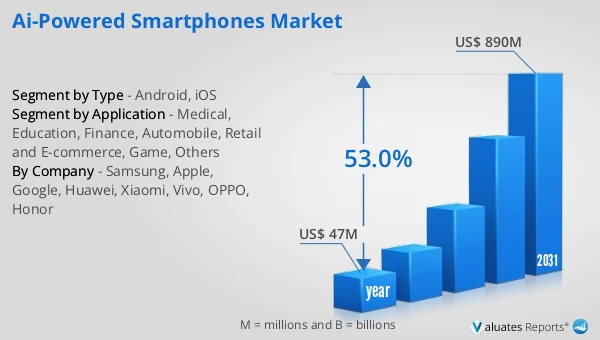
The global AI-powered Smartphones market is projected to grow from US$ 47 million in 2024 to US$ 890 million by 2031, at a CAGR of 53.0% (2025-2031), driven by critical product segments and diverse end‑use applications.

AI-powered Smartphones Market

AI-powered Smartphones Market

AI smartphones, also known as AI-powered smartphones, are mobile devices that utilize artificial intelligence (AI) technology to enhance various features and functions. These smartphones integrate AI algorithms and capabilities into different aspects of the device, enabling advanced functionalities and improved user experiences.
From a downstream perspective, Medical accounted for % of 2024 revenue, surging to US$ million by 2031 (CAGR: % from 2025–2031).
AI-powered Smartphones leading manufacturers including Samsung, Apple, Google, Huawei, Xiaomi, Vivo, OPPO, Honor, etc., dominate supply; the top five capture approximately % of global revenue, with Samsung leading 2024 sales at US$ million.
Regional Outlook:
North America rose from US$ million in 2024 to a forecast US$ million by 2031 (CAGR %).
Asia‑Pacific will expand from US$ million to US$ million (CAGR  %), led by China (US$ million in 2024, % share rising to % by 2031), Japan (CAGR %), South Korea (CAGR %), and Southeast Asia (CAGR %).
Europe is set to grow from US$ million to US$ million (CAGR %), with Germany projected to hit US$ million by 2031 (CAGR %).

Report Includes:

This definitive report equips CEOs, marketing directors, and investors with a 360° view of the global AI-powered Smartphones market across value chain. It analyzes historical revenue data (2020–2024) and delivers forecasts through 2031, illuminating demand trends and growth drivers.
By segmenting the market by Type and by Application, the study quantifies market size, growth rates, niche opportunities, and substitution risks, and analyzes downstream customers distribution pattern.
Granular regional insights cover five major markets—North America, Europe, APAC, South America, and MEA—with in‑depth analysis of 20+ countries, detailing dominant products, competitive landscape, and downstream demand trends.
Critical competitive intelligence profiles players—revenue, margins, pricing strategies, and major customers—and dissects the top-player positioning across product lines, applications, and regions to reveal strategic strengths.
A concise Industry‑chain overview maps upstream, middlestream, and downstream distribution dynamics to identify strategic gaps and unmet demand.
Market Segmentation

Scope of AI-powered Smartphones Market Report

Report Metric Details
Report Name AI-powered Smartphones Market
Accounted market size in 2024 US$ 47 million
Forecasted market size in 2031 US$ 890 million
CAGR 53.0%
Base Year 2024
Forecasted years 2025 - 2031
Segment by Type
  • Android
  • iOS
Segment by Application
  • Medical
  • Education
  • Finance
  • Automobile
  • Retail and E-commerce
  • Game
  • Others
Sales by Region
  • North America (United States, Canada)
  • Europe (Germany, France, UK, Italy, Russia) Rest of Europe
  • Nordic Countries
  • Asia-Pacific (China, Japan, South Korea)
  • Southeast Asia (India, Australia)
  • Rest of Asia
  • Latin America (Mexico, Brazil)
  • Rest of Latin America
  • Middle East & Africa (Turkey, Saudi Arabia, UAE, Rest of MEA)
By Company Samsung, Apple, Google, Huawei, Xiaomi, Vivo, OPPO, Honor
Forecast units USD million in value
Report coverage Revenue and volume forecast, company share, competitive landscape, growth factors and trends

Chapter Outline

  • Chapter 1: Defines the AI-powered Smartphones study scope, segments the market by Type and by Application, etc, highlights segment size and growth potential.
  • Chapter 2: Offers current market state, projects global revenue and sales to 2031, pinpointing high consumption regions and emerging market catalysts
  • Chapter 3: Dissects the player landscape—ranks by revenue and profitability, details Player performance by product type and evaluates concentration alongside M&A moves.
  • Chapter 4: Unlocks high margin product segments—compares revenue, ASP, and technology differentiators, highlighting growth niches and substitution risks
  • Chapter 5: Targets downstream market opportunities—evaluates market size by Application, identifies emerging use cases, and profiles leading customers by region and by Application.
  • Chapter 6: North America—breaks down market size by Type, by Application and country, profiles key players and assesses growth drivers and barriers.
  • Chapter 7: Europe—analyses regional market by Type, by Application and players, flagging drivers and barriers.
  • Chapter 8: Asia Pacific—quantifies market size by Type, by Application, and region/country, profiles top players, and uncovers high potential expansion areas.
  • Chapter 9: Central & South America—measures market size by Type, by Application, and country, profiles top players, and identifies investment opportunities and challenges.
  • Chapter 10: Middle East and Africa—evaluates market size by Type, by Application, and country, profiles key players, and outlines investment prospects and market hurdles
  • Chapter 11: Profiles players in depth—details product specs, revenue, margins; Top-tier players 2024 sales breakdowns by Product type, by Application, by region SWOT analysis, and recent strategic developments.
  • Chapter 12: Industry chain—analyses upstream, cost drivers, plus downstream channels.
  • Chapter 13: Market dynamics—explores drivers, restraints, regulatory impacts, and risk mitigation strategies.
  • Chapter 14: Actionable conclusions and strategic recommendations.
  • Why This Report:
  • Beyond standard market data, this analysis provides a clear profitability roadmap—empowering you to:
  • Allocate capital strategically to high growth regions (Chapters 6–10) and margin rich segments (Chapter 5).
  • Negotiate from strength with suppliers (Chapter 12) and customers (Chapter 5) using cost and demand intelligence.
  • Outmaneuver competitors with granular insights into their operations, margins, and strategies (Chapters 3 and 11).
  • Capitalize on the projected billion‑dollar opportunity with data‑driven regional and segment tactics (Chapter 12-14).
  • Leverage this 360° intelligence to turn market complexity into actionable competitive advantage.

FAQ for this report

How fast is AI-powered Smartphones Market growing?

Ans: The AI-powered Smartphones Market witnessing a CAGR of 53.0% during the forecast period 2025-2031.

What is the AI-powered Smartphones Market size in 2031?

Ans: The AI-powered Smartphones Market size in 2031 will be US$ 890 million.

Who are the main players in the AI-powered Smartphones Market report?

Ans: The main players in the AI-powered Smartphones Market are Samsung, Apple, Google, Huawei, Xiaomi, Vivo, OPPO, Honor

What are the Application segmentation covered in the AI-powered Smartphones Market report?

Ans: The Applications covered in the AI-powered Smartphones Market report are Medical, Education, Finance, Automobile, Retail and E-commerce, Game, Others

What are the Type segmentation covered in the AI-powered Smartphones Market report?

Ans: The Types covered in the AI-powered Smartphones Market report are Android, iOS

1 Study Coverage
1.1 Introduction to AI-powered Smartphones: Definition, Properties, and Key Attributes
1.2 Market Segmentation by Type
1.2.1 Global AI-powered Smartphones Market Size by Type, 2020 VS 2024 VS 2031
1.2.2 Android
1.2.3 iOS
1.3 Market Segmentation by Application
1.3.1 Global AI-powered Smartphones Market Size by Application, 2020 VS 2024 VS 2031
1.3.2 Medical
1.3.3 Education
1.3.4 Finance
1.3.5 Automobile
1.3.6 Retail and E-commerce
1.3.7 Game
1.3.8 Others
1.4 Assumptions and Limitations
1.5 Study Objectives
1.6 Years Considered
2 Executive Summary
2.1 Global AI-powered Smartphones Revenue Estimates and Forecasts 2020-2031
2.2 Global AI-powered Smartphones Revenue by Region
2.2.1 Revenue Comparison: 2020 VS 2024 VS 2031
2.2.2 Historical and Forecasted Revenue by Region (2020-2031)
2.2.3 Global Revenue Market Share by Region (2020-2031)
2.2.4 Emerging Market Focus: Growth Drivers & Investment Trends
3 Competition by Players
3.1 Global AI-powered Smartphones Player Revenue Rankings and Profitability
3.1.1 Global Revenue (Value) by Players (2020-2025)
3.1.2 Global Key Player Revenue Ranking (2023 vs. 2024)
3.1.3 Revenue-Based Tier Segmentation (Tier 1, Tier 2, and Tier 3)
3.1.4 Gross Margin by Top Player (2020 VS 2024)
3.2 Global AI-powered Smartphones Companies Headquarters and Service Footprint
3.3 Main Product Type Market Size by Players
3.3.1 Android Market Size by Players
3.3.2 iOS Market Size by Players
3.4 Global AI-powered Smartphones Market Concentration and Dynamics
3.4.1 Global Market Concentration (CR5 and HHI)
3.4.2 Entrant/Exit Impact Analysis
3.4.3 Strategic Moves: M&A, Expansion, R&D Investment
4 Global Product Segmentation Analysis
4.1 Global AI-powered Smartphones Revenue Trends by Type
4.1.1 Global Historical and Forecasted Revenue by Type (2020-2031)
4.1.2 Global Revenue Market Share by Type (2020-2031)
4.2 Key Product Attributes and Differentiation
4.3 Subtype Dynamics: Growth Leaders, Profitability and Risk
4.3.1 High-Growth Niches and Adoption Drivers
4.3.2 Profitability Hotspots and Cost Drivers
4.3.3 Substitution Threats
5 Global Downstream Application Analysis
5.1 Global AI-powered Smartphones Revenue by Application
5.1.1 Global Historical and Forecasted Revenue by Application (2020-2031)
5.1.2 Revenue Market Share by Application (2020-2031)
5.1.3 High-Growth Application Identification
5.1.4 Emerging Application Case Studies
5.2 Downstream Customer Analysis
5.2.1 Top Customers by Region
5.2.2 Top Customers by Application
6 North America
6.1 North America Market Size (2020-2031)
6.2 North America Key Players Revenue in 2024
6.3 North America AI-powered Smartphones Market Size by Type (2020-2031)
6.4 North America AI-powered Smartphones Market Size by Application (2020-2031)
6.5 North America Growth Accelerators and Market Barriers
6.6 North America AI-powered Smartphones Market Size by Country
6.6.1 North America Revenue Trends by Country
6.6.2 US
6.6.3 Canada
6.6.4 Mexico
7 Europe
7.1 Europe Market Size (2020-2031)
7.2 Europe Key Players Revenue in 2024
7.3 Europe AI-powered Smartphones Market Size by Type (2020-2031)
7.4 Europe AI-powered Smartphones Market Size by Application (2020-2031)
7.5 Europe Growth Accelerators and Market Barriers
7.6 Europe AI-powered Smartphones Market Size by Country
7.6.1 Europe Revenue Trends by Country
7.6.2 Germany
7.6.3 France
7.6.4 U.K.
7.6.5 Italy
7.6.6 Russia
8 Asia-Pacific
8.1 Asia-Pacific Market Size (2020-2031)
8.2 Asia-Pacific Key Players Revenue in 2024
8.3 Asia-Pacific AI-powered Smartphones Market Size by Type (2020-2031)
8.4 Asia-Pacific AI-powered Smartphones Market Size by Application (2020-2031)
8.5 Asia-Pacific Growth Accelerators and Market Barriers
8.6 Asia-Pacific AI-powered Smartphones Market Size by Region
8.6.1 Asia-Pacific Revenue Trends by Region
8.7 China
8.8 Japan
8.9 South Korea
8.10 Australia
8.11 India
8.12 Southeast Asia
8.12.1 Indonesia
8.12.2 Vietnam
8.12.3 Malaysia
8.12.4 Philippines
8.12.5 Singapore
9 Central and South America
9.1 Central and South America Market Size (2020-2031)
9.2 Central and South America Key Players Revenue in 2024
9.3 Central and South America AI-powered Smartphones Market Size by Type (2020-2031)
9.4 Central and South America AI-powered Smartphones Market Size by Application (2020-2031)
9.5 Central and South America Investment Opportunities and Key Challenges
9.6 Central and South America AI-powered Smartphones Market Size by Country
9.6.1 Central and South America Revenue Trends by Country (2020 VS 2024 VS 2031)
9.6.2 Brazil
9.6.3 Argentina
10 Middle East and Africa
10.1 Middle East and Africa Market Size (2020-2031)
10.2 Middle East and Africa Key Players Revenue in 2024
10.3 Middle East and Africa AI-powered Smartphones Market Size by Type (2020-2031)
10.4 Middle East and Africa AI-powered Smartphones Market Size by Application (2020-2031)
10.5 Middle East and Africa Investment Opportunities and Key Challenges
10.6 Middle East and Africa AI-powered Smartphones Market Size by Country
10.6.1 Middle East and Africa Revenue Trends by Country (2020 VS 2024 VS 2031)
10.6.2 GCC Countries
10.6.3 Israel
10.6.4 Egypt
10.6.5 South Africa
11 Corporate Profile
11.1 Samsung
11.1.1 Samsung Corporation Information
11.1.2 Samsung Business Overview
11.1.3 Samsung AI-powered Smartphones Product Features and Attributes
11.1.4 Samsung AI-powered Smartphones Revenue and Gross Margin (2020-2025)
11.1.5 Samsung AI-powered Smartphones Revenue by Product in 2024
11.1.6 Samsung AI-powered Smartphones Revenue by Application in 2024
11.1.7 Samsung AI-powered Smartphones Revenue by Geographic Area in 2024
11.1.8 Samsung AI-powered Smartphones SWOT Analysis
11.1.9 Samsung Recent Developments
11.2 Apple
11.2.1 Apple Corporation Information
11.2.2 Apple Business Overview
11.2.3 Apple AI-powered Smartphones Product Features and Attributes
11.2.4 Apple AI-powered Smartphones Revenue and Gross Margin (2020-2025)
11.2.5 Apple AI-powered Smartphones Revenue by Product in 2024
11.2.6 Apple AI-powered Smartphones Revenue by Application in 2024
11.2.7 Apple AI-powered Smartphones Revenue by Geographic Area in 2024
11.2.8 Apple AI-powered Smartphones SWOT Analysis
11.2.9 Apple Recent Developments
11.3 Google
11.3.1 Google Corporation Information
11.3.2 Google Business Overview
11.3.3 Google AI-powered Smartphones Product Features and Attributes
11.3.4 Google AI-powered Smartphones Revenue and Gross Margin (2020-2025)
11.3.5 Google AI-powered Smartphones Revenue by Product in 2024
11.3.6 Google AI-powered Smartphones Revenue by Application in 2024
11.3.7 Google AI-powered Smartphones Revenue by Geographic Area in 2024
11.3.8 Google AI-powered Smartphones SWOT Analysis
11.3.9 Google Recent Developments
11.4 Huawei
11.4.1 Huawei Corporation Information
11.4.2 Huawei Business Overview
11.4.3 Huawei AI-powered Smartphones Product Features and Attributes
11.4.4 Huawei AI-powered Smartphones Revenue and Gross Margin (2020-2025)
11.4.5 Huawei AI-powered Smartphones Revenue by Product in 2024
11.4.6 Huawei AI-powered Smartphones Revenue by Application in 2024
11.4.7 Huawei AI-powered Smartphones Revenue by Geographic Area in 2024
11.4.8 Huawei AI-powered Smartphones SWOT Analysis
11.4.9 Huawei Recent Developments
11.5 Xiaomi
11.5.1 Xiaomi Corporation Information
11.5.2 Xiaomi Business Overview
11.5.3 Xiaomi AI-powered Smartphones Product Features and Attributes
11.5.4 Xiaomi AI-powered Smartphones Revenue and Gross Margin (2020-2025)
11.5.5 Xiaomi AI-powered Smartphones Revenue by Product in 2024
11.5.6 Xiaomi AI-powered Smartphones Revenue by Application in 2024
11.5.7 Xiaomi AI-powered Smartphones Revenue by Geographic Area in 2024
11.5.8 Xiaomi AI-powered Smartphones SWOT Analysis
11.5.9 Xiaomi Recent Developments
11.6 Vivo
11.6.1 Vivo Corporation Information
11.6.2 Vivo Business Overview
11.6.3 Vivo AI-powered Smartphones Product Features and Attributes
11.6.4 Vivo AI-powered Smartphones Revenue and Gross Margin (2020-2025)
11.6.5 Vivo Recent Developments
11.7 OPPO
11.7.1 OPPO Corporation Information
11.7.2 OPPO Business Overview
11.7.3 OPPO AI-powered Smartphones Product Features and Attributes
11.7.4 OPPO AI-powered Smartphones Revenue and Gross Margin (2020-2025)
11.7.5 OPPO Recent Developments
11.8 Honor
11.8.1 Honor Corporation Information
11.8.2 Honor Business Overview
11.8.3 Honor AI-powered Smartphones Product Features and Attributes
11.8.4 Honor AI-powered Smartphones Revenue and Gross Margin (2020-2025)
11.8.5 Honor Recent Developments
12 AI-powered SmartphonesIndustry Chain Analysis
12.1 AI-powered Smartphones Industry Chain
12.2 Upstream Analysis
12.2.1 Upstream Key Suppliers
12.3 Middlestream Analysis
12.4 Downstream Sales Model and Distribution Networks
12.4.1 Sales Channels
12.4.2 Distributors
13 AI-powered Smartphones Market Dynamics
13.1 Industry Trends and Evolution
13.2 Market Growth Drivers and Emerging Opportunities
13.3 Market Challenges, Risks, and Restraints
14 Key Findings in the Global AI-powered Smartphones Study
15 Appendix
15.1 Research Methodology
15.1.1 Methodology/Research Approach
15.1.1.1 Research Programs/Design
15.1.1.2 Market Size Estimation
15.1.1.3 Market Breakdown and Data Triangulation
15.1.2 Data Source
15.1.2.1 Secondary Sources
15.1.2.2 Primary Sources
15.2 Author Details
List of Tables
 Table 1. Global AI-powered Smartphones Market Size Growth Rate by Type, 2020 VS 2024 VS 2031 (US$ Million)
 Table 2. Global AI-powered Smartphones Market Size Growth Rate by Application, 2020 VS 2024 VS 2031 (US$ Million)
 Table 3. Global AI-powered Smartphones Revenue Grow Rate (CAGR) by Region: 2020 VS 2024 VS 2031 (US$ Million)
 Table 4. Global AI-powered Smartphones Revenue by Region (2020-2025) & (US$ Million)
 Table 5. Global AI-powered Smartphones Revenue by Region (2026-2031) & (US$ Million)
 Table 6. Emerging Market Revenue Grow Rate (CAGR) by Country (2020 VS 2024 VS 2031) (US$ Million)
 Table 7. Global AI-powered Smartphones Revenue by Players (2020-2025) & (US$ Million)
 Table 8. Global AI-powered Smartphones Revenue Market Share by Players (2020-2025)
 Table 9. Global Key Players’Ranking Shift (2023 vs. 2024) (Based on Revenue)
 Table 10. Global AI-powered Smartphones by Player Tier (Tier 1, Tier 2, and Tier 3) & (based on the Revenue in AI-powered Smartphones as of 2024)
 Table 11. Global AI-powered Smartphones Average Gross Margin (%) by Player (2020 VS 2024)
 Table 12. Global AI-powered Smartphones Companies Headquarters
 Table 13. Global AI-powered Smartphones Market Concentration Ratio (CR5 and HHI)
 Table 14. Key Market Entrant/Exit (2020-2024) – Drivers & Impact Analysis
 Table 15. Key Mergers & Acquisitions, Expansion Plans, R&D Investment
 Table 16. Global AI-powered Smartphones Revenue by Type (2020-2025) & (US$ Million)
 Table 17. Global AI-powered Smartphones Revenue by Type (2026-2031) & (US$ Million)
 Table 18. Key Product Attributes and Differentiation
 Table 19. Global AI-powered Smartphones Revenue by Application (2020-2025) & (US$ Million)
 Table 20. Global AI-powered Smartphones Revenue by Application (2026-2031) & (US$ Million)
 Table 21. AI-powered Smartphones High-Growth Sectors Demand CAGR (2024-2031)
 Table 22. Top Customers by Region
 Table 23. Top Customers by Application
 Table 24. North America AI-powered Smartphones Growth Accelerators and Market Barriers
 Table 25. North America AI-powered Smartphones Revenue Grow Rate (CAGR) by Country (2020 VS 2024 VS 2031) (US$ Million)
 Table 26. Europe AI-powered Smartphones Growth Accelerators and Market Barriers
 Table 27. Europe AI-powered Smartphones Revenue Grow Rate (CAGR) by Country: 2020 VS 2024 VS 2031 (US$ Million)
 Table 28. Asia-Pacific AI-powered Smartphones Growth Accelerators and Market Barriers
 Table 29. Asia-Pacific AI-powered Smartphones Revenue Grow Rate (CAGR) by Region: 2020 VS 2024 VS 2031 (US$ Million)
 Table 30. Central and South America AI-powered Smartphones Investment Opportunities and Key Challenges
 Table 31. Central and South America AI-powered Smartphones Revenue Grow Rate (CAGR) by Country (2020 VS 2024 VS 2031) (US$ Million)
 Table 32. Middle East and Africa AI-powered Smartphones Investment Opportunities and Key Challenges
 Table 33. Middle East and Africa AI-powered Smartphones Revenue Grow Rate (CAGR) by Country (2020 VS 2024 VS 2031) (US$ Million)
 Table 34. Samsung Corporation Information
 Table 35. Samsung Description and Major Businesses
 Table 36. Samsung Product Features and Attributes
 Table 37. Samsung Revenue (US$ Million) and Gross Margin (2020-2025)
 Table 38. Samsung Revenue Proportion by Product in 2024
 Table 39. Samsung Revenue Proportion by Application in 2024
 Table 40. Samsung Revenue Proportion by Geographic Area in 2024
 Table 41. Samsung AI-powered Smartphones SWOT Analysis
 Table 42. Samsung Recent Developments
 Table 43. Apple Corporation Information
 Table 44. Apple Description and Major Businesses
 Table 45. Apple Product Features and Attributes
 Table 46. Apple Revenue (US$ Million) and Gross Margin (2020-2025)
 Table 47. Apple Revenue Proportion by Product in 2024
 Table 48. Apple Revenue Proportion by Application in 2024
 Table 49. Apple Revenue Proportion by Geographic Area in 2024
 Table 50. Apple AI-powered Smartphones SWOT Analysis
 Table 51. Apple Recent Developments
 Table 52. Google Corporation Information
 Table 53. Google Description and Major Businesses
 Table 54. Google Product Features and Attributes
 Table 55. Google Revenue (US$ Million) and Gross Margin (2020-2025)
 Table 56. Google Revenue Proportion by Product in 2024
 Table 57. Google Revenue Proportion by Application in 2024
 Table 58. Google Revenue Proportion by Geographic Area in 2024
 Table 59. Google AI-powered Smartphones SWOT Analysis
 Table 60. Google Recent Developments
 Table 61. Huawei Corporation Information
 Table 62. Huawei Description and Major Businesses
 Table 63. Huawei Product Features and Attributes
 Table 64. Huawei Revenue (US$ Million) and Gross Margin (2020-2025)
 Table 65. Huawei Revenue Proportion by Product in 2024
 Table 66. Huawei Revenue Proportion by Application in 2024
 Table 67. Huawei Revenue Proportion by Geographic Area in 2024
 Table 68. Huawei AI-powered Smartphones SWOT Analysis
 Table 69. Huawei Recent Developments
 Table 70. Xiaomi Corporation Information
 Table 71. Xiaomi Description and Major Businesses
 Table 72. Xiaomi Product Features and Attributes
 Table 73. Xiaomi Revenue (US$ Million) and Gross Margin (2020-2025)
 Table 74. Xiaomi Revenue Proportion by Product in 2024
 Table 75. Xiaomi Revenue Proportion by Application in 2024
 Table 76. Xiaomi Revenue Proportion by Geographic Area in 2024
 Table 77. Xiaomi AI-powered Smartphones SWOT Analysis
 Table 78. Xiaomi Recent Developments
 Table 79. Vivo Corporation Information
 Table 80. Vivo Description and Major Businesses
 Table 81. Vivo Product Features and Attributes
 Table 82. Vivo Revenue (US$ Million) and Gross Margin (2020-2025)
 Table 83. Vivo Recent Developments
 Table 84. OPPO Corporation Information
 Table 85. OPPO Description and Major Businesses
 Table 86. OPPO Product Features and Attributes
 Table 87. OPPO Revenue (US$ Million) and Gross Margin (2020-2025)
 Table 88. OPPO Recent Developments
 Table 89. Honor Corporation Information
 Table 90. Honor Description and Major Businesses
 Table 91. Honor Product Features and Attributes
 Table 92. Honor Revenue (US$ Million) and Gross Margin (2020-2025)
 Table 93. Honor Recent Developments
 Table 94. Raw Materials Key Suppliers
 Table 95. Distributors List
 Table 96. Market Trends and Market Evolution
 Table 97. Market Drivers and Opportunities
 Table 98. Market Challenges, Risks, and Restraints
 Table 99. Research Programs/Design for This Report
 Table 100. Key Data Information from Secondary Sources
 Table 101. Key Data Information from Primary Sources


List of Figures
 Figure 1. AI-powered Smartphones Product Picture
 Figure 2. Global AI-powered Smartphones Market Size Growth Rate by Type, 2020 VS 2024 VS 2031 (US$ Million)
 Figure 3. Android Product Picture
 Figure 4. iOS Product Picture
 Figure 5. Global AI-powered Smartphones Market Size Growth Rate by Application, 2020 VS 2024 VS 2031 (US$ Million)
 Figure 6. Medical
 Figure 7. Education
 Figure 8. Finance
 Figure 9. Automobile
 Figure 10. Retail and E-commerce
 Figure 11. Game
 Figure 12. Others
 Figure 13. AI-powered Smartphones Report Years Considered
 Figure 14. Global AI-powered Smartphones Revenue, (US$ Million), 2020 VS 2024 VS 2031
 Figure 15. Global AI-powered Smartphones Revenue (2020-2031) & (US$ Million)
 Figure 16. Global AI-powered Smartphones Revenue (CAGR) by Region: 2020 VS 2024 VS 2031 (US$ Million)
 Figure 17. Global AI-powered Smartphones Revenue Market Share by Region (2020-2031)
 Figure 18. Global AI-powered Smartphones Revenue Market Share Ranking (2024)
 Figure 19. Tier Distribution by Revenue Contribution (2020 VS 2024)
 Figure 20. Android Revenue Market Share by Player in 2024
 Figure 21. iOS Revenue Market Share by Player in 2024
 Figure 22. Global AI-powered Smartphones Revenue Market Share by Type (2020-2031)
 Figure 23. Global AI-powered Smartphones Revenue Market Share by Application (2020-2031)
 Figure 24. North America AI-powered Smartphones Revenue YoY (2020-2031) & (US$ Million)
 Figure 25. North America Top 5 Players AI-powered Smartphones Revenue (US$ Million) in 2024
 Figure 26. North America AI-powered Smartphones Revenue (US$ Million) by Type (2020 - 2031)
 Figure 27. North America AI-powered Smartphones Revenue (US$ Million) by Application (2020-2031)
 Figure 28. US AI-powered Smartphones Revenue (2020-2031) & (US$ Million)
 Figure 29. Canada AI-powered Smartphones Revenue (2020-2031) & (US$ Million)
 Figure 30. Mexico AI-powered Smartphones Revenue (2020-2031) & (US$ Million)
 Figure 31. Europe AI-powered Smartphones Revenue YoY (2020-2031) & (US$ Million)
 Figure 32. Europe Top 5 Players AI-powered Smartphones Revenue (US$ Million) in 2024
 Figure 33. Europe AI-powered Smartphones Revenue (US$ Million) by Type (2020-2031)
 Figure 34. Europe AI-powered Smartphones Revenue (US$ Million) by Application (2020-2031)
 Figure 35. Germany AI-powered Smartphones Revenue (2020-2031) & (US$ Million)
 Figure 36. France AI-powered Smartphones Revenue (2020-2031) & (US$ Million)
 Figure 37. U.K. AI-powered Smartphones Revenue (2020-2031) & (US$ Million)
 Figure 38. Italy AI-powered Smartphones Revenue (2020-2031) & (US$ Million)
 Figure 39. Russia AI-powered Smartphones Revenue (2020-2031) & (US$ Million)
 Figure 40. Asia-Pacific AI-powered Smartphones Revenue YoY (2020-2031) & (US$ Million)
 Figure 41. Asia-Pacific Top 8 Players AI-powered Smartphones Revenue (US$ Million) in 2024
 Figure 42. Asia-Pacific AI-powered Smartphones Revenue (US$ Million) by Type (2020-2031)
 Figure 43. Asia-Pacific AI-powered Smartphones Revenue (US$ Million) by Application (2020-2031)
 Figure 44. Indonesia AI-powered Smartphones Revenue (2020-2031) & (US$ Million)
 Figure 45. Japan AI-powered Smartphones Revenue (2020-2031) & (US$ Million)
 Figure 46. South Korea AI-powered Smartphones Revenue (2020-2031) & (US$ Million)
 Figure 47. Australia AI-powered Smartphones Revenue (2020-2031) & (US$ Million)
 Figure 48. India AI-powered Smartphones Revenue (2020-2031) & (US$ Million)
 Figure 49. Indonesia AI-powered Smartphones Revenue (2020-2031) & (US$ Million)
 Figure 50. Vietnam AI-powered Smartphones Revenue (2020-2031) & (US$ Million)
 Figure 51. Malaysia AI-powered Smartphones Revenue (2020-2031) & (US$ Million)
 Figure 52. Philippines AI-powered Smartphones Revenue (2020-2031) & (US$ Million)
 Figure 53. Singapore AI-powered Smartphones Revenue (2020-2031) & (US$ Million)
 Figure 54. Central and South America AI-powered Smartphones Revenue YoY (2020-2031) & (US$ Million)
 Figure 55. Central and South America Top 5 Players AI-powered Smartphones Revenue (US$ Million) in 2024
 Figure 56. Central and South America AI-powered Smartphones Revenue (US$ Million) by Type (2020-2031)
 Figure 57. Central and South America AI-powered Smartphones Revenue (US$ Million) by Application (2020-2031)
 Figure 58. Brazil AI-powered Smartphones Revenue (2020-2025) & (US$ Million)
 Figure 59. Argentina AI-powered Smartphones Revenue (2020-2025) & (US$ Million)
 Figure 60. Middle East and Africa AI-powered Smartphones Revenue YoY (2020-2031) & (US$ Million)
 Figure 61. Middle East and Africa Top 5 Players AI-powered Smartphones Revenue (US$ Million) in 2024
 Figure 62. South America AI-powered Smartphones Revenue (US$ Million) by Type (2020-2031)
 Figure 63. Middle East and Africa AI-powered Smartphones Revenue (US$ Million) by Application (2020-2031)
 Figure 64. GCC Countries AI-powered Smartphones Revenue (2020-2025) & (US$ Million)
 Figure 65. Israel AI-powered Smartphones Revenue (2020-2025) & (US$ Million)
 Figure 66. Egypt AI-powered Smartphones Revenue (2020-2025) & (US$ Million)
 Figure 67. South Africa AI-powered Smartphones Revenue (2020-2025) & (US$ Million)
 Figure 68. AI-powered Smartphones Industry Chain Mapping
 Figure 69. Channels of Distribution (Direct Vs Distribution)
 Figure 70. Bottom-up and Top-down Approaches for This Report
 Figure 71. Data Triangulation
 Figure 72. Key Executives Interviewed
SELECT A FORMAT
Added to Cart
Electronic (PDF)

$4900

This license allows only one user to access the PDF.
Electronic (PDF)

$7350

This license allows 1 - 5 user to access the PDF, license is suitable for small groups of 5 users working together
Electronic (PDF)

$9800

This license allows users/teams in a same Enterprise to use this report, various departments within an enterpise can use this report
Add to Cart
Buy Now (15% Discount)

OUR CUSTOMER

SecuX Technology Inc