FEATURED COMPANIES
Vatti
DE & E
LG
Smart Range Hood Market Size
The global Smart Range Hood market was valued at US$ 2946 million in 2025 and is anticipated to reach US$ 4998 million by 2032, at a CAGR of 7.9% from 2026 to 2032.
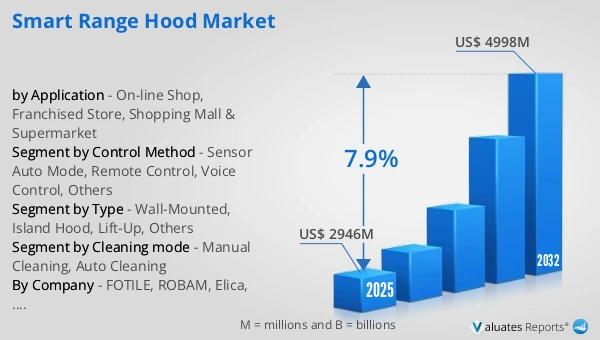
Smart Range Hood Market
The 2025 U.S. tariff policies introduce profound uncertainty into the global economic landscape. This report critically examines the implications of recent tariff adjustments and international strategic countermeasures on Smart Range Hood competitive dynamics, regional economic interdependencies, and supply chain reconfigurations.
In 2025, global Smart Range Hood production reached approximately 3.48 M units, with an average global market price of around US$ 845.2 per unit.
Smart Range Hood is a kitchen exhaust system that integrates sensors, networking, and algorithm control capabilities on the basis of traditional range hoods. It can automatically adjust airflow and air pressure based on signals such as smoke, PM, temperature, humidity, and volatile organic compounds. It also supports mobile app, voice, and touch control linkage (such as with cooktops, gas valves, kitchen lighting, air purifiers/fresh air systems) to achieve functions such as automatic on/off, delayed exhaust, filter life reminders, fault self-diagnosis, and remote maintenance, thereby improving exhaust efficiency, ease of use, and safety.
The focus has shifted from simply "connecting to the internet" to "understanding the cooking process better," emphasizing automatic cruise boost, powerful exhaust during stir-frying, delayed shut-off, and integration with cooktop heat, cookware temperature, and gas safety to reduce manual operation and improve user consistency. This is achieved through more efficient motors and optimized air ducts to reduce noise and improve energy efficiency; enhanced self-cleaning (high-temperature steam/hot melt oil/automatic flushing, etc.), no-disassembly cleaning, and filter consumable management, coupled with digital after-sales support (remote diagnostics, maintenance reminders).
Multiple solutions are available for different kitchen layouts (open-plan, island, small apartments, low-rise poor ventilation, shared exhaust ducts), including side-suction, top-suction, lift-up, and integrated solutions, differentiated around features like "backflow prevention, oil stain resistance, and odor prevention." A unified app/ecosystem is established with refrigerators, dishwashers, and steam ovens, extending towards a more complete smart kitchen solution.
This report delivers a comprehensive overview of the global Smart Range Hood market, with both quantitative and qualitative analyses, to help readers develop growth strategies, assess the competitive landscape, evaluate their position in the current market, and make informed business decisions regarding Smart Range Hood. The Smart Range Hood market size, estimates, and forecasts are provided in terms of sales volume (K Units) and revenue (US$ millions), with 2025 as the base year and historical and forecast data for 2021–2032.
The report segments the global Smart Range Hood market comprehensively. Regional market sizes by Type, by Application, by Cleaning mode, and by company are also provided. For deeper insight, the report profiles the competitive landscape, key competitors, and their respective market rankings, and discusses technological trends and new product developments.
This report will assist Smart Range Hood manufacturers, new entrants, and companies across the industry value chain with information on revenues, sales volume, and average prices for the overall market and its sub-segments, by company, by Type, by Application, and by region.
Market Segmentation
Scope of Smart Range Hood Market Report
| Report Metric |
Details |
| Report Name |
Smart Range Hood Market |
| Accounted market size in 2025 |
US$ 2946 million |
| Forecasted market size in 2032 |
US$ 4998 million |
| CAGR |
7.9% |
| Base Year |
2025 |
| Forecasted years |
2026 - 2032 |
| Segment by Type |
- Wall-Mounted
- Island Hood
- Lift-Up
- Others
|
| Segment by Cleaning mode |
- Manual Cleaning
- Auto Cleaning
|
| Segment by Control Method |
- Sensor Auto Mode
- Remote Control
- Voice Control
- Others
|
| by Application |
- On-line Shop
- Franchised Store
- Shopping Mall & Supermarket
|
| Consumption by Region |
- North America (United States, Canada)
- Europe (Germany, France, UK, Italy, Russia)
- Asia-Pacific (China, Japan, South Korea, Taiwan)
- Southeast Asia (India)
- Latin America (Mexico, Brazil)
|
| By Company |
FOTILE, ROBAM, Elica, BSH Home Appliances Group, Broan-NuTone, Midea Group, Miele, Electrolux, AEG, Faber, Whirlpool, Panasonic, Samsung, VATTI, LG |
| Forecast units |
USD million in value |
| Report coverage |
Revenue and volume forecast, company share, competitive landscape, growth factors and trends |
Chapter Outline
- Chapter 1: Defines the scope of the report and presents an executive summary of market segments (by Type, by Application, by Cleaning mode, etc.), including the size of each segment and its future growth potential. It offers a high-level view of the current market and its likely evolution in the short, medium, and long term.
- Chapter 2: Provides a detailed analysis of the competitive landscape for Smart Range Hood manufacturers, covering pricing, sales and revenue shares, latest development plans, and mergers and acquisitions.
- Chapter 3: Examines Smart Range Hood sales and revenue at the regional and country levels. It quantifies market size and growth potential for each region and its key countries, and outlines market development, outlook, addressable space, and national market size.
- Chapter 4: Analyzes segments by Type, detailing the size and growth potential of each segment to help readers identify “blue ocean” opportunities.
- Chapter 5: Analyzes market segments by Application, covering the size and growth potential of each segment to help readers identify “blue ocean” opportunities in downstream markets.
- Chapter 6: Profiles key players, presenting core information on leading companies, including product sales, revenue, pricing, gross margin, product portfolio/introductions, and recent developments.
- Chapter 7: Reviews the industry value chain, including upstream and downstream segments.
- Chapter 8: Discusses market dynamics and recent developments, including drivers, restraints, challenges and risks for manufacturers, U.S. Tariffs and relevant policy analysis.
- Chapter 9: Summarizes the key findings and conclusions of the report.
FAQ for this report
How fast is Smart Range Hood Market growing?
Ans: The Smart Range Hood Market witnessing a CAGR of 7.9% during the forecast period 2026-2032.
What is the Smart Range Hood Market size in 2032?
Ans: The Smart Range Hood Market size in 2032 will be US$ 4998 million.
Who are the main players in the Smart Range Hood Market report?
Ans: The main players in the Smart Range Hood Market are FOTILE, ROBAM, Elica, BSH Home Appliances Group, Broan-NuTone, Midea Group, Miele, Electrolux, AEG, Faber, Whirlpool, Panasonic, Samsung, VATTI, LG
What are the Application segmentation covered in the Smart Range Hood Market report?
Ans: The Applications covered in the Smart Range Hood Market report are On-line Shop, Franchised Store, Shopping Mall & Supermarket
What are the Type segmentation covered in the Smart Range Hood Market report?
Ans: The Types covered in the Smart Range Hood Market report are Wall-Mounted, Island Hood, Lift-Up, Others