0
U.S. (TOLL FREE)
+1 (315) 215-3225
Automative

0
U.S. (TOLL FREE)
+1 (315) 215-3225
Global siRNA Drugs Market Size, Status and Forecast 2026-2032
Published Date: 2026-04-16
|
Report Code: QYRE-Auto-24S12503
Home | Market Reports
Global siRNA Drugs Market Size Status and Forecast 2022 2028
BUY CHAPTERS

Global siRNA Drugs Market Size, Status and Forecast 2026-2032

Code: QYRE-Auto-24S12503
Report
2026-04-16
Pages:102
QYResearch
Buy Now with 15% Discount
DESCRIPTION
TABLE OF CONTENT
TABLES & FIGURES

siRNA Drugs Market Size

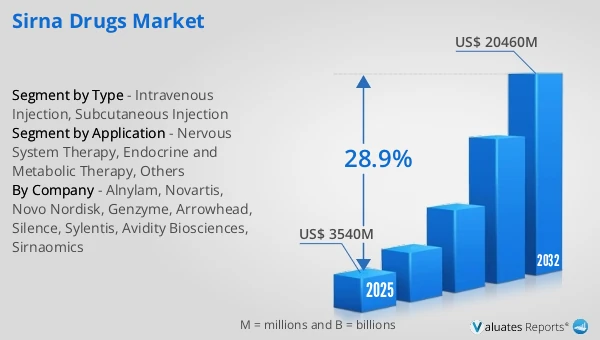
The global siRNA Drugs market was valued at US$ 3540 million in 2025 and is anticipated to reach US$ 20460 million by 2032, at a CAGR of 28.9% from 2026 to 2032.

siRNA Drugs Market

siRNA Drugs Market

Small interfering RNA (siRNA), sometimes known as short interfering RNA or silencing RNA, is a class of double-stranded RNA at first non-coding RNA molecules, typically 20–24 (normally 21) base pairs in length, similar to miRNA, and operating within the RNA interference (RNAi) pathway. siRNA plays a crucial role in gene silencing and regulation of gene expression. siRNA-based therapeutics have gained significant attention in recent years due to their potential to target specific genes involved in diseases such as cancer, genetic disorders, viral infections, and neurodegenerative diseases. The scope of siRNA drug products encompasses various aspects, including their design, development, testing, and regulatory approval.
Core manufacturers of siRNA Drugs include Alnylam, Novartis, Novo Nordisk, Genzyme and Arrowhead. USA is the largest consumption region, accounting for approximately 57% of the global market, followed by Europe. In terms of product type, subcutaneous injection are the largest market segment, with a share of more than 77%. In terms of product application, the largest application market is nervous system therapy, with a share of approximately 52%.
In-depth analysis of siRNA drug market driving factors
I. Technological breakthroughs: the leap from laboratory to clinic
Delivery system innovation
Lipid nanoparticle (LNP) technology optimization: Early siRNA drugs were limited to the field of rare diseases due to low delivery efficiency and insufficient targeting. In recent years, through technological breakthroughs such as ionized lipid component improvement and PEG modification, LNP can achieve liver-targeted delivery (such as Alnylam's Onpattro) or cross the blood-brain barrier (such as Denali's RVT-1201), significantly broadening the scope of indications.
Popularization of GalNAc coupling technology: This technology achieves efficient liver-targeted delivery by binding to asialoglycoprotein receptors, reducing the frequency of administration (such as Novartis' Leqvio subcutaneous injection once every six months), and promoting siRNA to penetrate into chronic diseases such as cardiovascular and metabolic diseases.
Mature chemical modification technology
Improved stability: Through 2'-O-methyl modification, thiophosphate backbone and other technologies, the half-life of siRNA is extended to several weeks, reducing the risk of immunogenicity.
Reduced off-target effects: AI-assisted sequence design (such as Sirnaomics' AI algorithm) combined with bioinformatics screening improves siRNA specificity and significantly improves clinical safety.
2. Market demand: The outbreak of unmet clinical needs
Indications expand from rare diseases to common diseases
Breakthrough in chronic diseases: Among the approximately 1 billion cardiovascular disease patients worldwide, the market potential for hypercholesterolemia is huge.
New paradigm for tumor treatment: siRNA combined with PD-1 inhibitors (such as Arrowhead's ARO-HIF2) shows synergistic effects in the treatment of renal cancer, pushing tumor immunotherapy into the era of gene regulation.
The rise of personalized medicine: siRNA therapy based on genotyping (such as Alzheimer's disease drugs for patients with APOE4 mutations) meets the needs of precision treatment and increases patients' willingness to pay.
3. Policy support: Improvement of the global regulatory framework
China's policy dividends
"The 14th Five-Year Plan for the Development of the Pharmaceutical Industry": Clearly support the development of new delivery systems and nucleic acid drugs, and provide tax incentives and research and development subsidies.
Priority review channel: CDE implements fast approval for innovative siRNA drugs, such as Sirnaomics' STP705 (treatment of squamous cell skin cancer) included in the breakthrough therapy.
International regulatory coordination
FDA accelerated approval: Onpattro (2018) was approved as the first siRNA drug, turning on the regulatory green light.
EMA adaptive path: Allows conditional approval based on alternative endpoints (such as biomarker changes) to shorten the R&D cycle.
IV. Capital influx: catalytic effect of industrial ecology
Increased investment and financing activity
Global capital layout: 33 financings in the field of small nucleic acid drugs in 2022, with an amount of nearly US$6 billion (such as Sirnaomics IPO raising US$150 million).
MNC giants enter the market: Roche acquires Dicerna for US$2.8 billion, and Novartis and Alnylam reach a US$3.5 billion cooperation to accelerate pipeline development.
CDMO service ecosystem matures
RiboBio, WuXi AppTec: Provide "one-stop" services from sequence design to cGMP production, reducing R&D costs by more than 50%.
Breakthrough in large-scale production: Through continuous flow synthesis technology, the annual production capacity of siRNA has been increased from grams to kilograms, and the cost per dose has been reduced to less than $100.
V. Competitive landscape: From technical barriers to ecological barriers
Strengthening of patent layout
Core patents for delivery systems: Alnylam owns key technology patent clusters such as LNP and GalNAc, forming a technological monopoly.
Chemical modification patent network: Ionis' 2'-MOE modification and Sirnaomics' GalNAc-siRNA coupling technology build a patent moat.
Cross-border cooperation is accelerating
Pharmaceutical company-biotechnology company alliance: For example, AstraZeneca and Silence Therapeutics cooperate to develop cardiovascular siRNA drugs, sharing R&D risks and benefits.
Collaborative innovation between industry, academia and research: Harvard University and Moderna cooperate to develop RNA editing technology to promote the transformation of basic research to clinical practice.
VI. Challenges and coping strategies
Breakthrough in technical bottlenecks
Improved tissue penetration: Through cell penetrating peptide (CPP) modification or exosome delivery, the problem of siRNA delivery in organs such as the lungs and brain is solved.
Long-term safety assessment: Establish real-time quantitative PCR to monitor off-target effects, and optimize sequence design in combination with single-cell sequencing technology.
Balance between cost and accessibility
Tiered pricing strategy: Adopt the "patent pool" model (such as MPP) in low-income countries to improve drug accessibility.
In the future, siRNA drugs are expected to become the third largest drug type after small molecules and antibodies, reshaping the biopharmaceutical industry landscape. Companies need to focus on core technology breakthroughs, differentiated indication layout and global cooperation to seize market opportunities.
This report focuses on the global siRNA Drugs status, future forecast, growth opportunity, key market, and key players. The study objectives are to present the siRNA Drugs development in different regions.
It segments the global siRNA Drugs market comprehensively. Regional market sizes by Type, by Application, , and by player are also provided. For deeper insight, the report profiles the competitive landscape, key competitors, and their respective market rankings, and discusses technological trends and new product developments.
This report will assist siRNA Drugs manufacturers, new entrants, and companies across the industry value chain with information on revenues, sales volume, and average prices for the overall market and its sub-segments, by company, by Type, by Application, and by region.
Market Segmentation

Scope of siRNA Drugs Market Report

Report Metric Details
Report Name siRNA Drugs Market
Accounted market size in 2025 US$ 3540 million
Forecasted market size in 2032 US$ 20460 million
CAGR 28.9%
Base Year 2025
Forecasted years 2026 - 2032
Segment by Type
  • Intravenous Injection
  • Subcutaneous Injection
Segment by Application
  • Nervous System Therapy
  • Endocrine and Metabolic Therapy
  • Others
By Region
  • North America (United States, Canada)
  • Europe (Germany, France, UK, Italy, Russia) Rest of Europe
  • Nordic Countries
  • Asia-Pacific (China, Japan, South Korea)
  • Southeast Asia (India, Australia)
  • Rest of Asia
  • Latin America (Mexico, Brazil)
  • Rest of Latin America
  • Middle East & Africa (Turkey, Saudi Arabia, UAE, Rest of MEA)
By Company Alnylam, Novartis, Novo Nordisk, Genzyme, Arrowhead, Silence, Sylentis, Avidity Biosciences, Sirnaomics
Forecast units USD million in value
Report coverage Revenue and volume forecast, company share, competitive landscape, growth factors and trends

FAQ for this report

How fast is siRNA Drugs Market growing?

Ans: The siRNA Drugs Market witnessing a CAGR of 28.9% during the forecast period 2026-2032.

What is the siRNA Drugs Market size in 2032?

Ans: The siRNA Drugs Market size in 2032 will be US$ 20460 million.

What is the siRNA Drugs Market share by type?

Ans: In terms of product type, subcutaneous injection are the largest market segment, with a share of more than 77%.

What is the siRNA Drugs Market share by application?

Ans: In terms of product application, the largest application market is nervous system therapy, with a share of approximately 52%.

Who are the main players in the siRNA Drugs Market report?

Ans: The main players in the siRNA Drugs Market are Alnylam, Novartis, Novo Nordisk, Genzyme, Arrowhead, Silence, Sylentis, Avidity Biosciences, Sirnaomics

What are the Application segmentation covered in the siRNA Drugs Market report?

Ans: The Applications covered in the siRNA Drugs Market report are Nervous System Therapy, Endocrine and Metabolic Therapy, Others

What are the Type segmentation covered in the siRNA Drugs Market report?

Ans: The Types covered in the siRNA Drugs Market report are Intravenous Injection, Subcutaneous Injection

1 Report Overview
1.1 Study Scope
1.2 Market Analysis by Type
1.2.1 Global siRNA Drugs Market Size Growth Rate by Type (2026-2032)
1.2.2 Intravenous Injection
1.2.3 Subcutaneous Injection
1.3 Market by Application
1.3.1 Global siRNA Drugs Market Share by Application (2026-2032)
1.3.2 Nervous System Therapy
1.3.3 Endocrine and Metabolic Therapy
1.3.4 Others
1.4 Study Objectives
1.5 Years Considered
2 Executive Summary
2.1 Global siRNA Drugs Market Size
2.2 siRNA Drugs Market Size by Region
2.2.1 siRNA Drugs Growth Rate by Region (2026-2032)
2.2.2 siRNA Drugs Market Share by Region (2026-2032)
2.3 Industry Trends
2.3.1 Market Top Trends
2.3.2 Market Use Cases
3 Key Players
3.1 siRNA Drugs Revenue by Players (2026 & 2032)
3.2 siRNA Drugs Key Players Headquarters and Area Served
3.3 Key Players siRNA Drugs Product/Solution/Service
3.4 Date of Enter into siRNA Drugs Market
3.5 Mergers & Acquisitions, Expansion Plans
4 Breakdown by Type and Application
4.1 Global siRNA Drugs Market Size by Type (2026-2032)
4.2 Global siRNA Drugs Market Size by Application (2026-2032)
5 North America
5.1 North America siRNA Drugs Market Forecast (2026-2032)
5.2 siRNA Drugs Key Players in North America
5.3 North America siRNA Drugs Market Size by Type
5.4 North America siRNA Drugs Market Size by Application
6 Europe
6.1 Europe siRNA Drugs Market Forecast (2026-2032)
6.2 siRNA Drugs Key Players in Europe
6.3 Europe siRNA Drugs Market Size by Type
6.4 Europe siRNA Drugs Market Size by Application
7 Asia-Pacific
7.1 Asia-Pacific siRNA Drugs Market Forecast (2026-2032)
7.2 siRNA Drugs Key Players in Asia-Pacific
7.3 Asia-Pacific siRNA Drugs Market Size by Type
7.4 Asia-Pacific siRNA Drugs Market Size by Application
8 Rest of World
8.1 Latin America
8.1.1 Latin America siRNA Drugs Market Analysis
8.1.2 Key Players in Latin America
8.2 Middle East & Africa
8.2.1 Middle East & Africa siRNA Drugs Market Analysis
8.2.2 Key Players in Middle East & Africa
9 International Players Profiles
9.1 Alnylam
9.1.1 Alnylam Company Details
9.1.2 Alnylam Description and Business Overview
9.1.3 Alnylam siRNA Drugs Introduction
9.1.4 Alnylam Revenue in siRNA Drugs Business (2026 & 2032)
9.1.5 Alnylam Recent Development
9.2 Novartis
9.2.1 Novartis Company Details
9.2.2 Novartis Description and Business Overview
9.2.3 Novartis siRNA Drugs Introduction
9.2.4 Novartis Revenue in siRNA Drugs Business (2026 & 2032)
9.2.5 Novartis Recent Development
9.3 Novo Nordisk
9.3.1 Novo Nordisk Company Details
9.3.2 Novo Nordisk Description and Business Overview
9.3.3 Novo Nordisk siRNA Drugs Introduction
9.3.4 Novo Nordisk Revenue in siRNA Drugs Business (2026 & 2032)
9.3.5 Novo Nordisk Recent Development
9.4 Genzyme
9.4.1 Genzyme Company Details
9.4.2 Genzyme Description and Business Overview
9.4.3 Genzyme siRNA Drugs Introduction
9.4.4 Genzyme Revenue in siRNA Drugs Business (2026 & 2032)
9.4.5 Genzyme Recent Development
9.5 Arrowhead
9.5.1 Arrowhead Company Details
9.5.2 Arrowhead Description and Business Overview
9.5.3 Arrowhead siRNA Drugs Introduction
9.5.4 Arrowhead Revenue in siRNA Drugs Business (2026 & 2032)
9.5.5 Arrowhead Recent Development
9.6 Silence
9.6.1 Silence Company Details
9.6.2 Silence Description and Business Overview
9.6.3 Silence siRNA Drugs Introduction
9.6.4 Silence Revenue in siRNA Drugs Business (2026 & 2032)
9.6.5 Silence Recent Development
9.7 Sylentis
9.7.1 Sylentis Company Details
9.7.2 Sylentis Description and Business Overview
9.7.3 Sylentis siRNA Drugs Introduction
9.7.4 Sylentis Revenue in siRNA Drugs Business (2026 & 2032)
9.7.5 Sylentis Recent Development
9.8 Avidity Biosciences
9.8.1 Avidity Biosciences Company Details
9.8.2 Avidity Biosciences Description and Business Overview
9.8.3 Avidity Biosciences siRNA Drugs Introduction
9.8.4 Avidity Biosciences Revenue in siRNA Drugs Business (2026 & 2032)
9.8.5 Avidity Biosciences Recent Development
9.9 Sirnaomics
9.9.1 Sirnaomics Company Details
9.9.2 Sirnaomics Description and Business Overview
9.9.3 Sirnaomics siRNA Drugs Introduction
9.9.4 Sirnaomics Revenue in siRNA Drugs Business (2026 & 2032)
9.9.5 Sirnaomics Recent Development
10 siRNA Drugs Market Dynamics
10.1 siRNA Drugs Industry Trends
10.2 siRNA Drugs Market Drivers
10.3 siRNA Drugs Market Challenges
10.4 siRNA Drugs Market Restraints
11 Key Findings in This Report
12 Appendix
12.1 Research Methodology
12.1.1 Methodology/Research Approach
12.1.1.1 Research Programs/Design
12.1.1.2 Market Size Estimation
12.1.1.3 Market Breakdown and Data Triangulation
12.1.2 Data Source
12.1.2.1 Secondary Sources
12.1.2.2 Primary Sources
12.2 Disclaimer
12.3 Author Details
List of Tables
 Table 1. Global siRNA Drugs Market Size Growth Rate by Type (2026-2032) & (US$ Million)
 Table 2. Key Players of Intravenous Injection
 Table 3. Key Players of Subcutaneous Injection
 Table 4. Global siRNA Drugs Market Size Growth by Application (2026-2032) & (US$ Million)
 Table 5. Global siRNA Drugs Market Size by Region (2026-2032) & (US$ Million)
 Table 6. Global siRNA Drugs Market Size by Region (2026-2032) & (US$ Million)
 Table 7. Global siRNA Drugs Market Share by Region (2026-2032)
 Table 8. Market Top Trends
 Table 9. Market Use Cases
 Table 10. Global siRNA Drugs Revenue by Players (2026 & 2032) & (US$ Million)
 Table 11. Global siRNA Drugs Market Share by Players (2026 & 2032)
 Table 12. Key Players Headquarters and Area Served
 Table 13. Key Players siRNA Drugs Product/Solution/Service
 Table 14. Date of Enter into siRNA Drugs Market
 Table 15. Mergers & Acquisitions, Expansion Plans
 Table 16. Global siRNA Drugs Market Size by Type (2026-2032) & (US$ Million)
 Table 17. Global siRNA Drugs Market Size Share by Type (2026-2032)
 Table 18. Global siRNA Drugs Market Size by Application (2026-2032) & (US$ Million)
 Table 19. Global siRNA Drugs Market Size Share by Application (2026-2032)
 Table 20. North America Key Players siRNA Drugs Revenue (2026 & 2032) & (US$ Million)
 Table 21. North America Key Players siRNA Drugs Market Share (2026 & 2032)
 Table 22. North America siRNA Drugs Market Size by Type (2026-2032) & (US$ Million)
 Table 23. North America siRNA Drugs Market Share by Type (2026-2032)
 Table 24. North America siRNA Drugs Market Size by Application (2026-2032) & (US$ Million)
 Table 25. North America siRNA Drugs Market Share by Application (2026-2032)
 Table 26. Europe Key Players siRNA Drugs Revenue (2026 & 2032) & (US$ Million)
 Table 27. Europe Key Players siRNA Drugs Market Share (2026 & 2032)
 Table 28. Europe siRNA Drugs Market Size by Type (2026-2032) & (US$ Million)
 Table 29. Europe siRNA Drugs Market Share by Type (2026-2032)
 Table 30. Europe siRNA Drugs Market Size by Application (2026-2032) & (US$ Million)
 Table 31. Europe siRNA Drugs Market Share by Application (2026-2032)
 Table 32. Asia-Pacific Key Players siRNA Drugs Revenue (2026 & 2032) & (US$ Million)
 Table 33. Asia-Pacific Key Players siRNA Drugs Market Share (2026 & 2032)
 Table 34. Asia-Pacific siRNA Drugs Market Size by Type (2026-2032) & (US$ Million)
 Table 35. Asia-Pacific siRNA Drugs Market Share by Type (2026-2032)
 Table 36. Asia-Pacific siRNA Drugs Market Size by Application (2026-2032) & (US$ Million)
 Table 37. Asia-Pacific siRNA Drugs Market Share by Application (2026-2032)
 Table 38. Key Players in Latin America
 Table 39. Key Players in Middle East & Africa
 Table 40. Alnylam Company Details
 Table 41. Alnylam Description and Business Overview
 Table 42. Alnylam siRNA Drugs Product
 Table 43. Alnylam Revenue in siRNA Drugs Business: 2026 & 2032
 Table 44. Alnylam Recent Development
 Table 45. Novartis Company Details
 Table 46. Novartis Description and Business Overview
 Table 47. Novartis siRNA Drugs Product
 Table 48. Novartis Revenue in siRNA Drugs Business: 2026 & 2032
 Table 49. Novartis Recent Development
 Table 50. Novo Nordisk Company Details
 Table 51. Novo Nordisk Description and Business Overview
 Table 52. Novo Nordisk siRNA Drugs Product
 Table 53. Novo Nordisk Revenue in siRNA Drugs Business: 2026 & 2032
 Table 54. Novo Nordisk Recent Development
 Table 55. Genzyme Company Details
 Table 56. Genzyme Description and Business Overview
 Table 57. Genzyme siRNA Drugs Product
 Table 58. Genzyme Revenue in siRNA Drugs Business: 2026 & 2032
 Table 59. Genzyme Recent Development
 Table 60. Arrowhead Company Details
 Table 61. Arrowhead Description and Business Overview
 Table 62. Arrowhead siRNA Drugs Product
 Table 63. Arrowhead Revenue in siRNA Drugs Business: 2026 & 2032
 Table 64. Arrowhead Recent Development
 Table 65. Silence Company Details
 Table 66. Silence Description and Business Overview
 Table 67. Silence siRNA Drugs Product
 Table 68. Silence Revenue in siRNA Drugs Business: 2026 & 2032
 Table 69. Silence Recent Development
 Table 70. Sylentis Company Details
 Table 71. Sylentis Description and Business Overview
 Table 72. Sylentis siRNA Drugs Product
 Table 73. Sylentis Revenue in siRNA Drugs Business: 2026 & 2032
 Table 74. Sylentis Recent Development
 Table 75. Avidity Biosciences Company Details
 Table 76. Avidity Biosciences Description and Business Overview
 Table 77. Avidity Biosciences siRNA Drugs Product
 Table 78. Avidity Biosciences Revenue in siRNA Drugs Business: 2026 & 2032
 Table 79. Avidity Biosciences Recent Development
 Table 80. Sirnaomics Company Details
 Table 81. Sirnaomics Description and Business Overview
 Table 82. Sirnaomics siRNA Drugs Product
 Table 83. Sirnaomics Revenue in siRNA Drugs Business: 2026 & 2032
 Table 84. Sirnaomics Recent Development
 Table 85. siRNA Drugs Market Trends
 Table 86. siRNA Drugs Market Drivers
 Table 87. siRNA Drugs Market Challenges
 Table 88. siRNA Drugs Market Restraints
 Table 89. Research Programs/Design for This Report
 Table 90. Key Data Information from Secondary Sources
 Table 91. Key Data Information from Primary Sources


List of Figures
 Figure 1. Global siRNA Drugs Market Share by Type in 2026 & 2032
 Figure 2. Intravenous Injection Features
 Figure 3. Subcutaneous Injection Features
 Figure 4. Global siRNA Drugs Market Share by Application in 2026 & 2032
 Figure 5. Nervous System Therapy Case Studies
 Figure 6. Endocrine and Metabolic Therapy Case Studies
 Figure 7. Others Case Studies
 Figure 8. siRNA Drugs Report Years Considered
 Figure 9. Global siRNA Drugs Market Size and Growth Rate 2026-2032 (US$ Million)
 Figure 10. Global siRNA Drugs Market Share by Region (2026-2032)
 Figure 11. Global siRNA Drugs Market Size Market Share by Type (2026-2032)
 Figure 12. North America siRNA Drugs Market Size 2026-2032 (US$ Million)
 Figure 13. Europe siRNA Drugs Market Size 2026-2032 (US$ Million)
 Figure 14. Asia-Pacific siRNA Drugs Market Size 2026-2032 (US$ Million)
 Figure 15. siRNA Drugs Market Size in Latin America (2026-2032) & (US$ Million)
 Figure 16. siRNA Drugs Market Size in Middle East & Africa (2026-2032) & (US$ Million)
 Figure 17. Bottom-up and Top-down Approaches for This Report
 Figure 18. Data Triangulation
 Figure 19. Key Executives Interviewed

SELECT A FORMAT
Added to Cart
Electronic

$2900

Single User License
Electronic

$4350

Multi User License
Electronic

$5800

Enterprise License
Add to Cart
Buy Now (15% Discount)

OUR CUSTOMER

SecuX Technology Inc