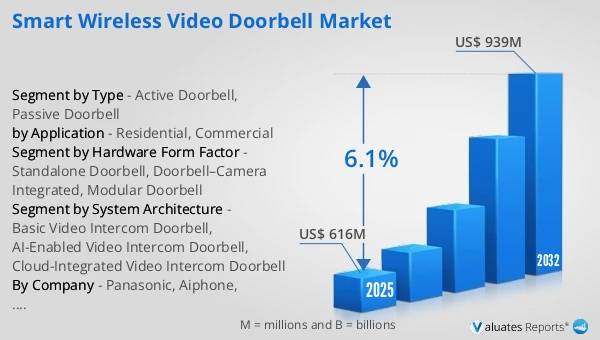
The global Smart Wireless Video Doorbell market was valued at US$ 616 million in 2025 and is anticipated to reach US$ 939 million by 2032, at a CAGR of 6.1% from 2026 to 2032.
Smart Wireless Video Doorbell Market
The 2025 U.S. tariff policies introduce profound uncertainty into the global economic landscape. This report critically examines the implications of recent tariff adjustments and international strategic countermeasures on Smart Wireless Video Doorbell competitive dynamics, regional economic interdependencies, and supply chain reconfigurations.
A smart wireless video doorbell is a wirelessly connected (most commonly Wi-Fi, sometimes with Bluetooth provisioning and optional cellular backhaul) front-door video communication and security endpoint that enables occupants to visually verify visitors, conduct two-way audio conversations, receive real-time event alerts, and retain recordings even when they are away or unable to answer the door. It addresses the key limitations of traditional doorbells—no visual confirmation, unreliable audio, no remote response, and limited evidence capture—while also enabling automation with smart locks, indoor chimes, home hubs, and broader security systems. Historically, the category evolved from wired building intercoms and door stations toward a consumer-friendly, self-installed device model as home Wi-Fi, smartphones, and cloud services became ubiquitous; continuous improvements in low-power imaging, wireless connectivity, battery management, and edge computing then pushed the product beyond basic “talk and record” into smarter event detection, richer notifications, and more seamless device orchestration. Upstream inputs typically include enclosure and protection materials (engineering plastics or metal housings, tempered glass/acrylic covers, gaskets, waterproof adhesives, coatings and UV-resistant materials), and key electronic/optical components (CMOS image sensors, lens assemblies, IR LEDs and drivers, microphones and speakers, audio codecs/amplifiers, SoC/MCU processors, memory, Wi-Fi/Bluetooth RF parts and antennas, power management and charging ICs, battery protection and gauging, passives and connectors), plus supporting accessories (buttons/triggers, indoor chimes/repeaters, mounting brackets and fasteners). These components are usually sourced from established consumer electronics, security camera, and IoT connectivity supply chains, after which OEMs focus on RF tuning, power optimization, weatherproof reliability, and integrated firmware–app–cloud validation for mass production.In 2025, the global production capacity of smart wireless video doorbells reached 12 million units, with sales totaling 9.875 million units. The average selling price was USD 62.4 per unit, and industry gross margins generally ranged between 30% and 40%.
The market today is characterized by a dual pull toward retail-friendly, self-installed devices and system-level integration into broader home security and smart-home stacks. In the consumer channel, purchasing decisions hinge on day-to-day experience—notification reliability, false-alert control, night/low-light performance, call latency, battery behavior, and app stability—while distribution is shaped by e-commerce, big-box retail, and, in some regions, ISP or broadband bundles. At the same time, many offerings are positioned as the “front-door node” inside a wider ecosystem, working in tandem with smart locks, indoor chimes, hubs, cameras, and alarms to deliver a coherent entryway workflow. As the hardware supply chain becomes increasingly modular and standardized, differentiation is shifting away from core components and toward software quality, detection logic, cloud/service reliability, privacy safeguards, and after-sales execution.
The next phase will move from “wireless video + alerts” to “edge intelligence + low-power trusted interaction,” alongside deeper ecosystem and service maturity. Technologically, more decision-making will happen on-device to reduce cloud dependence, improve responsiveness, and maintain acceptable performance under weak network conditions—while false-alert governance becomes a key battleground through multi-signal fusion (video, audio, and optional sensing) and more context-aware filtering. Product roadmaps will continue to revolve around battery experience and connectivity robustness, driven by more efficient power management, smarter wake/sleep strategies, and better coordination with indoor repeaters or edge hubs that stabilize links in challenging environments. In parallel, management capabilities will expand for multi-occupant households, rentals, and shared properties, enabling finer-grained permissions, temporary access workflows, and clearer event traceability. On the commercial side, cloud storage and premium AI packs will remain important, but vendors will need to articulate clearer value and cost control to address subscription sensitivity.
Demand tailwinds come from the rising frequency of doorstep events and stronger security expectations: deliveries, ad-hoc visitors, remote caregiving for elderly family members, and single-person households all reinforce the need for remote verification and auditable records. The growing penetration of smart locks and whole-home automation further elevates the doorbell into a natural trigger point for coordinated actions and consistent ecosystem experiences. Constraints remain substantial, including variable wireless conditions that create latency and reliability swings, stringent outdoor durability and tamper resistance requirements that challenge quality consistency, fragmented platforms that limit cross-brand interoperability, and escalating privacy/cybersecurity compliance burdens that increase both engineering and operational complexity. Combined with intense price competition and hardware commoditization, vendors must continuously balance cost, on-device compute, cloud spend, and service commitments—pushing the market toward defensible advantages built on stability, privacy/security posture, and long-term support.
This report delivers a comprehensive overview of the global Smart Wireless Video Doorbell market, with both quantitative and qualitative analyses, to help readers develop growth strategies, assess the competitive landscape, evaluate their position in the current market, and make informed business decisions regarding Smart Wireless Video Doorbell. The Smart Wireless Video Doorbell market size, estimates, and forecasts are provided in terms of sales volume (K Units) and revenue (US$ millions), with 2025 as the base year and historical and forecast data for 2021–2032.
The report segments the global Smart Wireless Video Doorbell market comprehensively. Regional market sizes by Type, by Application, by Hardware Form Factor, and by company are also provided. For deeper insight, the report profiles the competitive landscape, key competitors, and their respective market rankings, and discusses technological trends and new product developments.
This report will assist Smart Wireless Video Doorbell manufacturers, new entrants, and companies across the industry value chain with information on revenues, sales volume, and average prices for the overall market and its sub-segments, by company, by Type, by Application, and by region.
Market Segmentation
Scope of Smart Wireless Video Doorbell Market Report
| Report Metric |
Details |
| Report Name |
Smart Wireless Video Doorbell Market |
| Accounted market size in 2025 |
US$ 616 million |
| Forecasted market size in 2032 |
US$ 939 million |
| CAGR |
6.1% |
| Base Year |
2025 |
| Forecasted years |
2026 - 2032 |
| Segment by Type |
- Active Doorbell
- Passive Doorbell
|
| Segment by Hardware Form Factor |
- Standalone Doorbell
- Doorbell–Camera Integrated
- Modular Doorbell
|
| Segment by System Architecture |
- Basic Video Intercom Doorbell
- AI-Enabled Video Intercom Doorbell
- Cloud-Integrated Video Intercom Doorbell
|
| by Application |
|
| Consumption by Region |
- North America (United States, Canada)
- Europe (Germany, France, UK, Italy, Russia)
- Asia-Pacific (China, Japan, South Korea, Taiwan)
- Southeast Asia (India)
- Latin America (Mexico, Brazil)
|
| By Company |
Panasonic, Aiphone, Ring, Legrand, Commax, TCS AG, ABB, Skybell, TP-LINK, DNAKE, FERMAX, Xiaomi, Hikvision, Ezviz, Anker Innovations, Guangdong Roule Electronics, Guangdong Farbell, Xiamen Leelen Technology, Guangdong Anjubao Digital Technology |
| Forecast units |
USD million in value |
| Report coverage |
Revenue and volume forecast, company share, competitive landscape, growth factors and trends |
Chapter Outline
- Chapter 1: Defines the scope of the report and presents an executive summary of market segments (by Type, by Application, by Hardware Form Factor, etc.), including the size of each segment and its future growth potential. It offers a high-level view of the current market and its likely evolution in the short, medium, and long term.
- Chapter 2: Provides a detailed analysis of the competitive landscape for Smart Wireless Video Doorbell manufacturers, covering pricing, sales and revenue shares, latest development plans, and mergers and acquisitions.
- Chapter 3: Examines Smart Wireless Video Doorbell sales and revenue at the regional and country levels. It quantifies market size and growth potential for each region and its key countries, and outlines market development, outlook, addressable space, and national market size.
- Chapter 4: Analyzes segments by Type, detailing the size and growth potential of each segment to help readers identify “blue ocean” opportunities.
- Chapter 5: Analyzes market segments by Application, covering the size and growth potential of each segment to help readers identify “blue ocean” opportunities in downstream markets.
- Chapter 6: Profiles key players, presenting core information on leading companies, including product sales, revenue, pricing, gross margin, product portfolio/introductions, and recent developments.
- Chapter 7: Reviews the industry value chain, including upstream and downstream segments.
- Chapter 8: Discusses market dynamics and recent developments, including drivers, restraints, challenges and risks for manufacturers, U.S. Tariffs and relevant policy analysis.
- Chapter 9: Summarizes the key findings and conclusions of the report.
Ans: The main players in the Smart Wireless Video Doorbell Market are Panasonic, Aiphone, Ring, Legrand, Commax, TCS AG, ABB, Skybell, TP-LINK, DNAKE, FERMAX, Xiaomi, Hikvision, Ezviz, Anker Innovations, Guangdong Roule Electronics, Guangdong Farbell, Xiamen Leelen Technology, Guangdong Anjubao Digital Technology