0
U.S. (TOLL FREE)
+1 (315) 215-3225
Automative

0
U.S. (TOLL FREE)
+1 (315) 215-3225
Global Deep Learning for Cognitive Computing Market Research Report 2025
Published Date: May 2025
|
Report Code: QYRE-Auto-34Y12915
Home | Market Reports | Computers & Electronics| Software
Global Deep Learning for Cognitive Computing Market Research Report 2023
BUY CHAPTERS

Global Deep Learning for Cognitive Computing Market Research Report 2025

Code: QYRE-Auto-34Y12915
Report
May 2025
Pages:96
QYResearch
Buy Now with 15% Discount
DESCRIPTION
TABLE OF CONTENT
TABLES & FIGURES

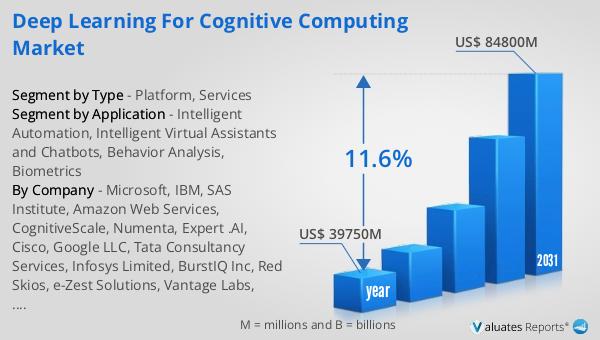
The global market for Deep Learning for Cognitive Computing was valued at US$ 39750 million in the year 2024 and is projected to reach a revised size of US$ 84800 million by 2031, growing at a CAGR of 11.6% during the forecast period.

Deep Learning for Cognitive Computing Market

Deep Learning for Cognitive Computing Market

Deep learning enables the system to be self-training to learn how to perform specific tasks. And AI itself is part of a larger area called cognitive computing. In ML, pruning means simplifying, compressing, and optimizing a decision tree by removing sections that are uncritical or redundant.
The global deep learning for cognitive computing market refers to the market for deep learning technologies and solutions that are specifically applied in cognitive computing systems. Cognitive computing involves the development of systems that can mimic human intelligence, understand and interpret natural language, recognize patterns, make decisions, and learn from data.
Deep learning is a subset of machine learning that utilizes artificial neural networks with multiple layers to process and analyze large amounts of data. It allows cognitive computing systems to understand complex patterns, extract meaningful insights, and make accurate predictions or decisions.
The market for deep learning in cognitive computing is driven by several factors, including:
Advancements in AI and Machine Learning: The rapid advancements in AI and machine learning technologies have enabled the development of more sophisticated deep learning algorithms. These algorithms can process vast amounts of structured and unstructured data, leading to significant advancements in cognitive computing capabilities.
Big Data and IoT: The proliferation of big data and the ever-increasing number of connected devices through the Internet of Things (IoT) generate vast amounts of data. Deep learning provides the tools to analyze and extract valuable insights from this data, enabling more effective cognitive computing applications.
Natural Language Processing (NLP): Deep learning techniques, such as recurrent neural networks (RNNs) and long short-term memory (LSTM), have revolutionized natural language processing. This has led to significant progress in the development of conversational AI systems, chatbots, and virtual assistants that can understand and respond to human language.
Healthcare and Life Sciences: The healthcare and life sciences sector has witnessed substantial growth in the adoption of deep learning for cognitive computing applications. Deep learning algorithms can analyze medical images, genomics data, patient records, and clinical trials data to improve disease diagnosis, drug discovery, personalized medicine, and patient care.
Financial Services: Deep learning has also found extensive use in the financial services industry. It enables advanced fraud detection, algorithmic trading, risk assessment, credit scoring, and customer behavior analysis, improving operational efficiency and reducing financial risks.
Automotive and Manufacturing: The automotive and manufacturing sectors utilize deep learning in cognitive computing applications for autonomous vehicles, predictive maintenance, quality control, supply chain optimization, and robotics, among others. Deep learning enables these industries to leverage AI technologies for more efficient and intelligent operations.
North America has been a significant contributor to the global deep learning for cognitive computing market, primarily driven by extensive research and development activities, the presence of leading technology companies, and early adoption of AI technologies. However, the market is witnessing growth in other regions as well, including Europe, Asia Pacific, and Latin America, as organizations across various industries realize the potential benefits of deep learning in cognitive computing.
The market is highly competitive, with major technology companies, startups, and research institutions actively engaged in developing and commercializing deep learning solutions for cognitive computing. The key players in the market offer a wide range of deep learning frameworks, platforms, and tools to support cognitive computing applications.
In summary, the global deep learning for cognitive computing market is experiencing significant growth, fueled by advancements in AI and machine learning, the proliferation of big data and IoT, and the increasing adoption of deep learning in various industries. As organizations seek to harness the power of cognitive computing to gain insights from data and improve decision-making processes, the market for deep learning in cognitive computing is expected to expand further in the coming years.The global deep learning for cognitive computing market refers to the market for deep learning technologies and solutions that are specifically applied in cognitive computing systems. Cognitive computing involves the development of systems that can mimic human intelligence, understand and interpret natural language, recognize patterns, make decisions, and learn from data.
Deep learning is a subset of machine learning that utilizes artificial neural networks with multiple layers to process and analyze large amounts of data. It allows cognitive computing systems to understand complex patterns, extract meaningful insights, and make accurate predictions or decisions.
The market for deep learning in cognitive computing is driven by several factors, including:
Advancements in AI and Machine Learning: The rapid advancements in AI and machine learning technologies have enabled the development of more sophisticated deep learning algorithms. These algorithms can process vast amounts of structured and unstructured data, leading to significant advancements in cognitive computing capabilities.
Big Data and IoT: The proliferation of big data and the ever-increasing number of connected devices through the Internet of Things (IoT) generate vast amounts of data. Deep learning provides the tools to analyze and extract valuable insights from this data, enabling more effective cognitive computing applications.
Natural Language Processing (NLP): Deep learning techniques, such as recurrent neural networks (RNNs) and long short-term memory (LSTM), have revolutionized natural language processing. This has led to significant progress in the development of conversational AI systems, chatbots, and virtual assistants that can understand and respond to human language.
Healthcare and Life Sciences: The healthcare and life sciences sector has witnessed substantial growth in the adoption of deep learning for cognitive computing applications. Deep learning algorithms can analyze medical images, genomics data, patient records, and clinical trials data to improve disease diagnosis, drug discovery, personalized medicine, and patient care.
Financial Services: Deep learning has also found extensive use in the financial services industry. It enables advanced fraud detection, algorithmic trading, risk assessment, credit scoring, and customer behavior analysis, improving operational efficiency and reducing financial risks.
Automotive and Manufacturing: The automotive and manufacturing sectors utilize deep learning in cognitive computing applications for autonomous vehicles, predictive maintenance, quality control, supply chain optimization, and robotics, among others. Deep learning enables these industries to leverage AI technologies for more efficient and intelligent operations.
North America has been a significant contributor to the global deep learning for cognitive computing market, primarily driven by extensive research and development activities, the presence of leading technology companies, and early adoption of AI technologies. However, the market is witnessing growth in other regions as well, including Europe, Asia Pacific, and Latin America, as organizations across various industries realize the potential benefits of deep learning in cognitive computing.
The market is highly competitive, with major technology companies, startups, and research institutions actively engaged in developing and commercializing deep learning solutions for cognitive computing. The key players in the market offer a wide range of deep learning frameworks, platforms, and tools to support cognitive computing applications.
In summary, the global deep learning for cognitive computing market is experiencing significant growth, fueled by advancements in AI and machine learning, the proliferation of big data and IoT, and the increasing adoption of deep learning in various industries. As organizations seek to harness the power of cognitive computing to gain insights from data and improve decision-making processes, the market for deep learning in cognitive computing is expected to expand further in the coming years.
This report aims to provide a comprehensive presentation of the global market for Deep Learning for Cognitive Computing, with both quantitative and qualitative analysis, to help readers develop business/growth strategies, assess the market competitive situation, analyze their position in the current marketplace, and make informed business decisions regarding Deep Learning for Cognitive Computing.
The Deep Learning for Cognitive Computing market size, estimations, and forecasts are provided in terms of and revenue ($ millions), considering 2024 as the base year, with history and forecast data for the period from 2020 to 2031. This report segments the global Deep Learning for Cognitive Computing market comprehensively. Regional market sizes, concerning products by Type, by Application, and by players, are also provided.
For a more in-depth understanding of the market, the report provides profiles of the competitive landscape, key competitors, and their respective market ranks. The report also discusses technological trends and new product developments.
The report will help the Deep Learning for Cognitive Computing companies, new entrants, and industry chain related companies in this market with information on the revenues for the overall market and the sub-segments across the different segments, by company, by Type, by Application, and by regions.
Market Segmentation

Scope of Deep Learning for Cognitive Computing Market Report

Report Metric Details
Report Name Deep Learning for Cognitive Computing Market
Accounted market size in year US$ 39750 million
Forecasted market size in 2031 US$ 84800 million
CAGR 11.6%
Base Year year
Forecasted years 2025 - 2031
Segment by Type
  • Platform
  • Services
Segment by Application
By Region
  • North America (United States, Canada)
  • Europe (Germany, France, UK, Italy, Russia) Rest of Europe
  • Nordic Countries
  • Asia-Pacific (China, Japan, South Korea)
  • Southeast Asia (India, Australia)
  • Rest of Asia
  • Latin America (Mexico, Brazil)
  • Rest of Latin America
  • Middle East & Africa (Turkey, Saudi Arabia, UAE, Rest of MEA)
By Company Microsoft, IBM, SAS Institute, Amazon Web Services, CognitiveScale, Numenta, Expert .AI, Cisco, Google LLC, Tata Consultancy Services, Infosys Limited, BurstIQ Inc, Red Skios, e-Zest Solutions, Vantage Labs, Cognitive Software Group, SparkCognition
Forecast units USD million in value
Report coverage Revenue and volume forecast, company share, competitive landscape, growth factors and trends

Chapter Outline

  • Chapter 1: Introduces the report scope of the report, executive summary of different market segments (by Type, by Application, etc), including the market size of each market segment, future development potential, and so on. It offers a high-level view of the current state of the market and its likely evolution in the short to mid-term, and long term.
  • Chapter 2: Introduces executive summary of global market size, regional market size, this section also introduces the market dynamics, latest developments of the market, the driving factors and restrictive factors of the market, the challenges and risks faced by companies in the industry, and the analysis of relevant policies in the industry.
  • Chapter 3: Detailed analysis of Deep Learning for Cognitive Computing company competitive landscape, revenue market share, latest development plan, merger, and acquisition information, etc.
  • Chapter 4: Provides the analysis of various market segments by Type, covering the market size and development potential of each market segment, to help readers find the blue ocean market in different market segments.
  • Chapter 5: Provides the analysis of various market segments by Application, covering the market size and development potential of each market segment, to help readers find the blue ocean market in different downstream markets.
  • Chapter 6, 7, 8, 9, 10: North America, Europe, Asia Pacific, Latin America, Middle East and Africa segment by country. It provides a quantitative analysis of the market size and development potential of each region and its main countries and introduces the market development, future development prospects, market space, and capacity of each country in the world.
  • Chapter 11: Provides profiles of key players, introducing the basic situation of the main companies in the market in detail, including product sales, revenue, price, gross margin, product introduction, recent development, etc.
  • Chapter 12: The main points and conclusions of the report.

FAQ for this report

How fast is Deep Learning for Cognitive Computing Market growing?

Ans: The Deep Learning for Cognitive Computing Market witnessing a CAGR of 11.6% during the forecast period 2025-2031.

What is the Deep Learning for Cognitive Computing Market size in 2031?

Ans: The Deep Learning for Cognitive Computing Market size in 2031 will be US$ 84800 million.

Who are the main players in the Deep Learning for Cognitive Computing Market report?

Ans: The main players in the Deep Learning for Cognitive Computing Market are Microsoft, IBM, SAS Institute, Amazon Web Services, CognitiveScale, Numenta, Expert .AI, Cisco, Google LLC, Tata Consultancy Services, Infosys Limited, BurstIQ Inc, Red Skios, e-Zest Solutions, Vantage Labs, Cognitive Software Group, SparkCognition

What are the Application segmentation covered in the Deep Learning for Cognitive Computing Market report?

Ans: The Applications covered in the Deep Learning for Cognitive Computing Market report are Intelligent Automation, Intelligent Virtual Assistants and Chatbots, Behavior Analysis, Biometrics

What are the Type segmentation covered in the Deep Learning for Cognitive Computing Market report?

Ans: The Types covered in the Deep Learning for Cognitive Computing Market report are Platform, Services

Recommended Reports

AI Cognitive Platforms

Deep Learning Applications

Edge and AI Hardware

1 Report Overview
1.1 Study Scope
1.2 Market Analysis by Type
1.2.1 Global Deep Learning for Cognitive Computing Market Size Growth Rate by Type: 2020 VS 2024 VS 2031
1.2.2 Platform
1.2.3 Services
1.3 Market by Application
1.3.1 Global Deep Learning for Cognitive Computing Market Growth by Application: 2020 VS 2024 VS 2031
1.3.2 Intelligent Automation
1.3.3 Intelligent Virtual Assistants and Chatbots
1.3.4 Behavior Analysis
1.3.5 Biometrics
1.4 Assumptions and Limitations
1.5 Study Objectives
1.6 Years Considered
2 Global Growth Trends
2.1 Global Deep Learning for Cognitive Computing Market Perspective (2020-2031)
2.2 Global Deep Learning for Cognitive Computing Growth Trends by Region
2.2.1 Global Deep Learning for Cognitive Computing Market Size by Region: 2020 VS 2024 VS 2031
2.2.2 Deep Learning for Cognitive Computing Historic Market Size by Region (2020-2025)
2.2.3 Deep Learning for Cognitive Computing Forecasted Market Size by Region (2026-2031)
2.3 Deep Learning for Cognitive Computing Market Dynamics
2.3.1 Deep Learning for Cognitive Computing Industry Trends
2.3.2 Deep Learning for Cognitive Computing Market Drivers
2.3.3 Deep Learning for Cognitive Computing Market Challenges
2.3.4 Deep Learning for Cognitive Computing Market Restraints
3 Competition Landscape by Key Players
3.1 Global Top Deep Learning for Cognitive Computing Players by Revenue
3.1.1 Global Top Deep Learning for Cognitive Computing Players by Revenue (2020-2025)
3.1.2 Global Deep Learning for Cognitive Computing Revenue Market Share by Players (2020-2025)
3.2 Global Deep Learning for Cognitive Computing Market Share by Company Type (Tier 1, Tier 2, and Tier 3)
3.3 Global Key Players Ranking by Deep Learning for Cognitive Computing Revenue
3.4 Global Deep Learning for Cognitive Computing Market Concentration Ratio
3.4.1 Global Deep Learning for Cognitive Computing Market Concentration Ratio (CR5 and HHI)
3.4.2 Global Top 10 and Top 5 Companies by Deep Learning for Cognitive Computing Revenue in 2024
3.5 Global Key Players of Deep Learning for Cognitive Computing Head office and Area Served
3.6 Global Key Players of Deep Learning for Cognitive Computing, Product and Application
3.7 Global Key Players of Deep Learning for Cognitive Computing, Date of Enter into This Industry
3.8 Mergers & Acquisitions, Expansion Plans
4 Deep Learning for Cognitive Computing Breakdown Data by Type
4.1 Global Deep Learning for Cognitive Computing Historic Market Size by Type (2020-2025)
4.2 Global Deep Learning for Cognitive Computing Forecasted Market Size by Type (2026-2031)
5 Deep Learning for Cognitive Computing Breakdown Data by Application
5.1 Global Deep Learning for Cognitive Computing Historic Market Size by Application (2020-2025)
5.2 Global Deep Learning for Cognitive Computing Forecasted Market Size by Application (2026-2031)
6 North America
6.1 North America Deep Learning for Cognitive Computing Market Size (2020-2031)
6.2 North America Deep Learning for Cognitive Computing Market Growth Rate by Country: 2020 VS 2024 VS 2031
6.3 North America Deep Learning for Cognitive Computing Market Size by Country (2020-2025)
6.4 North America Deep Learning for Cognitive Computing Market Size by Country (2026-2031)
6.5 United States
6.6 Canada
7 Europe
7.1 Europe Deep Learning for Cognitive Computing Market Size (2020-2031)
7.2 Europe Deep Learning for Cognitive Computing Market Growth Rate by Country: 2020 VS 2024 VS 2031
7.3 Europe Deep Learning for Cognitive Computing Market Size by Country (2020-2025)
7.4 Europe Deep Learning for Cognitive Computing Market Size by Country (2026-2031)
7.5 Germany
7.6 France
7.7 U.K.
7.8 Italy
7.9 Russia
7.10 Nordic Countries
8 Asia-Pacific
8.1 Asia-Pacific Deep Learning for Cognitive Computing Market Size (2020-2031)
8.2 Asia-Pacific Deep Learning for Cognitive Computing Market Growth Rate by Region: 2020 VS 2024 VS 2031
8.3 Asia-Pacific Deep Learning for Cognitive Computing Market Size by Region (2020-2025)
8.4 Asia-Pacific Deep Learning for Cognitive Computing Market Size by Region (2026-2031)
8.5 China
8.6 Japan
8.7 South Korea
8.8 Southeast Asia
8.9 India
8.10 Australia
9 Latin America
9.1 Latin America Deep Learning for Cognitive Computing Market Size (2020-2031)
9.2 Latin America Deep Learning for Cognitive Computing Market Growth Rate by Country: 2020 VS 2024 VS 2031
9.3 Latin America Deep Learning for Cognitive Computing Market Size by Country (2020-2025)
9.4 Latin America Deep Learning for Cognitive Computing Market Size by Country (2026-2031)
9.5 Mexico
9.6 Brazil
10 Middle East & Africa
10.1 Middle East & Africa Deep Learning for Cognitive Computing Market Size (2020-2031)
10.2 Middle East & Africa Deep Learning for Cognitive Computing Market Growth Rate by Country: 2020 VS 2024 VS 2031
10.3 Middle East & Africa Deep Learning for Cognitive Computing Market Size by Country (2020-2025)
10.4 Middle East & Africa Deep Learning for Cognitive Computing Market Size by Country (2026-2031)
10.5 Turkey
10.6 Saudi Arabia
10.7 UAE
11 Key Players Profiles
11.1 Microsoft
11.1.1 Microsoft Company Details
11.1.2 Microsoft Business Overview
11.1.3 Microsoft Deep Learning for Cognitive Computing Introduction
11.1.4 Microsoft Revenue in Deep Learning for Cognitive Computing Business (2020-2025)
11.1.5 Microsoft Recent Development
11.2 IBM
11.2.1 IBM Company Details
11.2.2 IBM Business Overview
11.2.3 IBM Deep Learning for Cognitive Computing Introduction
11.2.4 IBM Revenue in Deep Learning for Cognitive Computing Business (2020-2025)
11.2.5 IBM Recent Development
11.3 SAS Institute
11.3.1 SAS Institute Company Details
11.3.2 SAS Institute Business Overview
11.3.3 SAS Institute Deep Learning for Cognitive Computing Introduction
11.3.4 SAS Institute Revenue in Deep Learning for Cognitive Computing Business (2020-2025)
11.3.5 SAS Institute Recent Development
11.4 Amazon Web Services
11.4.1 Amazon Web Services Company Details
11.4.2 Amazon Web Services Business Overview
11.4.3 Amazon Web Services Deep Learning for Cognitive Computing Introduction
11.4.4 Amazon Web Services Revenue in Deep Learning for Cognitive Computing Business (2020-2025)
11.4.5 Amazon Web Services Recent Development
11.5 CognitiveScale
11.5.1 CognitiveScale Company Details
11.5.2 CognitiveScale Business Overview
11.5.3 CognitiveScale Deep Learning for Cognitive Computing Introduction
11.5.4 CognitiveScale Revenue in Deep Learning for Cognitive Computing Business (2020-2025)
11.5.5 CognitiveScale Recent Development
11.6 Numenta
11.6.1 Numenta Company Details
11.6.2 Numenta Business Overview
11.6.3 Numenta Deep Learning for Cognitive Computing Introduction
11.6.4 Numenta Revenue in Deep Learning for Cognitive Computing Business (2020-2025)
11.6.5 Numenta Recent Development
11.7 Expert .AI
11.7.1 Expert .AI Company Details
11.7.2 Expert .AI Business Overview
11.7.3 Expert .AI Deep Learning for Cognitive Computing Introduction
11.7.4 Expert .AI Revenue in Deep Learning for Cognitive Computing Business (2020-2025)
11.7.5 Expert .AI Recent Development
11.8 Cisco
11.8.1 Cisco Company Details
11.8.2 Cisco Business Overview
11.8.3 Cisco Deep Learning for Cognitive Computing Introduction
11.8.4 Cisco Revenue in Deep Learning for Cognitive Computing Business (2020-2025)
11.8.5 Cisco Recent Development
11.9 Google LLC
11.9.1 Google LLC Company Details
11.9.2 Google LLC Business Overview
11.9.3 Google LLC Deep Learning for Cognitive Computing Introduction
11.9.4 Google LLC Revenue in Deep Learning for Cognitive Computing Business (2020-2025)
11.9.5 Google LLC Recent Development
11.10 Tata Consultancy Services
11.10.1 Tata Consultancy Services Company Details
11.10.2 Tata Consultancy Services Business Overview
11.10.3 Tata Consultancy Services Deep Learning for Cognitive Computing Introduction
11.10.4 Tata Consultancy Services Revenue in Deep Learning for Cognitive Computing Business (2020-2025)
11.10.5 Tata Consultancy Services Recent Development
11.11 Infosys Limited
11.11.1 Infosys Limited Company Details
11.11.2 Infosys Limited Business Overview
11.11.3 Infosys Limited Deep Learning for Cognitive Computing Introduction
11.11.4 Infosys Limited Revenue in Deep Learning for Cognitive Computing Business (2020-2025)
11.11.5 Infosys Limited Recent Development
11.12 BurstIQ Inc
11.12.1 BurstIQ Inc Company Details
11.12.2 BurstIQ Inc Business Overview
11.12.3 BurstIQ Inc Deep Learning for Cognitive Computing Introduction
11.12.4 BurstIQ Inc Revenue in Deep Learning for Cognitive Computing Business (2020-2025)
11.12.5 BurstIQ Inc Recent Development
11.13 Red Skios
11.13.1 Red Skios Company Details
11.13.2 Red Skios Business Overview
11.13.3 Red Skios Deep Learning for Cognitive Computing Introduction
11.13.4 Red Skios Revenue in Deep Learning for Cognitive Computing Business (2020-2025)
11.13.5 Red Skios Recent Development
11.14 e-Zest Solutions
11.14.1 e-Zest Solutions Company Details
11.14.2 e-Zest Solutions Business Overview
11.14.3 e-Zest Solutions Deep Learning for Cognitive Computing Introduction
11.14.4 e-Zest Solutions Revenue in Deep Learning for Cognitive Computing Business (2020-2025)
11.14.5 e-Zest Solutions Recent Development
11.15 Vantage Labs
11.15.1 Vantage Labs Company Details
11.15.2 Vantage Labs Business Overview
11.15.3 Vantage Labs Deep Learning for Cognitive Computing Introduction
11.15.4 Vantage Labs Revenue in Deep Learning for Cognitive Computing Business (2020-2025)
11.15.5 Vantage Labs Recent Development
11.16 Cognitive Software Group
11.16.1 Cognitive Software Group Company Details
11.16.2 Cognitive Software Group Business Overview
11.16.3 Cognitive Software Group Deep Learning for Cognitive Computing Introduction
11.16.4 Cognitive Software Group Revenue in Deep Learning for Cognitive Computing Business (2020-2025)
11.16.5 Cognitive Software Group Recent Development
11.17 SparkCognition
11.17.1 SparkCognition Company Details
11.17.2 SparkCognition Business Overview
11.17.3 SparkCognition Deep Learning for Cognitive Computing Introduction
11.17.4 SparkCognition Revenue in Deep Learning for Cognitive Computing Business (2020-2025)
11.17.5 SparkCognition Recent Development
12 Analyst's Viewpoints/Conclusions
13 Appendix
13.1 Research Methodology
13.1.1 Methodology/Research Approach
13.1.1.1 Research Programs/Design
13.1.1.2 Market Size Estimation
13.1.1.3 Market Breakdown and Data Triangulation
13.1.2 Data Source
13.1.2.1 Secondary Sources
13.1.2.2 Primary Sources
13.2 Author Details
13.3 Disclaimer
List of Tables
 Table 1. Global Deep Learning for Cognitive Computing Market Size Growth Rate by Type (US$ Million): 2020 VS 2024 VS 2031
 Table 2. Key Players of Platform
 Table 3. Key Players of Services
 Table 4. Global Deep Learning for Cognitive Computing Market Size Growth by Application (US$ Million): 2020 VS 2024 VS 2031
 Table 5. Global Deep Learning for Cognitive Computing Market Size by Region (US$ Million): 2020 VS 2024 VS 2031
 Table 6. Global Deep Learning for Cognitive Computing Market Size by Region (2020-2025) & (US$ Million)
 Table 7. Global Deep Learning for Cognitive Computing Market Share by Region (2020-2025)
 Table 8. Global Deep Learning for Cognitive Computing Forecasted Market Size by Region (2026-2031) & (US$ Million)
 Table 9. Global Deep Learning for Cognitive Computing Market Share by Region (2026-2031)
 Table 10. Deep Learning for Cognitive Computing Market Trends
 Table 11. Deep Learning for Cognitive Computing Market Drivers
 Table 12. Deep Learning for Cognitive Computing Market Challenges
 Table 13. Deep Learning for Cognitive Computing Market Restraints
 Table 14. Global Deep Learning for Cognitive Computing Revenue by Players (2020-2025) & (US$ Million)
 Table 15. Global Deep Learning for Cognitive Computing Market Share by Players (2020-2025)
 Table 16. Global Top Deep Learning for Cognitive Computing Players by Company Type (Tier 1, Tier 2, and Tier 3) & (based on the Revenue in Deep Learning for Cognitive Computing as of 2024)
 Table 17. Ranking of Global Top Deep Learning for Cognitive Computing Companies by Revenue (US$ Million) in 2024
 Table 18. Global 5 Largest Players Market Share by Deep Learning for Cognitive Computing Revenue (CR5 and HHI) & (2020-2025)
 Table 19. Global Key Players of Deep Learning for Cognitive Computing, Headquarters and Area Served
 Table 20. Global Key Players of Deep Learning for Cognitive Computing, Product and Application
 Table 21. Global Key Players of Deep Learning for Cognitive Computing, Date of Enter into This Industry
 Table 22. Mergers & Acquisitions, Expansion Plans
 Table 23. Global Deep Learning for Cognitive Computing Market Size by Type (2020-2025) & (US$ Million)
 Table 24. Global Deep Learning for Cognitive Computing Revenue Market Share by Type (2020-2025)
 Table 25. Global Deep Learning for Cognitive Computing Forecasted Market Size by Type (2026-2031) & (US$ Million)
 Table 26. Global Deep Learning for Cognitive Computing Revenue Market Share by Type (2026-2031)
 Table 27. Global Deep Learning for Cognitive Computing Market Size by Application (2020-2025) & (US$ Million)
 Table 28. Global Deep Learning for Cognitive Computing Revenue Market Share by Application (2020-2025)
 Table 29. Global Deep Learning for Cognitive Computing Forecasted Market Size by Application (2026-2031) & (US$ Million)
 Table 30. Global Deep Learning for Cognitive Computing Revenue Market Share by Application (2026-2031)
 Table 31. North America Deep Learning for Cognitive Computing Market Size Growth Rate by Country (US$ Million): 2020 VS 2024 VS 2031
 Table 32. North America Deep Learning for Cognitive Computing Market Size by Country (2020-2025) & (US$ Million)
 Table 33. North America Deep Learning for Cognitive Computing Market Size by Country (2026-2031) & (US$ Million)
 Table 34. Europe Deep Learning for Cognitive Computing Market Size Growth Rate by Country (US$ Million): 2020 VS 2024 VS 2031
 Table 35. Europe Deep Learning for Cognitive Computing Market Size by Country (2020-2025) & (US$ Million)
 Table 36. Europe Deep Learning for Cognitive Computing Market Size by Country (2026-2031) & (US$ Million)
 Table 37. Asia-Pacific Deep Learning for Cognitive Computing Market Size Growth Rate by Region (US$ Million): 2020 VS 2024 VS 2031
 Table 38. Asia-Pacific Deep Learning for Cognitive Computing Market Size by Region (2020-2025) & (US$ Million)
 Table 39. Asia-Pacific Deep Learning for Cognitive Computing Market Size by Region (2026-2031) & (US$ Million)
 Table 40. Latin America Deep Learning for Cognitive Computing Market Size Growth Rate by Country (US$ Million): 2020 VS 2024 VS 2031
 Table 41. Latin America Deep Learning for Cognitive Computing Market Size by Country (2020-2025) & (US$ Million)
 Table 42. Latin America Deep Learning for Cognitive Computing Market Size by Country (2026-2031) & (US$ Million)
 Table 43. Middle East & Africa Deep Learning for Cognitive Computing Market Size Growth Rate by Country (US$ Million): 2020 VS 2024 VS 2031
 Table 44. Middle East & Africa Deep Learning for Cognitive Computing Market Size by Country (2020-2025) & (US$ Million)
 Table 45. Middle East & Africa Deep Learning for Cognitive Computing Market Size by Country (2026-2031) & (US$ Million)
 Table 46. Microsoft Company Details
 Table 47. Microsoft Business Overview
 Table 48. Microsoft Deep Learning for Cognitive Computing Product
 Table 49. Microsoft Revenue in Deep Learning for Cognitive Computing Business (2020-2025) & (US$ Million)
 Table 50. Microsoft Recent Development
 Table 51. IBM Company Details
 Table 52. IBM Business Overview
 Table 53. IBM Deep Learning for Cognitive Computing Product
 Table 54. IBM Revenue in Deep Learning for Cognitive Computing Business (2020-2025) & (US$ Million)
 Table 55. IBM Recent Development
 Table 56. SAS Institute Company Details
 Table 57. SAS Institute Business Overview
 Table 58. SAS Institute Deep Learning for Cognitive Computing Product
 Table 59. SAS Institute Revenue in Deep Learning for Cognitive Computing Business (2020-2025) & (US$ Million)
 Table 60. SAS Institute Recent Development
 Table 61. Amazon Web Services Company Details
 Table 62. Amazon Web Services Business Overview
 Table 63. Amazon Web Services Deep Learning for Cognitive Computing Product
 Table 64. Amazon Web Services Revenue in Deep Learning for Cognitive Computing Business (2020-2025) & (US$ Million)
 Table 65. Amazon Web Services Recent Development
 Table 66. CognitiveScale Company Details
 Table 67. CognitiveScale Business Overview
 Table 68. CognitiveScale Deep Learning for Cognitive Computing Product
 Table 69. CognitiveScale Revenue in Deep Learning for Cognitive Computing Business (2020-2025) & (US$ Million)
 Table 70. CognitiveScale Recent Development
 Table 71. Numenta Company Details
 Table 72. Numenta Business Overview
 Table 73. Numenta Deep Learning for Cognitive Computing Product
 Table 74. Numenta Revenue in Deep Learning for Cognitive Computing Business (2020-2025) & (US$ Million)
 Table 75. Numenta Recent Development
 Table 76. Expert .AI Company Details
 Table 77. Expert .AI Business Overview
 Table 78. Expert .AI Deep Learning for Cognitive Computing Product
 Table 79. Expert .AI Revenue in Deep Learning for Cognitive Computing Business (2020-2025) & (US$ Million)
 Table 80. Expert .AI Recent Development
 Table 81. Cisco Company Details
 Table 82. Cisco Business Overview
 Table 83. Cisco Deep Learning for Cognitive Computing Product
 Table 84. Cisco Revenue in Deep Learning for Cognitive Computing Business (2020-2025) & (US$ Million)
 Table 85. Cisco Recent Development
 Table 86. Google LLC Company Details
 Table 87. Google LLC Business Overview
 Table 88. Google LLC Deep Learning for Cognitive Computing Product
 Table 89. Google LLC Revenue in Deep Learning for Cognitive Computing Business (2020-2025) & (US$ Million)
 Table 90. Google LLC Recent Development
 Table 91. Tata Consultancy Services Company Details
 Table 92. Tata Consultancy Services Business Overview
 Table 93. Tata Consultancy Services Deep Learning for Cognitive Computing Product
 Table 94. Tata Consultancy Services Revenue in Deep Learning for Cognitive Computing Business (2020-2025) & (US$ Million)
 Table 95. Tata Consultancy Services Recent Development
 Table 96. Infosys Limited Company Details
 Table 97. Infosys Limited Business Overview
 Table 98. Infosys Limited Deep Learning for Cognitive Computing Product
 Table 99. Infosys Limited Revenue in Deep Learning for Cognitive Computing Business (2020-2025) & (US$ Million)
 Table 100. Infosys Limited Recent Development
 Table 101. BurstIQ Inc Company Details
 Table 102. BurstIQ Inc Business Overview
 Table 103. BurstIQ Inc Deep Learning for Cognitive Computing Product
 Table 104. BurstIQ Inc Revenue in Deep Learning for Cognitive Computing Business (2020-2025) & (US$ Million)
 Table 105. BurstIQ Inc Recent Development
 Table 106. Red Skios Company Details
 Table 107. Red Skios Business Overview
 Table 108. Red Skios Deep Learning for Cognitive Computing Product
 Table 109. Red Skios Revenue in Deep Learning for Cognitive Computing Business (2020-2025) & (US$ Million)
 Table 110. Red Skios Recent Development
 Table 111. e-Zest Solutions Company Details
 Table 112. e-Zest Solutions Business Overview
 Table 113. e-Zest Solutions Deep Learning for Cognitive Computing Product
 Table 114. e-Zest Solutions Revenue in Deep Learning for Cognitive Computing Business (2020-2025) & (US$ Million)
 Table 115. e-Zest Solutions Recent Development
 Table 116. Vantage Labs Company Details
 Table 117. Vantage Labs Business Overview
 Table 118. Vantage Labs Deep Learning for Cognitive Computing Product
 Table 119. Vantage Labs Revenue in Deep Learning for Cognitive Computing Business (2020-2025) & (US$ Million)
 Table 120. Vantage Labs Recent Development
 Table 121. Cognitive Software Group Company Details
 Table 122. Cognitive Software Group Business Overview
 Table 123. Cognitive Software Group Deep Learning for Cognitive Computing Product
 Table 124. Cognitive Software Group Revenue in Deep Learning for Cognitive Computing Business (2020-2025) & (US$ Million)
 Table 125. Cognitive Software Group Recent Development
 Table 126. SparkCognition Company Details
 Table 127. SparkCognition Business Overview
 Table 128. SparkCognition Deep Learning for Cognitive Computing Product
 Table 129. SparkCognition Revenue in Deep Learning for Cognitive Computing Business (2020-2025) & (US$ Million)
 Table 130. SparkCognition Recent Development
 Table 131. Research Programs/Design for This Report
 Table 132. Key Data Information from Secondary Sources
 Table 133. Key Data Information from Primary Sources
 Table 134. Authors List of This Report


List of Figures
 Figure 1. Deep Learning for Cognitive Computing Picture
 Figure 2. Global Deep Learning for Cognitive Computing Market Size Comparison by Type (2020-2031) & (US$ Million)
 Figure 3. Global Deep Learning for Cognitive Computing Market Share by Type: 2024 VS 2031
 Figure 4. Platform Features
 Figure 5. Services Features
 Figure 6. Global Deep Learning for Cognitive Computing Market Size by Application (2020-2031) & (US$ Million)
 Figure 7. Global Deep Learning for Cognitive Computing Market Share by Application: 2024 VS 2031
 Figure 8. Intelligent Automation Case Studies
 Figure 9. Intelligent Virtual Assistants and Chatbots Case Studies
 Figure 10. Behavior Analysis Case Studies
 Figure 11. Biometrics Case Studies
 Figure 12. Deep Learning for Cognitive Computing Report Years Considered
 Figure 13. Global Deep Learning for Cognitive Computing Market Size (US$ Million), Year-over-Year: 2020-2031
 Figure 14. Global Deep Learning for Cognitive Computing Market Size, (US$ Million), 2020 VS 2024 VS 2031
 Figure 15. Global Deep Learning for Cognitive Computing Market Share by Region: 2024 VS 2031
 Figure 16. Global Deep Learning for Cognitive Computing Market Share by Players in 2024
 Figure 17. Global Top Deep Learning for Cognitive Computing Players by Company Type (Tier 1, Tier 2, and Tier 3) & (based on the Revenue in Deep Learning for Cognitive Computing as of 2024)
 Figure 18. The Top 10 and 5 Players Market Share by Deep Learning for Cognitive Computing Revenue in 2024
 Figure 19. North America Deep Learning for Cognitive Computing Market Size YoY Growth (2020-2031) & (US$ Million)
 Figure 20. North America Deep Learning for Cognitive Computing Market Share by Country (2020-2031)
 Figure 21. United States Deep Learning for Cognitive Computing Market Size YoY Growth (2020-2031) & (US$ Million)
 Figure 22. Canada Deep Learning for Cognitive Computing Market Size YoY Growth (2020-2031) & (US$ Million)
 Figure 23. Europe Deep Learning for Cognitive Computing Market Size YoY Growth (2020-2031) & (US$ Million)
 Figure 24. Europe Deep Learning for Cognitive Computing Market Share by Country (2020-2031)
 Figure 25. Germany Deep Learning for Cognitive Computing Market Size YoY Growth (2020-2031) & (US$ Million)
 Figure 26. France Deep Learning for Cognitive Computing Market Size YoY Growth (2020-2031) & (US$ Million)
 Figure 27. U.K. Deep Learning for Cognitive Computing Market Size YoY Growth (2020-2031) & (US$ Million)
 Figure 28. Italy Deep Learning for Cognitive Computing Market Size YoY Growth (2020-2031) & (US$ Million)
 Figure 29. Russia Deep Learning for Cognitive Computing Market Size YoY Growth (2020-2031) & (US$ Million)
 Figure 30. Nordic Countries Deep Learning for Cognitive Computing Market Size YoY Growth (2020-2031) & (US$ Million)
 Figure 31. Asia-Pacific Deep Learning for Cognitive Computing Market Size YoY Growth (2020-2031) & (US$ Million)
 Figure 32. Asia-Pacific Deep Learning for Cognitive Computing Market Share by Region (2020-2031)
 Figure 33. China Deep Learning for Cognitive Computing Market Size YoY Growth (2020-2031) & (US$ Million)
 Figure 34. Japan Deep Learning for Cognitive Computing Market Size YoY Growth (2020-2031) & (US$ Million)
 Figure 35. South Korea Deep Learning for Cognitive Computing Market Size YoY Growth (2020-2031) & (US$ Million)
 Figure 36. Southeast Asia Deep Learning for Cognitive Computing Market Size YoY Growth (2020-2031) & (US$ Million)
 Figure 37. India Deep Learning for Cognitive Computing Market Size YoY Growth (2020-2031) & (US$ Million)
 Figure 38. Australia Deep Learning for Cognitive Computing Market Size YoY Growth (2020-2031) & (US$ Million)
 Figure 39. Latin America Deep Learning for Cognitive Computing Market Size YoY Growth (2020-2031) & (US$ Million)
 Figure 40. Latin America Deep Learning for Cognitive Computing Market Share by Country (2020-2031)
 Figure 41. Mexico Deep Learning for Cognitive Computing Market Size YoY Growth (2020-2031) & (US$ Million)
 Figure 42. Brazil Deep Learning for Cognitive Computing Market Size YoY Growth (2020-2031) & (US$ Million)
 Figure 43. Middle East & Africa Deep Learning for Cognitive Computing Market Size YoY Growth (2020-2031) & (US$ Million)
 Figure 44. Middle East & Africa Deep Learning for Cognitive Computing Market Share by Country (2020-2031)
 Figure 45. Turkey Deep Learning for Cognitive Computing Market Size YoY Growth (2020-2031) & (US$ Million)
 Figure 46. Saudi Arabia Deep Learning for Cognitive Computing Market Size YoY Growth (2020-2031) & (US$ Million)
 Figure 47. UAE Deep Learning for Cognitive Computing Market Size YoY Growth (2020-2031) & (US$ Million)
 Figure 48. Microsoft Revenue Growth Rate in Deep Learning for Cognitive Computing Business (2020-2025)
 Figure 49. IBM Revenue Growth Rate in Deep Learning for Cognitive Computing Business (2020-2025)
 Figure 50. SAS Institute Revenue Growth Rate in Deep Learning for Cognitive Computing Business (2020-2025)
 Figure 51. Amazon Web Services Revenue Growth Rate in Deep Learning for Cognitive Computing Business (2020-2025)
 Figure 52. CognitiveScale Revenue Growth Rate in Deep Learning for Cognitive Computing Business (2020-2025)
 Figure 53. Numenta Revenue Growth Rate in Deep Learning for Cognitive Computing Business (2020-2025)
 Figure 54. Expert .AI Revenue Growth Rate in Deep Learning for Cognitive Computing Business (2020-2025)
 Figure 55. Cisco Revenue Growth Rate in Deep Learning for Cognitive Computing Business (2020-2025)
 Figure 56. Google LLC Revenue Growth Rate in Deep Learning for Cognitive Computing Business (2020-2025)
 Figure 57. Tata Consultancy Services Revenue Growth Rate in Deep Learning for Cognitive Computing Business (2020-2025)
 Figure 58. Infosys Limited Revenue Growth Rate in Deep Learning for Cognitive Computing Business (2020-2025)
 Figure 59. BurstIQ Inc Revenue Growth Rate in Deep Learning for Cognitive Computing Business (2020-2025)
 Figure 60. Red Skios Revenue Growth Rate in Deep Learning for Cognitive Computing Business (2020-2025)
 Figure 61. e-Zest Solutions Revenue Growth Rate in Deep Learning for Cognitive Computing Business (2020-2025)
 Figure 62. Vantage Labs Revenue Growth Rate in Deep Learning for Cognitive Computing Business (2020-2025)
 Figure 63. Cognitive Software Group Revenue Growth Rate in Deep Learning for Cognitive Computing Business (2020-2025)
 Figure 64. SparkCognition Revenue Growth Rate in Deep Learning for Cognitive Computing Business (2020-2025)
 Figure 65. Bottom-up and Top-down Approaches for This Report
 Figure 66. Data Triangulation
 Figure 67. Key Executives Interviewed

SELECT A FORMAT
Added to Cart
Electronic (PDF)

$2900

This license allows only one user to access the PDF.
Electronic (PDF)

$4350

This license allows 1 - 5 user to access the PDF, license is suitable for small groups of 5 users working together
Electronic (PDF)

$5800

This license allows users/teams in a same Enterprise to use this report, various departments within an enterpise can use this report
Add to Cart
Buy Now (15% Discount)

OUR CUSTOMER

Leap India

RELATED REPORTS

Global BYOD Market Research Report 2025

120 Pages
Type: Report
Code: QYRE-Auto-11T6229
Fri Sep 12 00:00:00 UTC 2025

Add to Cart

Global Translation Management Software Market Research Report 2025

120 Pages
Type: Report
Code: QYRE-Auto-36Z5964
Fri Sep 12 00:00:00 UTC 2025

Add to Cart

Global Archiving Software Market Research Report 2025

120 Pages
Type: Report
Code: QYRE-Auto-11S6221
Fri Sep 12 00:00:00 UTC 2025

Add to Cart

Global Point of Sale Automation System Market Research Report 2025

120 Pages
Type: Report
Code: QYRE-Auto-11J6299
Fri Sep 12 00:00:00 UTC 2025

Add to Cart