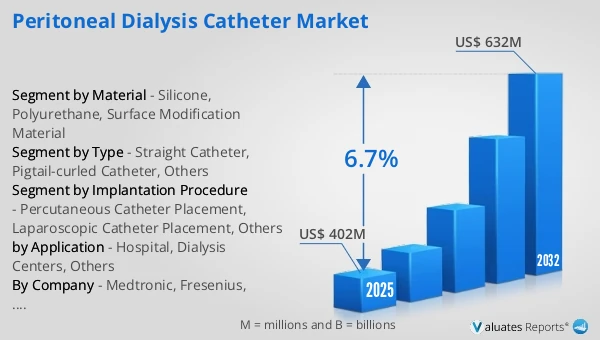
The global Peritoneal Dialysis Catheter market was valued at US$ 402 million in 2025 and is anticipated to reach US$ 632 million by 2032, at a CAGR of 6.7% from 2026 to 2032.
Peritoneal Dialysis Catheter Market
The 2025 U.S. tariff policies introduce profound uncertainty into the global economic landscape. This report critically examines the implications of recent tariff adjustments and international strategic countermeasures on Peritoneal Dialysis Catheter competitive dynamics, regional economic interdependencies, and supply chain reconfigurations.
A peritoneal dialysis catheter is a long-term implantable medical device placed into the peritoneal cavity to establish access for peritoneal dialysis, enabling repeated infusion and drainage of dialysate so that metabolic waste and excess fluid can be removed through the peritoneal membrane as a natural semipermeable barrier. The primary clinical problem it addresses is how to maintain a stable, patent, and low-infection-risk access route over extended periods of repeated use, while supporting the safety, comfort, and practicality required for home-based therapy. The evolution of peritoneal dialysis catheters closely follows the development of home dialysis and chronic kidney disease management: early designs were relatively basic and associated with higher rates of leakage, migration, and peritonitis, whereas the introduction and refinement of Tenckhoff-type catheters—with dual Dacron cuffs, varied tip configurations (straight or coiled), improved flexibility, and optimized fixation—significantly enhanced long-term stability and infection control. Upstream materials and components typically include medical-grade silicone elastomers or polyurethane for the catheter shaft, polyester or Dacron cuff materials to promote tissue ingrowth and anchoring, radiopaque additives or markers for imaging visibility, precision-molded connectors and transfer sets, caps and clamping elements, as well as sterile barrier packaging and sterilization-related materials. These inputs are supplied by a network of medical polymer producers, fiber-material manufacturers, precision molding specialists, and sterile packaging and sterilization service providers, forming the foundational supply chain for finished peritoneal dialysis catheters.In 2025, the global production capacity of peritoneal dialysis catheters reached 7.0 million units, with sales volume totaling 5.194 million units. The average selling price was approximately USD 77.3 per unit, and manufacturers' gross margins were generally in the range of 20% to 30%.
The peritoneal dialysis catheter market is increasingly shaped by steady demand release, more standardized clinical pathways, and a shift toward integrated product-and-service offerings. As healthcare systems seek to manage the long-term burden of kidney failure, many are encouraging home-based dialysis and outpatient chronic-care models, making PD-related access consumables comparatively resilient. Hospital decision-making has moved beyond the catheter itself to the full quality of the access pathway—operator training and technique, infection-prevention protocols, compatibility with associated disposables (transfer sets, caps, care accessories), and supply reliability. Competition typically favors established players with long-standing clinical evidence, broad regulatory coverage, and robust training infrastructures, while regional manufacturers gain share through local registration speed, delivery, and pricing. Despite the seemingly standardized form factor, barriers remain meaningful: biocompatible material consistency, tight sterile barrier and sterilization control, and strong clinician familiarity create high perceived switching costs.
Going forward, innovation will concentrate on reducing infections and complications while improving the practical fit for home therapy, closely aligned with chronic-care digital follow-up and quality management. On the product side, manufacturers will further integrate infection-mitigation and patency strategies through optimized cuff designs and surface characteristics, structures that reduce leakage and migration, and more user-friendly connection/transfer components that simplify care routines. Patient-specific selection will become clearer, with more explicit guidance that accounts for body habitus, abdominal wall conditions, and preferred insertion approaches, alongside standardized model offerings. On the ecosystem side, companies will compete on combined capabilities—catheter plus insertion support plus home-care infrastructure—covering clinician training, patient education, standardized accessory packs, traceability, and integration with hospital follow-up or inventory systems, shifting the basis of competition from single-product features to pathway- and outcome-oriented value.
Key drivers include payer and resource-allocation incentives: increasing the share of home dialysis can relieve pressure on in-center hemodialysis capacity, reduce transportation and caregiver burdens, and improve patient quality of life. As clinical practice continues to mature—through more consistent insertion techniques, infection-prevention management, and standardized care protocols—real-world complication risks can decline, supporting broader physician and patient acceptance. The main constraints cluster around infection and adherence challenges, variability in specialized team capabilities, and stringent quality/compliance requirements across the supply chain. Peritonitis remains a critical determinant of long-term outcomes and patient confidence, and real-world performance depends heavily on home-use discipline, training coverage, and sustained follow-up. In some regions, limited availability of skilled inserters and PD nursing programs slows adoption. Additionally, high expectations for material consistency, sterilization controls, and packaging validation mean that changes can trigger revalidation and regulatory management burdens; combined with tender-driven cost pressure, this can create a structural tension where policy aims to expand PD, but implementation progresses more slowly.
This report delivers a comprehensive overview of the global Peritoneal Dialysis Catheter market, with both quantitative and qualitative analyses, to help readers develop growth strategies, assess the competitive landscape, evaluate their position in the current market, and make informed business decisions regarding Peritoneal Dialysis Catheter. The Peritoneal Dialysis Catheter market size, estimates, and forecasts are provided in terms of sales volume (K Units) and revenue (US$ millions), with 2025 as the base year and historical and forecast data for 2021–2032.
The report segments the global Peritoneal Dialysis Catheter market comprehensively. Regional market sizes by Type, by Application, by Material, and by company are also provided. For deeper insight, the report profiles the competitive landscape, key competitors, and their respective market rankings, and discusses technological trends and new product developments.
This report will assist Peritoneal Dialysis Catheter manufacturers, new entrants, and companies across the industry value chain with information on revenues, sales volume, and average prices for the overall market and its sub-segments, by company, by Type, by Application, and by region.
Market Segmentation
Scope of Peritoneal Dialysis Catheter Market Report
| Report Metric |
Details |
| Report Name |
Peritoneal Dialysis Catheter Market |
| Accounted market size in 2025 |
US$ 402 million |
| Forecasted market size in 2032 |
US$ 632 million |
| CAGR |
6.7% |
| Base Year |
2025 |
| Forecasted years |
2026 - 2032 |
| Segment by Type |
- Straight Catheter
- Pigtail-curled Catheter
- Others
|
| Segment by Material |
- Silicone
- Polyurethane
- Surface Modification Material
|
| Segment by Implantation Procedure |
- Percutaneous Catheter Placement
- Laparoscopic Catheter Placement
- Others
|
| by Application |
- Hospital
- Dialysis Centers
- Others
|
| Consumption by Region |
- North America (United States, Canada)
- Europe (Germany, France, UK, Italy, Russia)
- Asia-Pacific (China, Japan, South Korea, Taiwan)
- Southeast Asia (India)
- Latin America (Mexico, Brazil)
|
| By Company |
Medtronic, Fresenius, Baxter, US rental care, B.Braun, Diaverum, Nipro Corporation, Asahi Kasei, Nikkiso, Toray, WEGO group, Merit Medical, PFM Medical, AMECATH, AdvinHealthcare |
| Forecast units |
USD million in value |
| Report coverage |
Revenue and volume forecast, company share, competitive landscape, growth factors and trends |
Chapter Outline
- Chapter 1: Defines the scope of the report and presents an executive summary of market segments (by Type, by Application, by Material, etc.), including the size of each segment and its future growth potential. It offers a high-level view of the current market and its likely evolution in the short, medium, and long term.
- Chapter 2: Provides a detailed analysis of the competitive landscape for Peritoneal Dialysis Catheter manufacturers, covering pricing, sales and revenue shares, latest development plans, and mergers and acquisitions.
- Chapter 3: Examines Peritoneal Dialysis Catheter sales and revenue at the regional and country levels. It quantifies market size and growth potential for each region and its key countries, and outlines market development, outlook, addressable space, and national market size.
- Chapter 4: Analyzes segments by Type, detailing the size and growth potential of each segment to help readers identify “blue ocean” opportunities.
- Chapter 5: Analyzes market segments by Application, covering the size and growth potential of each segment to help readers identify “blue ocean” opportunities in downstream markets.
- Chapter 6: Profiles key players, presenting core information on leading companies, including product sales, revenue, pricing, gross margin, product portfolio/introductions, and recent developments.
- Chapter 7: Reviews the industry value chain, including upstream and downstream segments.
- Chapter 8: Discusses market dynamics and recent developments, including drivers, restraints, challenges and risks for manufacturers, U.S. Tariffs and relevant policy analysis.
- Chapter 9: Summarizes the key findings and conclusions of the report.
Ans: The Peritoneal Dialysis Catheter Market witnessing a CAGR of 6.7% during the forecast period 2026-2032.
Ans: The Peritoneal Dialysis Catheter Market size in 2032 will be US$ 632 million.
Ans: The main players in the Peritoneal Dialysis Catheter Market are Medtronic, Fresenius, Baxter, US rental care, B.Braun, Diaverum, Nipro Corporation, Asahi Kasei, Nikkiso, Toray, WEGO group, Merit Medical, PFM Medical, AMECATH, AdvinHealthcare
Ans: The Applications covered in the Peritoneal Dialysis Catheter Market report are Hospital, Dialysis Centers, Others
Ans: The Types covered in the Peritoneal Dialysis Catheter Market report are Straight Catheter, Pigtail-curled Catheter, Others